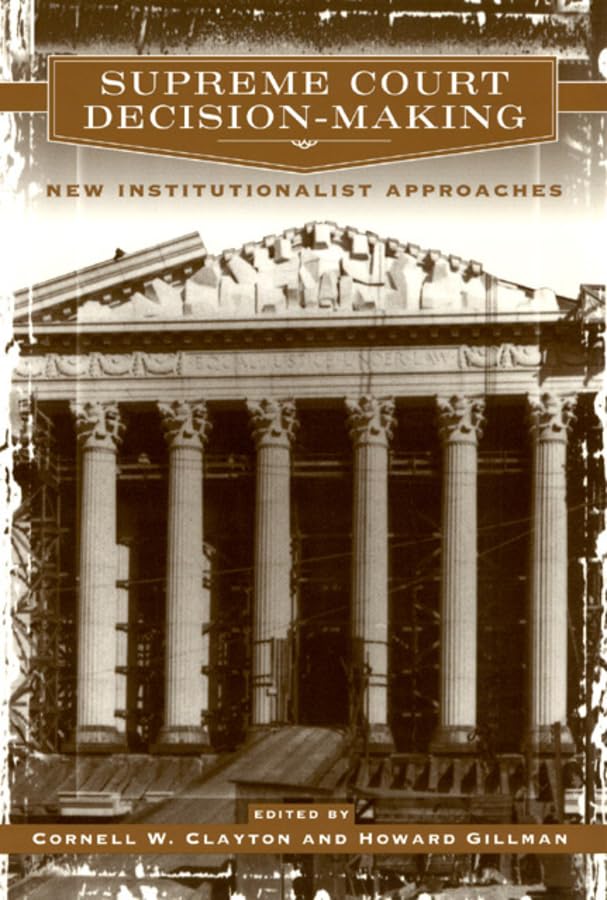

Supreme Court decision-making new institutionalist approaches edited by Cornell W. Clayton and Howard Gillman.
Detalles de publicación: Chicago University Of Chicago Press 1999.Descripción: xiv , 344p. ill. 24 cmISBN:- 0226109542(cloth : alk. paper)
- 0226109550(pbk. : alk. paper}
- KF 8748 .S878 1999
| Imagen de cubierta | Tipo de ítem | Biblioteca actual | Biblioteca de origen | Colección | Ubicación en estantería | Signatura topográfica | Materiales especificados | Info Vol | URL | Copia número | Estado | Notas | Fecha de vencimiento | Código de barras | Reserva de ítems | Prioridad de la cola de reserva de ejemplar | Reservas para cursos | |
|---|---|---|---|---|---|---|---|---|---|---|---|---|---|---|---|---|---|---|
| Libro | Biblioteca de Derecho Mons. Fremiot Torres Oliver Colección General biblioteca derecho | KF8784 .S878 1999 (Navegar estantería(Abre debajo)) | Disponible | 70000000641873 |
Descripciones mejoradas de Syndetics:
What influences decisions of the U.S. Supreme Court? For decades social scientists focused on the ideology of individual justices. Supreme Court Decision Making moves beyond this focus by exploring how justices are influenced by the distinctive features of courts as institutions and their place in the political system.
Drawing on interpretive-historical institutionalism as well as rational choice theory, a group of leading scholars consider such factors as the influence of jurisprudence, the unique characteristics of supreme courts, the dynamics of coalition building, and the effects of social movements. The volume's distinguished contributors and broad range make it essential reading for those interested either in the Supreme Court or the nature of institutional politics.
Original essays contributed by Lawrence Baum, Paul Brace, Elizabeth Bussiere, Cornell Clayton, Sue Davis, Charles Epp, Lee Epstein, Howard Gillman, Melinda Gann Hall, Ronald Kahn, Jack Knight, Forrest Maltzman, David O'Brien, Jeffrey Segal, Charles Sheldon, James Spriggs II, and Paul Wahlbeck.
Includes bibliographical references (p. 301 - 328) and index.
Beyond judicial attitudes : institutional approaches to Supreme Court decision - making / Howard Gillman and Cornell W. Clayton - - The Suprreme Court and political jurisprudence : new and old institutionalisms / Cornel W. Clayton - - Straregy and judicial choice : new institutionalist approaches to Supreme Court decision - making / Forrest Maltzman , James F. Spriggs II , and Paul J. Wahlbeck - -The Court as an idea , not a building (or a game) : interpretive institutional norms and Supreme Court opinions : on reconsidering the rise of individual opinions / David M. O'Brien - -The incidence and structure of dissensus on a State Supreme Court / Charles H. Sheldon - - The Chief Justice and judicial decision - making : the institutional basis for laedership on the Supreme Court / Sue Davis - - The Supreme Court and the development of the welfare state ; judicial liberalism and the problem of welfare rights / Elizabeth Bussiere - - Institutional norms and Supreme Court decision - making : the Rehnquist Court on privacy and religion / Ronald Kahn - - Recruitment and the motivation of Supreme Court justice/ Lawrence Baum - - Mapping out the strategic terrain : the informational role of Amici curiae / Lee Epstein andJack Knight - -Supreme Court deference to Congress : an examination of the marksist model / Jeffrey A. Segal - - External pressure and the Supreme Court's agenda / Charles R. Epp - -State Supreme Courts and their environments : avenues to general theories of judicial choice / Melinda Gann Hall and Paul Brace . x x x
Tabla de contenidos provista por Syndetics
- List of Figures and Tables
- Acknowledgments
- Introduction: Beyond Judicial Attitudes: Institutional Approaches to Supreme Court Decision-Making
- Part 1 Conceptualizing the Supreme Court as an Institution
- 1 The Supreme Court and Political Jurisprudence: New and Old Institutionalisms
- 2 Strategy and Judicial Choice: New Institutionalist Approaches to Supreme Court Decision-Making
- 3 The Court as an Idea, Not a Building (or a Game): Interpretive Institutionalism and the Analysis of Supreme Court Decision-Making
- Part 2 Legal Norms and the Internal Structure of Supreme Court Decision-Making
- 4 Institutional Norms and Supreme Court Opinions: On Reconsidering the Rise of Individual Opinions
- 5 The Incidence and Structure of Dissensus on a State Supreme Court
- 6 The Chief Justice and Judicial Decision-Making: The Institutional Basis for Leadership on the Supreme Court
- 7 The Supreme Court and the Development of the Welfare State: Judicial Liberalism and the Problem of Welfare Rights
- 8 Institutional Norms and Supreme Court Decision-Making: The Rehnquist Court on Privacy and Religion
- Part 3 Extra-Judicial Influences on Supreme Court Decision-Making
- 9 Recruitment and the Motivations of Supreme Court Justices
- 10 Mapping Out the Strategic Terrain: The Informational Role of Amici Curiae
- 11 Supreme Court Deference to Congress: An Examination of the Marksist Model
- 12 External Pressure and the Supreme Court's Agenda
- 13 State Supreme Courts and Their Environments: Avenues to General Theories of Judicial Choice
- References
- Cases Cited
- Contributors
- Index
Reseñas proporcionadas por Syndetics
CHOICE Review
Clayton and Gillman (political scientists at Washington State and the University of Southern California) have compiled a baker's dozen of essays, many by prominent scholars, on the new institutionalist approaches to judicial decision making. Distinguished both from earlier legalistic analyses and modern behaviorism, new institutionalism encompasses diverse approaches. Generally, its proponents advocate understanding the individual behavior of judges and justices in the context of institutions and norms, and favor taking seriously the reasons judges offer for their decisions. The book has three parts. The first, largely methodological part, conceptualizes the Supreme Court as an institution. The second part examines legal norms and the internal structure of Supreme Court decision making. One essay examines state supreme courts; others probe the rise of concurring and dissenting opinions on the US Supreme Court, the role of the Chief Justice, and court decisions on welfare, privacy, and religion. The third section looks at such extrajudicial influences on Supreme Court decision making as the recruitment of justices, the role of amici curiae briefs, and congressional pressures. This volume illustrates both the diversity and vitality of current approaches to judicial studies. Recommended for graduate students and above. J. R. Vile Middle Tennessee State UniversityNotas de autor provistas por Syndetics
Cornell W. Clayton is associate professor of political science at Washington State UniversityHoward Gillman is associate professor of political science at the University of Southern California