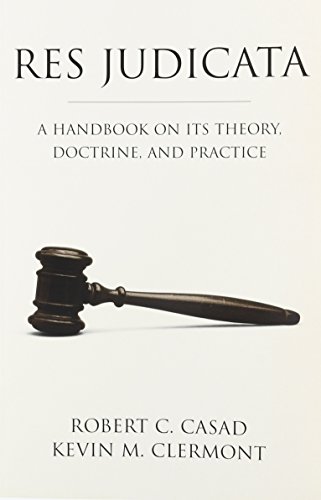

Res judicata a handbook on its theory, doctrine, and practice Robert C. Casad, Kevin M. Clermont.
Detalles de publicación: Durham, N. C. Carolina Academic Press 2001.Descripción: xiv, 280 p. 23 cmISBN:- 0890897050
- KF 8992 .C28 2001
| Imagen de cubierta | Tipo de ítem | Biblioteca actual | Biblioteca de origen | Colección | Ubicación en estantería | Signatura topográfica | Materiales especificados | Info Vol | URL | Copia número | Estado | Notas | Fecha de vencimiento | Código de barras | Reserva de ítems | Prioridad de la cola de reserva de ejemplar | Reservas para cursos | |
|---|---|---|---|---|---|---|---|---|---|---|---|---|---|---|---|---|---|---|
| Libro | Biblioteca de Derecho Mons. Fremiot Torres Oliver Colección General biblioteca derecho | KF8992 .C28 2001 (Navegar estantería(Abre debajo)) | Disponible | 70000000653480 |
Descripciones mejoradas de Syndetics:
Res judicata is a major and critical topic in civil procedure. At a mundane level, the term specifies the effect that an adjudication has on subsequent litigation. At a more profound level, it is the law that sets the boundaries on the output of the judicial branch of government. In other words, it specifies what a judgment decides and does not decide and how a judgment differs from legislation and administration. It is a policy-driven and judge-made body of law, generated independently by each of the states, by the federal system, and by each country.
The book is written at a middle level of depth, between a simplistic summary of the doctrine and a personalized reformulation of the subject. The latter is the domain of difficult and theoretical law review articles, and the former is served by outlines and nutshells.
The three major parts of the book cover theory, doctrine, and practice. Authors Casad and Clermont believe that attention to the basic concepts and policies underlying res judicata helps the reader understand this concept.
This book remains the only accessible, one-volume treatment of this important procedural topic. It will be useful for readers with some familiarity with the doctrine, for students reviewing the subject, or as a basic reference work.
Includes bibliographical references and index.
Tabla de contenidos provista por Syndetics
- Summary of Contents(p. v)
- Part I Theory
- Chapter 1 Introduction to Res Judicata(p. 3)
- A. Significance(p. 3)
- B. Sources(p. 5)
- C. Contexts(p. 7)
- D. Basics(p. 8)
- E. Terminology(p. 9)
- 1. Claim Preclusion(p. 11)
- 2. Issue Preclusion(p. 11)
- Chapter 2 Related Doctrines(p. 13)
- A. Stare Decisis(p. 13)
- B. Law of the Case(p. 16)
- C. Former Adjudication as Evidence(p. 17)
- D. Former Recovery(p. 18)
- E. Equitable Estoppel(p. 18)
- F. Judicial Estoppel(p. 18)
- G. Election of Remedies(p. 19)
- H. Other Action Pending(p. 21)
- I. Double Jeopardy(p. 22)
- 1. Collateral Estoppel from Criminal Judgment to Subsequent Criminal Prosecution of Same Defendant(p. 24)
- a. Collateral Estoppel Asserted by Acquitted Defendant(p. 24)
- b. Collateral Estoppel Asserted Against Convicted Defendant(p. 25)
- 2. Collateral Estoppel from Criminal Judgment to Subsequent Criminal Prosecution of Different Defendant(p. 26)
- 3. Collateral Estoppel from Civil Judgment to Subsequent Criminal Prosecution(p. 27)
- Chapter 3 Policies Underlying Rules and Exceptions(p. 29)
- A. Res Judicata Rules(p. 31)
- 1. Procedural Factors Favoring Preclusion(p. 31)
- 2. Procedural Factors Favoring Nonpreclusion(p. 33)
- 3. Combining All Factors(p. 35)
- B. Res Judicata Exceptions(p. 36)
- C. Summary(p. 36)
- Chapter 4 Jurisprudence of Rules and Exceptions(p. 39)
- A. Res Judicata Rules and Exceptions(p. 40)
- B. Claim and Issue Preclusion Doctrine(p. 43)
- Part II Doctrine
- Chapter 5 Prerequisites for Res Judicata(p. 49)
- A. Validity(p. 49)
- B. Finality(p. 50)
- 1. Meanings of Finality(p. 51)
- a. Claim Preclusion(p. 51)
- b. Issue Preclusion(p. 52)
- 2. Complications of Finality(p. 55)
- a. Effects of Reversal(p. 55)
- b. Inconsistent Judgments(p. 55)
- Chapter 6 Claim Preclusion(p. 61)
- A. Requirements of Rule(p. 61)
- 1. Dimensions of Claim(p. 62)
- a. Evolution of Transactional View(p. 62)
- b. Application of Transactional View(p. 69)
- 2. Extinguishing Claim by Judgment(p. 82)
- a. Merger(p. 83)
- b. Bar(p. 85)
- B. Exceptions to Rule(p. 85)
- 1. Adjudication Not on the Merits(p. 85)
- a. Dismissal for Lack of Jurisdiction(p. 87)
- b. Dismissal for Insufficiency of Complaint(p. 87)
- c. Dismissal for Prematurity in Bringing Action(p. 91)
- d. Dismissal for Statute of Frauds(p. 92)
- e. Dismissal for Statute of Limitations(p. 93)
- f. Summary Judgment(p. 96)
- g. Voluntary Dismissal(p. 96)
- h. Involuntary Dismissal(p. 97)
- i. Dismissal for Insufficiency of Evidence(p. 98)
- j. Summary(p. 98)
- 2. Jurisdictional or Procedural Limitation(p. 99)
- 3. Judicial Permission(p. 100)
- 4. Party Agreement(p. 102)
- 5. Generalized Exception(p. 103)
- a. Conflict with Substantive Policy(p. 103)
- b. Misrepresentation by Defendant(p. 104)
- c. Other Extraordinary Situations(p. 105)
- C. Special Applications: Counterclaims(p. 106)
- 1. Interposition of Counterclaim(p. 106)
- 2. Failure to Interpose Counterclaim(p. 108)
- a. Compulsory Counterclaim Statute or Rule(p. 109)
- b. Common-Law Compulsory Counterclaim(p. 111)
- Chapter 7 Issue Preclusion(p. 113)
- A. Requirements of Rule(p. 113)
- 1. Same Issue(p. 114)
- a. Dimensions of Issue(p. 114)
- b. Applications(p. 121)
- 2. Actually Litigated and Determined(p. 123)
- a. Applications(p. 125)
- b. A Contrary View(p. 126)
- 3. Essential to the Judgment(p. 127)
- B. Exceptions to Rule(p. 129)
- 1. Certain Issues of Law(p. 130)
- a. Pure Questions of Law(p. 130)
- b. Inequitable Administration of Law(p. 132)
- 2. Inferior Rendering Court(p. 134)
- a. Procedural Informality(p. 134)
- b. Jurisdictional Specialization(p. 135)
- 3. Different Burden of Persuasion(p. 138)
- 4. Inability to Appeal(p. 138)
- 5. Unforeseeability(p. 139)
- 6. Generalized Exception(p. 141)
- a. Lack of Full and Fair Opportunity(p. 141)
- b. Conflicting Substantive Policy(p. 142)
- C. Special Applications: Multiple Determinations(p. 143)
- 1. Cumulative Determinations(p. 143)
- 2. Ambiguous Determinations(p. 143)
- 3. Alternative Determinations(p. 145)
- Chapter 8 Effects on Nonparties(p. 149)
- A. Privies(p. 149)
- 1. Substantive Privity(p. 153)
- a. Successive Interests(p. 153)
- b. Other Substantive Relationships of Decreasing Closeness(p. 155)
- 2. Procedural Privity(p. 159)
- a. Actual Representation(p. 159)
- b. Other Procedural Relationships Based on Nonparty's Conduct(p. 163)
- B. Strangers(p. 165)
- 1. Parties Treated as Strangers: No Binding Effect(p. 165)
- a. Nominal Parties(p. 165)
- b. Parties Under Incapacity(p. 166)
- c. Parties Litigating in Different Capacities(p. 167)
- d. Nonadverse Parties(p. 167)
- 2. Strangers Treated as Parties: A Benefiting Effect(p. 169)
- a. Mutuality of Estoppel(p. 169)
- b. Nonmutual Estoppel(p. 174)
- c. Nonmutual Claim Preclusion(p. 184)
- d. Criticism of Modern Approach(p. 184)
- Chapter 9 Nonordinary Judgments(p. 189)
- A. Noncoercive Judgments(p. 189)
- B. Nonpersonal Judgments(p. 192)
- 1. In Rem(p. 193)
- a. Pure In Rem(p. 193)
- b. Jurisdiction over Status(p. 194)
- 2. Quasi In Rem(p. 196)
- a. Subtype One(p. 196)
- b. Subtype Two(p. 198)
- C. Noncivil Judgments(p. 204)
- 1. Plea of Guilty(p. 207)
- 2. Conviction as Evidence(p. 207)
- 3. Plea of Nolo Contendere(p. 208)
- D. Nonjudicial Proceedings(p. 208)
- 1. Administrative Adjudications(p. 208)
- 2. Arbitration Awards(p. 210)
- Chapter 10 Nondomestic Judgments(p. 211)
- A. General Considerations(p. 211)
- 1. Recognition(p. 212)
- 2. Enforcement(p. 212)
- B. Judgments of American Courts(p. 213)
- 1. State Judgments(p. 213)
- a. State--State(p. 213)
- b. State--Federal(p. 221)
- 2. Federal Judgments(p. 223)
- a. Federal--State(p. 223)
- b. Federal--Federal(p. 226)
- C. Judgments of Foreign Nations(p. 226)
- 1. Rules for Recognition and Enforcement(p. 226)
- a. General Practices(p. 226)
- b. Preclusion Specifics(p. 228)
- c. Governing Law(p. 229)
- 2. Special Exceptions to Recognition and Enforcement(p. 230)
- a. Reciprocity(p. 230)
- b. Public Policy(p. 231)
- 3. Hague Treaty(p. 232)
- Part III Practice
- Chapter 11 Invoking Res Judicata(p. 237)
- A. Raising(p. 237)
- 1. Timing(p. 238)
- 2. Method(p. 238)
- a. Claim Preclusion(p. 238)
- b. Issue Preclusion(p. 240)
- B. Proving(p. 242)
- 1. Burden(p. 242)
- 2. Evidence(p. 243)
- 3. Decision(p. 244)
- 4. Review(p. 245)
- Chapter 12 Defeating Res Judicata(p. 247)
- A. Methods of Attack(p. 248)
- 1. Motion for Relief(p. 248)
- 2. Independent Suit(p. 248)
- 3. Defensive Attack(p. 249)
- B. Grounds for Attack(p. 249)
- 1. Jurisdiction and Notice(p. 250)
- a. Jurisdiction(p. 250)
- b. Notice(p. 251)
- c. Summary(p. 252)
- 2. Equitable Grounds(p. 253)
- a. General(p. 253)
- b. Fraud(p. 254)
- C. Approaches to Attack's Methods and Grounds(p. 256)
- 1. Traditional, Rigid Approach(p. 257)
- 2. Ultramodern, Fluid Approach(p. 258)
- 3. Resolution(p. 259)
- Chapter 13 Jurisdiction to Determine Jurisdiction(p. 263)
- A. Status of This Subdoctrine(p. 265)
- B. Content of This Subdoctrine(p. 266)
- 1. Territorial Jurisdiction and Adequate Notice(p. 266)
- 2. Subject-Matter Jurisdiction(p. 268)
- C. Jurisdiction to Determine No Jurisdiction(p. 271)
- D. A Final View of Validity and Finality(p. 271)
- Table of Cases(p. 273)
- Index(p. 277)