Imagen de Amazon.com

Portada de Syndetics
Imagen de OpenLibrary
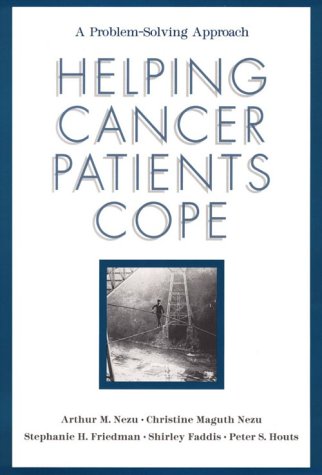
Helping cancer patients cope a problem-solving approach Arthur M. Nezu ... [et al.].
Detalles de publicación: Washington, DC American Psychological Association c1998.Descripción: xiii, 314 p. ill. 26 cmISBN:- 1557985332 (casebound : alk. paper)
- 616.9940019 H483 21
- RC262 .H44 1998
- 1999 F-302
- QZ 200
| Imagen de cubierta | Tipo de ítem | Biblioteca actual | Biblioteca de origen | Colección | Ubicación en estantería | Signatura topográfica | Materiales especificados | Info Vol | URL | Copia número | Estado | Notas | Fecha de vencimiento | Código de barras | Reserva de ítems | Prioridad de la cola de reserva de ejemplar | Reservas para cursos | |
|---|---|---|---|---|---|---|---|---|---|---|---|---|---|---|---|---|---|---|
| Libro | Biblioteca Encarnación Valdés Colección General bev | 616.9940019 H483 (Navegar estantería(Abre debajo)) | Disponible | 80000002135070 |
Total de reservas: 0
Descripciones mejoradas de Syndetics:
Good problem-solving skills are what make people flourish and succeed in coping with major life events such as cancer. These skills are also the hallmarks of optimism, courage and self-confidence. Working with cancer patients for over 20 years, Nezu and his co-authors have crafted a time-limited programme to teach patients these problem-solving skills. This model has been empirically shown to relieve suffering and aid cancer patients in constructing effective plans for dealing with the physical, financial, social and spiritual challenges of cancer.
Includes bibliographical references (p. 289-300) and index.
Tabla de contenidos provista por Syndetics
- Acknowledgments
- Table of Contents
- List of Tables
- List of Figures
- I. The Nature of Cancer and Coping
- Chapter 1. Cancer and Its Consequences
- Chapter 2. A Problem-Solving Conceptualization of Coping: Theory, Research, and Relevance to Cancer
- II. An Overview of Training
- Chapter 3. Problem-Solving Therapy for Cancer Patients: Overview, Process, and Related Clinical Issues
- Chapter 4. Critical Elements of Training
- III. Problem-Solving Coping Skills Training
- Chapter 5. Problem Orientation
- Chapter 6. Problem Definition and Formulation
- Chapter 7. Generation of Alternatives
- Chapter 8. Decision Making
- Chapter 9. Solution Implementation and Verification
- Chapter 10. Practice, Practice, Practice
- IV. Adaption of Problem-Solving Therapy for Caregiver Training
- Chapter 11. Problem-Solving Education for Family Caregivers of Cancer Patients
- References
- Index
- About the Authors