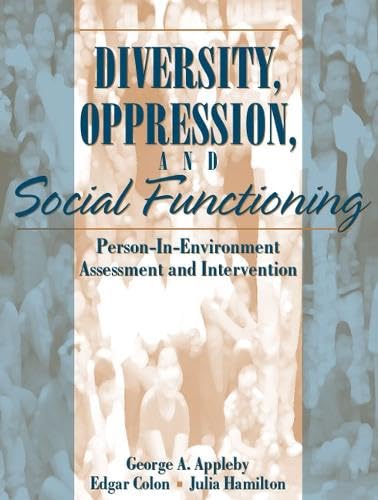

Diversity, oppression, and social functioning person-in-environment assessment and intervention George A. Appleby, Edgar Colon, Julia Hamilton, co-editors.
Detalles de publicación: Boston Allyn and Bacon 2001.Descripción: xvi, 272 p. ill. 24 cmISBN:- 0205298893
- 361.84 D6183 21
- HV3176 .D59 2001
| Imagen de cubierta | Tipo de ítem | Biblioteca actual | Biblioteca de origen | Colección | Ubicación en estantería | Signatura topográfica | Materiales especificados | Info Vol | URL | Copia número | Estado | Notas | Fecha de vencimiento | Código de barras | Reserva de ítems | Prioridad de la cola de reserva de ejemplar | Reservas para cursos | |
|---|---|---|---|---|---|---|---|---|---|---|---|---|---|---|---|---|---|---|
| Libro | Biblioteca Encarnación Valdés Colección General bev | 361.84 D6183 (Navegar estantería(Abre debajo)) | Disponible | 80000002134420 |
Descripciones mejoradas de Syndetics:
This book examines issues of oppression in the context of social work. It discusses the various forms of oppression, including racism, sexism, ethnocentricism, heterocentrism, heterosexism, homophobia, ableism, and religious bigotry. It describes the way these function socially, the dynamics they pr
Includes bibliographical references and index.
Framework for practice with diverse and oppressed clients / George A. Appleby -- Culture, social class, and social identity development / George A. Appleby -- Dynamics of oppression and discrimination / George A. Appleby -- Racism : people of color / Julia Hamilton -- Women and sexist oppression / Barbara Worden -- A multidiversity perspective on Latinos : issues of oppression and social functioning / Edgar Colon -- Native Americans : oppression and social work practice / Jack Paul Gesino -- Asian Americans : ethnocentrism and discrimination / Michie N. Hesselbrock and Cheryl Parks -- Lesbian, gay, bisexual, and transgender people confront heterocentrism, heterosexism, and homophobia / George A. Appleby -- Ableism : social work practice with individuals with physical disabilities / P. Minou Michilin and Silvia Juarez-Marazzo -- Religious bigotry and religious minorities / Constance L. Mindell -- Ableism : mentally and emotionally challenged people / Jaak Rakfeldt -- Affirmative practice with people who are culturally diverse and oppressed / Edgar Colon, George A. Appleby, and Julia Hamilton.
Tabla de contenidos provista por Syndetics
- Foreword(p. xi)
- Preface(p. xiii)
- 1 Framework for Practice with Diverse and Oppressed Clients(p. 1)
- Theory for Practice(p. 6)
- Ecological Framework for Practice(p. 7)
- Diversity and Strengths Perspective(p. 9)
- Value Base for Practice(p. 10)
- Assessment and Intervention Framework(p. 11)
- Conclusion(p. 14)
- References(p. 14)
- 2 Culture, Social Class, and Social Identity Development(p. 16)
- Culture(p. 18)
- Norms(p. 19)
- Values(p. 20)
- Language and Culture(p. 22)
- Cultural Change(p. 23)
- Subcultures(p. 26)
- Social Class(p. 26)
- Education and Social Class(p. 29)
- Social Identity Development(p. 30)
- Social Categorization(p. 30)
- Social Comparison(p. 31)
- Person-in-Environment Classification System(p. 32)
- Conclusion(p. 34)
- References(p. 34)
- 3 Dynamics of Oppression and Discrimination(p. 36)
- Oppression and Power(p. 37)
- Sexual Oppression(p. 39)
- Racial Oppression(p. 41)
- Discrimination(p. 42)
- Diversity(p. 42)
- Identity(p. 44)
- Stigma and Stigma Management(p. 45)
- Effects of Stigmatization(p. 47)
- Conclusion(p. 50)
- References(p. 51)
- 4 Racism: People of Color(p. 53)
- Defining Racism and Race(p. 54)
- Race and Developmental Process(p. 55)
- Who Are People of Color?(p. 57)
- Theories of Racism(p. 57)
- Micro Level Theories of Racism(p. 57)
- Macro Level Theory of Racism(p. 58)
- Perceptions of Whites(p. 61)
- The Changing Meaning of Race(p. 62)
- The Hidden Injuries of Race(p. 62)
- Assessment(p. 63)
- Assessment Process for the Social Worker(p. 65)
- Case Study(p. 65)
- Referral Issues(p. 66)
- Assessment Issues(p. 67)
- PIE Assessment of David(p. 68)
- Conclusion(p. 68)
- References(p. 69)
- 5 Women and Sexist Oppression(p. 70)
- Case Study(p. 72)
- The PIE Classification System for Problems in Social Functioning(p. 73)
- PIE Assessment of Jean(p. 74)
- The Empowerment Framework(p. 75)
- Male Models of Structured Reality(p. 76)
- Madness as a Feminist Construct(p. 78)
- Macro-Analysis: Feminist Epistemologies and the Nature of Knowledge Making(p. 80)
- What Do We Mean By the Oppression of Women?(p. 83)
- Women and Work(p. 84)
- Family Policy, Welfare, and Gender Roles(p. 84)
- Feminization of Poverty(p. 86)
- Conclusion(p. 88)
- Helpful Web Sites(p. 88)
- References(p. 89)
- 6 A Multidiversity Perspective on Latinos: Issues of Oppression and Social Functioning(p. 92)
- Hispanic versus Latino Terms(p. 93)
- Sociodemographic Profile(p. 94)
- Racial and Ethnic Identity(p. 94)
- Poverty and Social Status(p. 95)
- Labor Force Participation(p. 95)
- Latino Immigration(p. 95)
- Latino Normative and Cultural Values(p. 97)
- Latino Racial and Class Identity(p. 97)
- Respect, Dignity, and Personalism(p. 98)
- Help Seeking Behaviors(p. 98)
- Latino Family(p. 99)
- Gender Roles(p. 99)
- Family Support System(p. 100)
- A PIE Perspective of Working with Issues of Oppression and Social Functioning(p. 100)
- Assessing for Social Functioning Problems(p. 101)
- Assessing for Mental Health Problems(p. 102)
- Assessing for Health Problems(p. 102)
- Case Study(p. 105)
- Factor I Problems in Social Functioning(p. 105)
- Factor II Problems in the Environment(p. 105)
- Conclusion(p. 106)
- References(p. 107)
- 7 Native Americans: Oppression and Social Work Practice(p. 109)
- History of Racism(p. 110)
- Present Day: Social and Health Problems(p. 112)
- Mental Health(p. 114)
- Family, Beliefs, and Rituals(p. 115)
- Values and Traditions(p. 116)
- Spiritual Traditions of Native Americans(p. 116)
- Practice Implications(p. 117)
- Intervention(p. 121)
- The PIE System and Native Americans(p. 123)
- Case Study(p. 124)
- PIE Assessment of Mary(p. 124)
- Conclusion(p. 128)
- References(p. 128)
- 8 Asian Americans: Ethnocentrism and Discrimination(p. 131)
- Immigration and Resettlement Patterns and Consequences(p. 133)
- Chinese(p. 133)
- Japanese(p. 134)
- Filipinos(p. 135)
- Koreans and Asian Indians(p. 136)
- Southeast Asians(p. 136)
- Norms, Beliefs, and Cultural Stereotypes(p. 137)
- Common Beliefs(p. 138)
- Implications for Social Work Practice(p. 140)
- Case Study(p. 142)
- PIE Assessment of Mr. Yee(p. 142)
- Conclusion(p. 143)
- References(p. 143)
- 9 Lesbian, Gay, Bisexual, and Transgender People Confront Heterocentrism, Heterosexism, and Homophobia(p. 145)
- History(p. 150)
- Historical Oppression in Context(p. 153)
- Definitions(p. 154)
- The Roots of Oppression(p. 156)
- Gender Ideology(p. 157)
- Heterosexual Privilege(p. 158)
- Religion(p. 158)
- Psychiatry/Psychology(p. 160)
- Law and Policy(p. 160)
- AIDS and HIV Disease(p. 161)
- Popular Culture and Attitudes(p. 163)
- Violence and Gay Bashing(p. 166)
- Internalized Homophobia(p. 168)
- Case Study(p. 169)
- PIE Assessment of Jack(p. 172)
- Conclusion(p. 173)
- References(p. 173)
- 10 Ableism: Social Work Practice with Individuals with Physical Disabilities(p. 179)
- Historical Overview(p. 182)
- The Nature of Disability(p. 183)
- Functional Disability versus Socially Imposed Disability(p. 184)
- Early Age of Onset(p. 185)
- Later Age of Onset(p. 188)
- Person-in-Environment Assessment(p. 189)
- Case Study(p. 190)
- The Social Worker's Role(p. 191)
- PIE Assessment of Ms. S.(p. 192)
- Intervention(p. 193)
- Conclusion(p. 193)
- References(p. 194)
- 11 Religious Bigotry and Religious Minorities(p. 195)
- Religious Minorities(p. 196)
- The Role of Religion(p. 198)
- Beliefs and Customs(p. 199)
- Person-in-Environment Assessment(p. 201)
- Historical Overview(p. 207)
- Religious Bigotry as Historic Context for Understanding Religion(p. 207)
- Conclusion(p. 214)
- References(p. 215)
- 12 Ableism: Mentally and Emotionally Challenged People(p. 217)
- Theoretical Framework(p. 218)
- Mental Disorders as Social Roles(p. 219)
- Self-Concept(p. 224)
- Social Roles/Relationships and Psychiatric Disability(p. 227)
- Case Study(p. 228)
- PIE Assessment of Steve(p. 234)
- Theories of Practice: Person-in-Environment Analysis(p. 235)
- Conclusion(p. 235)
- References(p. 236)
- 13 Affirmative Practice with People Who Are Culturally Diverse and Oppressed(p. 239)
- A Paradigm for Affirmative Practice(p. 240)
- Culture and Diversity: A Transactional View(p. 240)
- The Power of Personal Experience(p. 241)
- Diversity and Worldviews(p. 241)
- Interrelatedness and Interconnectedness of Human Experience(p. 243)
- Interlocking Systems of Oppression(p. 243)
- Practice Implications: Women(p. 244)
- Practice Implications: Gays and Lesbians(p. 245)
- Practice Implications: Latinos(p. 247)
- Practice Implications: African Americans(p. 248)
- Practice Implications: Native Americans(p. 248)
- Practice Implications: The Chronically Mentally Ill and the Physically Challenged(p. 249)
- Micro Systems Intervention(p. 249)
- Mezzo Intervention(p. 251)
- Cultural Competence and the Profession(p. 252)
- Macro Intervention(p. 253)
- Conclusion(p. 253)
- References(p. 255)
- Appendix PIE Assessment Forms for Factors I and II(p. 257)
- Contributors(p. 263)
- Index(p. 265)