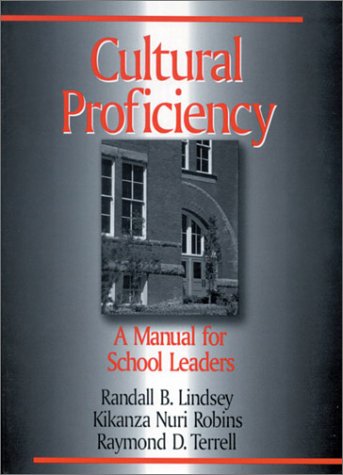

Cultural proficiency a manual for school leaders Randall B. Lindsey, Kikanza Nuri Robins, Raymond D. Terrell.
Detalles de publicación: Thousand Oaks, Calif. Corwin Press c1999.Descripción: xvi, 255 p. ill. 26 cmISBN:- 0803967624 (cloth : acid-free paper)
- 0803967632 (pbk. : acid-free paper)
- Multicultural education -- United States. -- Case studies
- Multicultural education -- United States -- Case studies
- Educational sociology -- United States -- Case studies
- Educational leadership
- Educational leadership -- United States. -- Case studies
- Educational sociology -- United States. -- Case studies
- 370.117 L752c 21
- LC1099.3 .L555 1999
| Imagen de cubierta | Tipo de ítem | Biblioteca actual | Biblioteca de origen | Colección | Ubicación en estantería | Signatura topográfica | Materiales especificados | Info Vol | URL | Copia número | Estado | Notas | Fecha de vencimiento | Código de barras | Reserva de ítems | Prioridad de la cola de reserva de ejemplar | Reservas para cursos | |
|---|---|---|---|---|---|---|---|---|---|---|---|---|---|---|---|---|---|---|
| Libro | Biblioteca de Mayagüez Colección General mb | LC 1099.3 .L555 1999 (Navegar estantería(Abre debajo)) | Disponible | 50000002090883 | ||||||||||||||
| Referencia | Biblioteca Encarnación Valdés Sala de Referencia bev | 370.117 L752c (Navegar estantería(Abre debajo)) | Disponible | 80000002132754 |
Descripciones mejoradas de Syndetics:
"A first-rate guide for making the changes in schools that ensure education for each and every student. Provides the concepts, history, theories, strategies, and activities to build cultural proficiency." Karen Kearney, Executive Director California School Leadership Academy
"An asset for any participant in a learning community. However, it is critically important for it to be read and used by principals and other educational leaders in our K-12 schools. The activities and processes are excellent." Kieran Vaughan, Coordinator Mount St. Mary′s College, Los Angeles, CA
"Helps us understand why educational equity is everyone′s responsibility. I recommend this book to all educators in the public school system." Phyllis J. Hart, Executive DirectorThe Achievement Council
"Breaks new ground in the effort to provide contextually appropriate environments for all students. The authors have issued a challenge to the educational community to make quality education available to all students." Allen A. Mori, Dean California State University, Los Angeles
"A sensitive, thoughtful, provocative exploration of perhaps the most significant issue facing today′s urban educator." Carmella S. Franco, SuperintendentWhittier School District, CA
Develop positive, productive responses to the diverse populations in your school and community.
The authors define "cultural proficiency" as that which enables one to interact effectively in a culturally diverse environment. Use your cultural proficiency to ensure that your students are treated with respect, compassion, and the expectation that they will achieve. Then make sure they do by adjusting your style to their needs and abilities.
You, your staff, and your students can learn how to:
Avoid unintentional cultural or ethnic slights Eliminate practices that create negative outcomes Recognize differences as diversity instead of seeing them as inappropriate responses Understand how historical distrust affects present-day interactions Accept that each culture finds some values and behaviors more important than othersDevelop and maintain good cross-cultural communications by learning to acknowledge the differences present in staff, students, and community members. Integrate cultural knowledge into staff development systems and curricula, and watch staff and student morale rise.
Master concepts and skills you can translate into culture-friendly curricula, programs, and activities. As a culturally proficient school leader, you will maximize the effectiveness of communication, reduce complaints, and create a more comfortable and pleasing climate in your school.
Includes 39 structured activities for developing cultural proficiency for use with students and staff.
Includes bibliographical references (p. 239-248) and index.
The case : presenting Rolling Meadows and Coolidge school districts -- What is cultural proficiency? -- Becoming a culturally proficient leader -- Overcoming resistance to change -- Understanding the barrier of entitlement -- Moving toward cultural proficiency -- Resources : structured activities for developing culturally proficient leaders.
Tabla de contenidos provista por Syndetics
- Foreword
- Preface
- About the Authors
- 1 The Case: Presenting Rolling Meadows and Coolidge School Districts
- 2 What is Cultural Proficiency?
- 3 Becoming a Culturally Proficient Leader
- 4 Overcoming Resistance to Change
- 5 Understanding the Barrier of Entitlement
- 6 Moving Toward Cultural Proficiency
- Resources: Structured Activities for Developing Culturally Proficient Leaders
- References
- Index
Notas de autor provistas por Syndetics
Randall B. Lindseyis Emeritus Professor at California State University, Los Angeles. He has served as a teacher, an administrator, executive director of a non-profit corporation, as Interim Dean at California Lutheran University, as Distinguished Educator in Residence at Pepperdine University, and as Chair of the Education Department at the University of Redlands. All of Randy''s experiences have been in working with diverse populations and his area of study is the behavior of white people in multicultural settings. His Ph.D. is in Educational Leadership from Georgia State University, his Master of Arts in Teaching is in History Education from the University of Illinois, and his B.S. in Social Science Education is from Western Illinois University. He has served as a junior high school and high school teacher and as an administrator in charge of school desegregation efforts. At Cal State, L.A. he served as Chair of the Division of Administration and Counseling and as Director of the Regional Assistance Centers for Educational Equity, a regional race desegregation assistance center. With co-authors he has written several books and articles on applying the Cultural Proficiency Framework in various contexts.Email - randallblindsey@gmail.comWebsite - CCPEP.orgTwitter - @RBLindsey41
Kikanza Nuri-Robins helps people to close the gap between what they say they are and what they actually do. Whether she is in a corporate boardroom, the fireside room of a retreat center, or a convention center auditorium, Kikanza uses her skills and insights to help people and organizations that are in transition - or ought to be. She shares her observations and recommendations with clarity and candor, while gently encouraging them to face the difficult situations that challenge their skill sets and their values. She leads people to this growing edge with unswerving focus, an understanding heart, and laughter that rises from the seat of her soul. Since 1978, Kikanza has worked as an organizational development consultant in a variety of settings including education, health care, criminal justice, and religion, focusing on leadership development, change management, and cultural proficiency. Her clients range from school districts, to university faculty, to government offices and non-profit organizations. The connecting thread is her passion for working with people who want to making a difference for others. Kikanza studied at Occidental College, the University of Southern California, and the San Francisco Theological Seminary. She is the author of many articles and five books, including: Cultural Proficiency and Culturally Proficient Responses to the LGBT Communities . Kikanza lives in Los Angeles where she spends her discretionary time as a textile artist.Raymond Terrell, EdD. retired as Associate Dean for Research and Diversity and member of he department of Educational Leadership at Miami University, Oxford