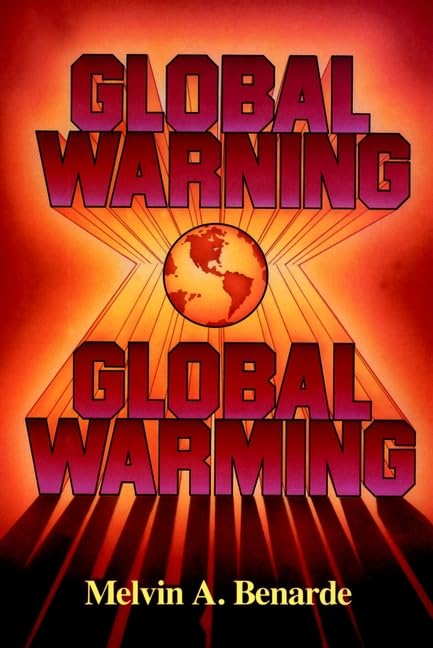

Global warning... global warning Melvin A. Benarde.
Detalles de publicación: New York John Wiley & Sons 1992.Descripción: xi, 317 p. ill. 23 cmISBN:- 0471513237
- 21 363.7387 B4567g
- QC981 .G56B44 1992
| Imagen de cubierta | Tipo de ítem | Biblioteca actual | Biblioteca de origen | Colección | Ubicación en estantería | Signatura topográfica | Materiales especificados | Info Vol | URL | Copia número | Estado | Notas | Fecha de vencimiento | Código de barras | Reserva de ítems | Prioridad de la cola de reserva de ejemplar | Reservas para cursos | |
|---|---|---|---|---|---|---|---|---|---|---|---|---|---|---|---|---|---|---|
| Libro | Biblioteca Encarnación Valdés Colección General bev | 363.7387 B4567g (Navegar estantería(Abre debajo)) | Disponible | 80000002114240 |
Descripciones mejoradas de Syndetics:
To understand and constructively participate in the current debate on global warming and its consequences, it is essential to have a guide to the playing field. Dr. Melvin A. Benarde's book is this guide and more. It is, in fact, a Baedeker through the minefields of uncertainty which currently bedevil much of the discussion on global warming. He contends that predictions of global warming and its consequences generated by mathematical models are too often taken as holy writ. When, in fact, he states, they can only be seen as tentative. Anything else severely tortures the data. Without this rendering the current discussions border on babble. Bias, prejudice, and hidden agendas are everywhere and can be obstacles and pitfalls for the unprepared and unwary. By no means does he shrug off the idea of a possible warming trend. Dr. Benarde takes this fully into account and discusses in generous detail the alternatives reasonable people would pursue in the face of prodigious uncertainty. Consequently the book goes well beyond any of the others currently in print in describing the shortcomings of the warming thesis, why the stable climate of the past 10,000 years may, or may not, change, as well as the advantages and disadvantages of a warmer world. Clearly, this fully documented book is essential reading for anyone interested in understanding the panoply of issues inherent in the possibility of climate change and contributes to much needed meaningful dialog.
Includes bibliographical references and index.
Tabla de contenidos provista por Syndetics
- Reasons for Seasons
- A Beneficent Greenhouse
- Models and Modeling
- Potential Dislocations...and Advantages
- Approaches to Solutions
- Glossary
- Tables
- Geologic Time
- Index