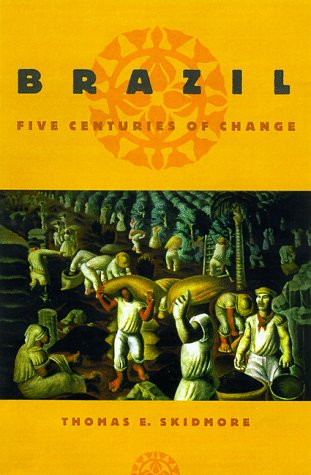

Brazil five centuries of change Thomas E. Skidmore.
Series Latin American historiesDetalles de publicación: New York Oxford University Press 1999.Descripción: xiv, 254 p. 25 cmISBN:- 0195058097 (hardcover)
- 0195058100 (pbk.)
- 981 21
- F2521 .S54 1999
| Imagen de cubierta | Tipo de ítem | Biblioteca actual | Biblioteca de origen | Colección | Ubicación en estantería | Signatura topográfica | Materiales especificados | Info Vol | URL | Copia número | Estado | Notas | Fecha de vencimiento | Código de barras | Reserva de ítems | Prioridad de la cola de reserva de ejemplar | Reservas para cursos | |
|---|---|---|---|---|---|---|---|---|---|---|---|---|---|---|---|---|---|---|
| Libro | Biblioteca Encarnación Valdés Colección General bev | 981 S6281b (Navegar estantería(Abre debajo)) | Disponible | 80000002112616 |
Descripciones mejoradas de Syndetics:
With a land mass larger than the continental United States, a unique culture that is part European, African, and indigenous, and the world's ninth largest economy, Brazil is one of the most important--yet one of the least understood--nations in the world. Thomas Skidmore, a preeminent authority on Brazil, vividly traces the 500 years of Brazil's development. Its epic story begins in the wake of Vasco da Gama's historic circumnavigation of the globe, when another Portuguese vessel, commanded by Pedro Alvares Cabral, ran aground on the coast of Brazil in April 1500. From there Skidmore probes Portugal's remarkable command of the vast country in the face of the advances of the Spanish, French, and Dutch colonial interests; Brazil's compromised independence in 1822; its evolution as the center of world coffee cultivation; and the creation of the republic in the late nineteenth century. Here also are examinations of its unique forms of modernist art and literature, the dictatorship of Getulio Vargas and the military coups, and the ambitious reforms of current President Fernando Henrique Cardoso. Informed by the most recent scholarship available, Brazil explores the country's many blessings: ethnic diversity, a vibrant cultural life, and a wealth of natural resources. But, as Skidmore writes, the Brazilians must also grapple with a history of political instability and military rule, a deplorable environmental record, chronic inflation, and international debt. Mapping out its past as well as its future, this eloquent and detailed look at Brazil will be the standard history of the country for years to come.
Includes bibliographical references (p. 239-250) and index.
Birth and growth of colonial Brazil: 1500-1750 -- Crisis of the colonial system and emergence of an independent Brazil: 1750-1830 -- Revolt, consolidation, and war: 1830-70 -- Making Brazil "modern": 1870-1910 -- World War I, the Great Depression, and dictatorship: 1910-45 -- Democracy under Vargas, halcyon days with Kubitschek, and a military coup: 1945-64 -- Rule of the military: 1964-85 -- Redemocratization--new hope, old problems: 1985- .
Tabla de contenidos provista por Syndetics
- Introduction: Why Read About Brazil?
- Chapter 1 Birth And Growth Of Colonial Brazil: 1500-1750
- The Country the Portuguese Created in the New World
- The Colonial Economy and Society
- Miscegenation: Biological and Cultural
- The Beginnings of a Luso-Brazilian Culture
- Chapter 2 Crisis Of The Colonial System And Emergence Of An Independent Brazil: 1790-1830
- The Economics and Politics of Post-1750 Brazil
- The Portuguese Court Comes to Brazil
- Chapter 3 Revolt, Consolidation, And War: 1830-1870
- Uprisings under the Regency
- Recentralization
- The Role of Pedro II
- The Rise of Coffee
- The Emerging Problems with Slavery as an Institution
- The Question of Abolition
- The Paraguayan War
- Chapter 4 Making Brazil ""Modern"": 1870-1910
- The End of the Empire
- Coffee Fluctuations, Emerging Industry, and Urban Labor
- Chapter 5 World War I, The Great Depression, And Dictatorship: 1910-1945
- The Shock of World War I
- New Currents in the 1920's
- The Revolution of 1930
- Getulio Vargas as Dictator
- Chapter 6 Democracy Under Vargas, Halcyon Days With Kubitschek, And A Military Coup: 1945-1964
- The 1945 Election and the Dutra Period Vargas Returns
- A Socioeconomic Profile of Brazil in the Late 1940s and 1950s
- A New President, Juscelino Kubitschek, Elected
- The Brief Presidency of Janio Guadros
- The Succession of Joao Goulart
- Chapter 7 Rule Of The Military: 1964-1985
- The Generals Search for a Political Base
- The Arrival of the Guerrillas
- Culture and the Generals
- The Economic ""Miracle"" Wrought by the Authoritarians
- The Road to Redemocratization
- Chapter 8 Redemocratization
- New Hope, Old Problems: 1985-
- Sarney and His Challenges
- The Debt Crisis and the Economy
- Widening Gaps Between Rich and Poor
- Public Health: The Fish That Swam Upstream
- Changes Affecting Women
- Race Relations
- The Political Spectrum in the New Democracy
- The Collor Debacle
- Another Vice-President in Command
- Back to Stabilization: The Plano Real
- The Presidential Election of 1994
- Epilogue
- Suggestions for further Readings