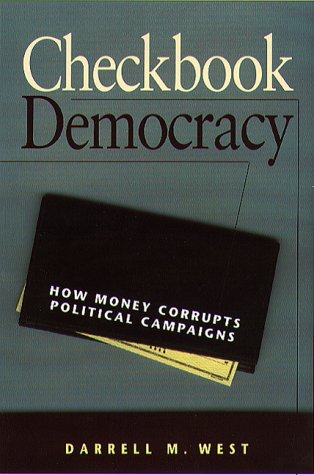
Imagen de portada de Amazon
Imagen de Amazon.com
Imagen de cubierta Syndetics
Portada de Syndetics
Imagen de OpenLibrary

Checkbook democracy how money corrupts political campaigns Darrell M. West.

Por: Detalles de publicación: Boston Northeastern University Press c2000.Descripción: x, 220 p. 22 cmISBN:
  • 1555534414 (cloth : alk. paper)
  • 1555534406 (pbk. : alk. paper)
Otro título:
  • How money corrupts political campaigns
Tema(s): Clasificación CDD:
  • 324.780973 W5161c 21
Clasificación LoC:
  • JK1991 .W47 2000
Contenidos:
Introduction -- The Willie Horton independent expenditure -- Issue advocacy and the Christian Action Network -- Contribution limits: George Steinbrenner and Simon Fireman -- Foreign nationals and the Democratic National Committee -- The Teamsters and the Clinton White House -- Big tobacco and the Republican National Committee -- Non-profits, foundations, and tax-exempt organizations -- Conclusion.
Valoración
    Valoración media: 0.0 (0 votos)
Existencias
Imagen de cubierta Tipo de ítem Biblioteca actual Biblioteca de origen Colección Ubicación en estantería Signatura topográfica Materiales especificados Info Vol URL Copia número Estado Notas Fecha de vencimiento Código de barras Reserva de ítems Prioridad de la cola de reserva de ejemplar Reservas para cursos
Libro Biblioteca Encarnación Valdés Colección General bev 324.780973 W5161c (Navegar estantería(Abre debajo)) Disponible 80000002121948
Total de reservas: 0

Descripciones mejoradas de Syndetics:

Counts are being taken before the political conventions convene: not delegates, but dollars. Public officials court donors more than voters, while the party faithful rally around the war chest rather than the platform. Virtually anything goes in campaign finance today, and, as a result, the electoral process is being hijacked by large contributions, secret influence, and increasingly unaccountable government leaders. In this lively and provocative book, Darrell M. West looks at how politics became such a money chase, why money has become such a pernicious influence on public debate, and what can be done to redeem the corrupted system. Drawing on interviews, memoirs, press coverage, legal depositions, and government documents, West's timely book investigates recent examples of campaign abuses to illustrate how political parties and organizations circumvent post-Watergate reform legislation -- and how money has become the key to winning elections and influencing the public. Included in his probe are such cases as the infamous Willie Horton ad in the 1988 presidential campaign, the Christian Action Network, Asian contributions to the Democrats, tobacco company donations to the Republicans, and President Clinton's 1996 campaign infractions. The numerous case studies expose the manifold loopholes and problems in current campaign finance laws, including soft money contributions, independent expenditures, issue advocacy, foreign contributions, and political activism by non-profit organizations. West's sober evaluation of the exploding costs of campaigns -- and escalating cynicism among voters -- offers a hard-hitting look at the forces working against reform and makes constructiveproposals for reversing this disconcerting trend in contemporary American politics.

Includes bibliographical references and index.

Introduction -- The Willie Horton independent expenditure -- Issue advocacy and the Christian Action Network -- Contribution limits: George Steinbrenner and Simon Fireman -- Foreign nationals and the Democratic National Committee -- The Teamsters and the Clinton White House -- Big tobacco and the Republican National Committee -- Non-profits, foundations, and tax-exempt organizations -- Conclusion.

Tabla de contenidos provista por Syndetics

  • Acknowledgments(p. ix)
  • 1. Introduction(p. 3)
  • 2. The Willie Horton Independent Expenditure(p. 16)
  • 3. Issue Advocacy and the Christian Action Network(p. 39)
  • 4. Contribution Limits: George Steinbrenner and Simon Fireman(p. 62)
  • 5. Foreign Nationals and the Democratic National Committee(p. 84)
  • 6. The Teamsters and the Clinton White House(p. 107)
  • 7. Big Tobacco and the Republican National Committee(p. 125)
  • 8. Non-Profits, Foundations, and Tax-Exempt Organizations(p. 146)
  • 9. Conclusion(p. 165)
  • Notes(p. 191)
  • Index(p. 209)

Extracto provisto por Syndetics

Chapter One     Introduction It started as a courageous act by a United States senator from Wisconsin. Tired of special-interest money pouring into political races, Democratic incumbent Russell Feingold announced a bold new electoral policy. For his 1998 re-election effort against Republican Mark Neumann, he would accept no more than 10 percent of his overall campaign dollars from political action committees. Furthermore, the senator would stick to a spending cap of $3.8 million, roughly $1 for every registered voter in the state. And the incumbent also announced that he would do all in his power to raise 75 percent of his money from within Wisconsin and would prevent national Democrats and sympathetic interest groups from running any advertisements on his behalf.     The system of financing American elections had long disgusted Feingold. His strong feelings on the subject had led him, along with Senator John McCain, Republican of Arizona, to propose a radical restructuring of campaign finance several years earlier. Dubbed the McCain-Feingold bill, their legislation sought to outlaw political action committees, ban unlimited soft-money contributions from large donors to political parties, and restrict issue ads broadcast against candidates by interest groups right before an election, among other reforms.     Early in the 1998 race, Feingold appeared a shoo-in for re-election. July polls gave him a lead of 49 to 30 percent over Neumann, a conservative House member with a record of controversial votes. Voters respected the senator for his strong stance in favor of campaign finance reform, health care regulation, and education initiatives. They worried that Neumann was too conservative for a state that had a tradition of electing progressive Democrats.     Unbeknownst to Feingold, though, others had decided to make an example of him. Senator Mitch McConnell of Kentucky headed the National Republican Senatorial Committee, the body charged with dispensing campaign funds for Senate Republicans. A vociferous opponent of campaign finance reform, McConnell was furious over Senator Feingold's strong support for such legislation. In the party chief's eyes, restrictions on the ability to spend money represented a dangerous threat to freedom of speech and were an absolute affront to the First Amendment.     From his position as head of the NRSC, McConnell would make sure Neumann had plenty of cash. Money would be no object in the battle to unseat his ardent policy foe, Feingold. If the Republican leader only could defeat the Wisconsin Democrat, he could drive a dagger right into the heart of campaign finance reform.     According to news reports, McConnell executed his plan with a vengeance. As the Republican political chief in the Senate, he redirected millions of dollars in party funds to Neumann in order to defeat Feingold. The Republican party donated $1 million to Neumann and spent about $2 million on soft-money ads criticizing the incumbent.     Conservative groups also put substantial resources into the race against Feingold. For example, the National Right to Life Committee was upset over the senator's position in support of so-called partial-birth abortions. It devoted nearly $100,000 to full-page newspaper ads in several states criticizing Feingold's abortion views. Groups that supported term limits and ones that opposed tough new regulations designed to crack down on the sources of global warming also poured money into the race.     Neumann himself criticized Feingold in negative ads claiming the senator, through his vote for a complex omnibus appropriation bill, had wasted taxpayers' money by funding a scientific study on "the uses of cow gas." Another spot employed an elderly woman to say, "You gotta watch that ol' Russ Feingold. He's slippery."     In the closing weeks of the campaign, the senator was in serious trouble. The polls had closed rapidly. According to GOP surveys, Neumann was in a dead heat with the incumbent. What several months earlier had appeared inconceivable was on the verge of becoming true. Neumann had a good shot to defeat Feingold.     Hamstrung by his own pledge not to accept much political action committee money and to keep the Democratic Senatorial Campaign Committee from expending resources on his behalf, Feingold counterattacked. Out-of-state interests were attempting to derail his re-election, he argued. Neumann was a pawn of special-interest groups. Such organizations should "get the heck out of the state. Let the people of Wisconsin decide the outcome of this race."     In the end, his plaintive appeals to the voters worked. By a 50 to 49 percent margin, Feingold defeated Neumann and reclaimed his seat in the U.S. Senate. The incumbent had beaten back a determined effort to silence his voice in national campaign finance battles.     Feingold's was not the only race in recent memory where money played a controversial role. In the past few years, we can see a number of new and creative ways in which money has attempted to influence the course of American elections. • In 1988, Republican presidential nominee George Bush used an innovative "two-track" system of campaign appeals. His official organization attacked Governor Michael Dukakis of Massachusetts on crime, taxes, and the environment, while a second "independent" campaign funded by outside groups played an ugly racial card against the Democratic nominee. • In 1992, interest groups opposed to Democratic presidential candidate Bill Clinton exploited a "public education" loophole in campaign finance rules to fund an "issues" ad claiming Clinton favored radical homosexual rights. • In 1996, the Democratic National Committee and the Clinton White House took money from illegal sources, such as foreign nationals, in order to finance an early advertising barrage against Republican nominee Robert Dole. • In 2000, George W. Bush rejected public financing of his campaign so he could spend an unlimited amount of money. By the turn of the millennium, it had become clear that the post-Watergate reform system created to combat the dangers of large, secret contributions had almost entirely broken down. A "Wild West" mentality, where virtually anything goes, rules.     In this book, I argue that we now have a "checkbook democracy," a form of government in which money has hijacked the campaign process. It is a system characterized by large contributions, secret influence, citizen cynicism, weak public representation, and increasingly unaccountable elected officials. Big money tied to private interest groups has disrupted democratic elections, raised the volume of negative ads, and turned off the general public.     Checkbook democracy weakens the leadership accountability that is such a crucial part of our political system. The need to raise large sums of money leads public officials to pay more attention to donors than voters. Some politicians dangle the prospect of favorable tax breaks and amendments to key legislation in order to further their fundraising. Others look aside when infractions are made public, resulting in lax enforcement of current laws.     Even large contributors, who in many cases benefit from the status quo, are angry at this system. The Sara Lee corporation's chief executive officer, John Bryan, an early supporter of President Clinton, refers to campaign fundraising as "legal bribery." From his vantage point, candidates spend all their time looking for contributions rather than conducting the people's business. "Everybody knows the system is absurd," he complains.     It is this legitimization and institutionalization of corruption in our political system that represents such a vital threat. Charges of vote trading, favors granted, and unsavory fundraising dominate American campaigns. Combined with selective enforcement of campaign finance laws because of confusing rules, voters, candidates, and contributors all face an untenable situation. Unless we confront and fix these problems, we risk the future of representative government.     In looking at the history of campaign fundraising, it is clear that money always has been a problem in American politics. Each era has handled the issue in very different ways, however. In the days before Watergate, our system of campaign finance had four basic features: 1. Weak disclosure rules 2. Unlimited contributions, which gave great clout to the wealthy 3. Unlimited spending based on whatever people Could raise 4. Clear partisan inequities in fundraising: during presidential contests, Republicans routinely outspent Democrats by a two-to-one margin; in congressional races, owing to their majority status in both houses, Democrats outspent the GOP     Stimulated by public disgust with the Watergate abuses, there was a revolution in campaign finance in the 1970s. In just a few years, Congress passed and the president signed a massive overhaul, much of which was sustained by the Supreme Court in its pivotal 1976 decision in Buckley v. Valeo .     These reforms were based on four new features: 1. Strong disclosure laws designed to end secrecy in fundraising 2. Caps on contributions at $1,000 per individual and $5,000 per political action committee, which sharply reduced the ability of the wealthy to fund individual candidates 3. Voluntary spending limits for presidential races in exchange for public subsidies 4. The creation of a new federal agency, the Federal Election Commission, with sweeping enforcement powers     Even more important than these legal changes in the rules of campaign finance, though, was a shift in the underlying norm of electoral competition. Although both legislators and justices explained their reforms as being mainly a matter of avoiding the perception of corruption in the political system, a perusal of the changes implemented during this period reveals a far more wide-reaching transformation.     For the first time in American history, the ability of the wealthy to fund individual candidates was sharply limited, although substantial sums still could be scattered among a large number of office seekers. And in the case of presidential contenders who voluntarily entered into the system of public subsidies (almost every major politician over the past twenty years except John Connally, Ross Perot, George W. Bush, and Steve Forbes), the parties were placed on identical footings in the amounts they were able to raise and spend.     This underlying spirit of egalitarianism was a stunning reversal from earlier periods of American politics. In every election before 1976, Americans could give as much as they wanted to particular politicians, and candidates could spend whatever they raised. If one party had more money than another, that was considered a tribute to its fundraising prowess. In the wake of Watergate, however, the risk of citizen cynicism was seen as too high to tolerate the machinations of fat cats or vast partisan spending imbalances at the presidential level.     In light of campaign finance rules before Watergate, it is not surprising that many of the reforms of the 1970s turned out to be porous restrictions on the ability to spend and the power of the wealthy. The combination of new court rulings, creative political strategies, and closely contested elections has led to a restoration of key features from earlier days, notably weak disclosure, secret spending, the presence of large contributors, and spending imbalances in presidential politics. Without any serious public debate, the 1970s' system, balancing freedom of expression, open disclosure, fair electoral competition, and equal spending in contests for the presidency, has been eviscerated.     To illustrate key features of our recent history and the more general problems of checkbook democracy, I examine a number of examples of campaign finance problems. My aim in these case studies is to illuminate various difficulties of campaign finance. I review how each problem developed after the Buckley decision, what the story says about our political system, and why the particular practice raises difficulties for American democracy. In detailed examinations of each area I discuss how accountability in American elections has been weakened and why money continues to be at the center of many of the problems facing our political system.     As part of my case studies, I rely upon press coverage, legal depositions, and government documents to get a sense of what happened. I examine recent court rulings that have opened the door to political abuses and created clear irrationalities in our current laws. Through open-ended interpretations of the principle of freedom of speech, many of these rulings have weakened accountability in our political system and elevated freedom of expression over other compelling principles, such as open disclosure and equity of electoral disclosure.     The outline of this book follows the general history over the past decade of how we arrived at this sad state of affairs. Chapter 2 examines the independent expenditure centering on the Willie Horton advertisement from the 1988 presidential contest. This illustrates how one major loophole emerged in the contemporary campaign system. Although the official Bush camp ran a "Revolving Door" commercial attacking Michael Dukakis's lack of toughness on crime, an outside group used an independent expenditure to broadcast a commercial using the name and likeness of the felon Willie Horton to criticize Dukakis. The Federal Election Commission compiled extensive evidence documenting that the two efforts were not truly independent, as required by law, but rather were coordinated. The difficulties FEC lawyers had in convincing authorities of this coordination opened the way for the flood of independent expenditures in subsequent elections.     Chapter 3 studies the rise of issue advocacy, using the case of the Christian Action Network. In 1992, CAN grew concerned about what it saw as the liberal drift of social policy in the United States, especially in regard to gay rights. Led by Martin Mawyer, a "pro-family" activist, the group decided to take action against presidential candidate Bill Clinton, who in its eyes favored "radical homosexual rights." The organization spent $2 million on electioneering devoted to defeating Clinton, none of which was disclosed because CAN considered its activities public education, not direct candidate advocacy. Following an unsuccessful FEC lawsuit against the organization, dozens of other interest groups began running issue ads on subjects such as a balanced budget, labor, term limits, abortion, and global warming, all outside required federal disclosure laws. Today, more than one-third of campaign ads are aired by interest groups, not parties or candidates.     Chapter 4 looks at controversies over contribution limits through the case of Simon Fireman, a Massachusetts businessman. In 1996, he was accused of making contributions above the $1,000 limit to Republican presidential candidate Robert Dole. After pleading guilty, Fireman and his company, Aqua-Leisure, were fined $6 million; he was also sentenced to six months of home confinement, the harshest penalty ever imposed on an individual in this type of case. The episode reveals the schizophrenia of current campaign finance rules. Individuals, unions, and corporations donate hundreds of thousands of dollars to the political parties. However, because these "soft money" contributions are not given directly to candidates to support their election, the law places no restrictions on their size. Since the parties use such contributions to run ads supporting particular candidates, a clear irrationality has emerged in regard to contributor limits.     Chapter 5 describes the role of donations from foreign nationals to the Democratic National Committee in 1996. A year before that election, the DNC faced a serious fundraising problem. With Republicans in control of both the House and Senate, the Democrats' fundraising lagged far behind that of the GOP. Donors often prefer to give money to the majority party in Congress, because it controls the legislative agenda and committee chairmanships. Fearing for his own re-election, President Bill Clinton developed a fundraising plan that ended background checks on contributors and expanded the universe of campaign solicitations. The end result was an embarrassing Democratic scandal in which illegal sources were tapped for millions of dollars, much of which had to be returned to donors after the election. Even worse, thorny national security questions arose about whether Clinton's fundraisers had traded information to representatives of the Chinese government in exchange.     In Chapter 6 I look at the case of the Teamsters Union and the Clinton White House. In 1996 the Teamsters' president, Ron Carey, faced a close re-election battle. Brought to power to clean up a union that was the most troubled in the history of American labor, Carey feared his reform slate would lose to a faction headed by his archrival, James Hoffa, Jr. Seeking to guarantee his victory, Carey enlisted the help of Clinton's aide Harold Ickes. In return for assistance, Carey promised the White House the union would raise money for the president's re-election. By delineating the controversial relationship between the Teamsters and the. Clinton administration, this case shows how large and powerful groups help government officials evade current campaign finance rules.     Chapter 7 examines the ties between big tobacco and the Republican National Committee. In 1998, it looked as if anti-smoking legislation had strong support in Congress. Scientific studies revealed a close tie between smoking and a variety of health ills such as heart disease and cancer. The American public had increasingly grown more negative about tobacco, with the result that smoking had been banned in restaurants, workplaces, and airplanes. But following a $43 million lobbying campaign, plus generous contributions to the Republican National Committee and key GOP allies, tobacco companies defeated the pending legislation and saved themselves billions of dollars. This affair reveals how large moneyed interests can defeat policy proposals that are supported by clear majorities among the people.     Chapter 8 studies the increasing reliance on non-profits, foundations, and tax-exempt organizations to finance partisan political activities. Such operations have become quite popular because they are not subject to disclosure requirements, have no restrictions on the amount of money that can be given, and can accept funds from whoever wants to contribute, whether it be a corporation, a wealthy individual, or a foreign government. With these obvious advantages, it is not surprising that public officials use these kinds of organizations as stealth vehicles in political contests.     After considering this range of money problems, the book concludes in Chapter 9 by examining why reform has proved so difficult and what we must do to improve our campaign finance system. The rules that emerged after Watergate and were upheld by the Supreme Court in Buckley v. Valeo are now in tatters. Loopholes have been created that violate the spirit of the political consensus that developed in the mid-1970s. Today, thanks to soft-money contributions, independent expenditures, issue advocacy, foreign contributions, and the political activism of non-profit organizations, we have large amounts of virtually unregulated and undisclosed cash flowing into campaigns.     Indeed, the very terminology surrounding such loopholes is often completely false. "Issue ads," for example, typically have less to do with issues and more to do with negative appeals than do commercials sponsored by candidates, and many of them cross the line into direct electioneering. It is time for politicians, interest groups, the public, and the courts to deal with these new challenges and redefine the concept of issue advocacy. Issue-based appeals that are made outside election campaigns (and which do not deserve regulation) should be distinguished from "sham" advocacy spots using the candidates' name and likeness in the months leading up to an election that look just like political commercials. In the eyes of voters and other candidates, the latter are de facto campaign advertisements and should fall under the terms of current disclosure laws on spending and contributions. Similarly, tax-exempt organizations that promote specific candidates should have their exemption revoked by the Internal Revenue Service. There is no First Amendment right to tax-subsidized freedom of expression. Copyright © 2000 Darrell M. West. All rights reserved.

Reseñas proporcionadas por Syndetics

Publishers Weekly Review

In the aftermath of Watergate, the U.S. Congress passed legislation that severely limited individual and corporate contributions to political campaigns. As this unsurprising book details, well-heeled contributors have evaded this law by contributing "soft money" to interest groups that don't have to open their books. In some cases, these interest groups, in the guise of "educating" the public about issues, actually "ran election ads in disguise." The author cites a number of cases, including the Willie Horton race-baiting ads used to support George Bush's 1988 campaign and the case of the Christian Action Network, which spent $2 million in 1992 (one of its ads depicted Bill Clinton and Al Gore among pictures of marchers in a Gay Pride parade and asked, "Is this your vision of a better America?"). The Federal Election Commission investigated the ads, but the CAN won its case in court. Even when individuals are fined for violating the campaign finance laws, enforcement is lax--New York Yankees owner George Steinbrennner paid a fine of only $35,000 for money laundering during the 1972 presidential campaign, and President Ronald Reagan later pardoned him. As the author notes, the courts have often interpreted "the freedom of speech as the freedom to spend." However, the recommendations suggested by West, a professor of political science at Brown University, at the end of the book seem merely Band-Aids for a systemic problem; he fails to convincingly rebut the argument that interest groups can advance democracy by allowing citizens with common interests to group together to express their views. In the end, this book, while timely, adds little to an issue already much in the news. (Apr). (c) Copyright PWxyz, LLC. All rights reserved

CHOICE Review

Brown University political scientist West contributes an engaging entry to national campaign finance reform competition. Unlike typical books on the subject, his focuses on specific cases to frame broad problems in campaign finance, an approach calculated to be more engaging than recitations of legal issues, case law, or lists of large contributors. Nonetheless, in thus structuring his pathologist's report, he neatly incorporates a more detailed description of the viscera of campaign finance. The result is a readable account of the expansion of big money politics in recent elections. As he shows, politically interested, well-funded groups can easily evade the law's intent through independent expenditures and issue advocacy campaigns. Even where the law ostensibly provides for effective regulation (e.g., limits on individual candidate contributions or the ban on contributions by foreign nationals), evasion or ineffective enforcement is all too common. Political innovations by closely regulated large organizations, notably labor and business, and traditionally apolitical organizational forms (e.g., nonprofits, foundations, and tax exempt groups) have opened new to ways for the well-funded to profit politically. In the end, West's largely conventional reform proposals offer little consolation to the overmatched American citizen. Recommended at all levels. T. Fackler University of Nevada, Las Vegas

Notas de autor provistas por Syndetics

Darrell M. West is Professor of Political Science and Director of the John Hazen White, Sr., Public Opinion Laboratory at Brown University.
Compartir
logopucpr-y-vive

Contáctanos

¡Queremos saber de ti!

Tel. 787.841.2000 Ext. 1801

bibliotecavaldes@pucpr.edu

⁣Búscanos en las redes

© 2026 Desarrollado por Ignite Online • All Rights Reserved • Powered by Koha.