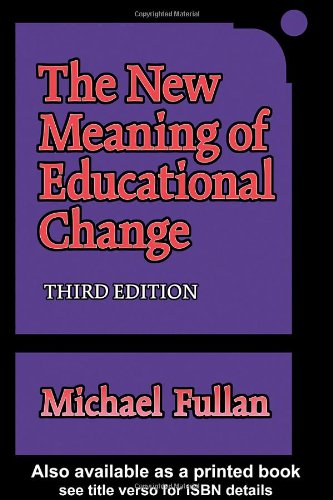

The new meaning of educational change Michael Fullan.
Detalles de publicación: New York, NY Teachers College 2001.Edición: 3th edDescripción: xi, 297 p. 23 cmISBN:- 0807740691
- 370.971 F965n3
- LA412 .F85 2001
| Imagen de cubierta | Tipo de ítem | Biblioteca actual | Biblioteca de origen | Colección | Ubicación en estantería | Signatura topográfica | Materiales especificados | Info Vol | URL | Copia número | Estado | Notas | Fecha de vencimiento | Código de barras | Reserva de ítems | Prioridad de la cola de reserva de ejemplar | Reservas para cursos | |
|---|---|---|---|---|---|---|---|---|---|---|---|---|---|---|---|---|---|---|
| Libro | Biblioteca de Mayagüez Colección General mb | LA412 .F85 2001 (Navegar estantería(Abre debajo)) | Disponible | 50000002140803 |
Descripciones mejoradas de Syndetics:
In 1982, an extraordinary book, The New Meaning of Educational Change, appeared which revolutionized how educational reform was regarded. Now, Michael Fullan has greatly revised and expanded the ideas that make this book the definitive up-to-date reference for the educational innovator in the new millennium. It provides powerful insights into the complexity of reform and recommends inspiring and practical strategies for lasting improvement. Written in clear, accessible language, Fullan provides a classic guide to reform.
Includes bibliographical references and index.
Tabla de contenidos provista por Syndetics
- Preface(p. xi)
- Part I Understanding Educational Change
- 1. A Brief History of Educational Change(p. 3)
- The First Attempt Falls Flat(p. 4)
- The Plan of the Book(p. 9)
- Prospects for Reform(p. 16)
- 2. Sources of Educational Change(p. 21)
- Innovation Overload(p. 21)
- Innovations Abound(p. 24)
- 3. The Meaning of Educational Change(p. 29)
- The General Problem of the Meaning of Change(p. 30)
- The Subjective Meaning of Educational Change(p. 32)
- The Objective Reality of Educational Change(p. 38)
- Shared Meaning and Program Coherence(p. 46)
- 4. The Causes and Processes of Initiation(p. 49)
- Factors Affecting Initiation(p. 53)
- The Dilemmas of Initiation(p. 65)
- 5. Causes/Processes of Implementation and Continuation(p. 69)
- Factors Affecting Implementation(p. 71)
- Key Factors in the Implementation Process(p. 72)
- Factors Affecting Continuation(p. 87)
- Implementation/Continuation Worries(p. 90)
- Perspectives on the Change Process(p. 91)
- 6. Planning, Doing, and Coping with Change(p. 95)
- Why Planning Fails(p. 95)
- Success Is Possible(p. 103)
- Planning and Coping(p. 104)
- The Scope of Change(p. 110)
- Part II Educational Change at the Local Level
- 7. The Teacher(p. 115)
- Where Teachers Are(p. 116)
- Enter Change(p. 123)
- Professionalism at the Crossroads(p. 133)
- 8. The Principal(p. 137)
- Where Principals Are(p. 138)
- The Principal and Change(p. 141)
- The Complexity of Leadership(p. 147)
- 9. The Student(p. 151)
- Where Students Are(p. 153)
- The Student and Change(p. 159)
- 10. The District Administrator(p. 165)
- Where District Administrators Are(p. 165)
- The District Administrators and Change(p. 170)
- What School Success Looks Like(p. 175)
- Cautions and Implications(p. 179)
- 11. The Consultant(p. 185)
- The Problem and Promise of Consultancy(p. 185)
- External Consultants: Outside-In(p. 193)
- Using Consultants: Inside-Out(p. 195)
- 12. The Parent and the Community(p. 197)
- Parent Involvement in Schools(p. 198)
- School Board and Communities(p. 208)
- Implications(p. 213)
- Part III Educational Change at the Regional and National Levels
- 13. Governments(p. 219)
- The Role of Governments(p. 220)
- The Case of the National Literacy and Numeracy Strategy(p. 225)
- Implications(p. 232)
- 14. Professional Preparation of Teachers(p. 237)
- The Preparation of Teachers(p. 239)
- Hiring and Induction(p. 249)
- 15. Professional Development of Educators(p. 253)
- Standards of Practice(p. 255)
- Reculturing Schools(p. 259)
- The Role of Leadership(p. 260)
- To Recreate a Profession(p. 265)
- 16. The Future of Educational Change(p. 267)
- References(p. 273)
- Index(p. 287)
- About the Author(p. 297)
Notas de autor provistas por Syndetics
Michael Fullan, Michael Fullan is the Dean of the Ontario Institute for Studies in Education of the University of Toronto. He is an international authority on educational change and reform and has participated in many partnerships to bring about educational improvements. He is a researcher, consultant, trainer and policy advisor for multiple educational reform projects. He is the author of "The Changes Forces" trilogy, "The New Meaning of Educational Change, Third Edition."In 1993, Fullan was awarded the Colonel Watson Award for Outstanding Leadership from the Ontario Association of Curriculum Development. He was also appointed Policy Implementation Advisor to the Ministry of Education and Training. From that position, he earned the "Contribution to Staff Development Award" from the National Staff Development Council in 1995.