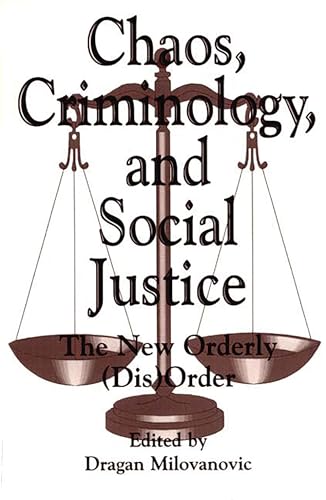

Chaos, criminology, and social justice the new orderly (dis)order edited by Dragan Milovanovic.
Series Praeger series in criminology and crime control policyDetalles de publicación: Westport, Conn. Praeger 1997.Descripción: xiv, 221 p. ill. 25 cmISBN:- 0275957071 (alk. paper)
- 0275959120 (pbk. : alk. paper)
- KV 6030 .C48 1997
| Imagen de cubierta | Tipo de ítem | Biblioteca actual | Biblioteca de origen | Colección | Ubicación en estantería | Signatura topográfica | Materiales especificados | Info Vol | URL | Copia número | Estado | Notas | Fecha de vencimiento | Código de barras | Reserva de ítems | Prioridad de la cola de reserva de ejemplar | Reservas para cursos | |
|---|---|---|---|---|---|---|---|---|---|---|---|---|---|---|---|---|---|---|
| Libro | Biblioteca de Derecho Mons. Fremiot Torres Oliver Colección General biblioteca derecho | HV 6030 .C48 1997 (Navegar estantería(Abre debajo)) | Disponible | 70000000641857 |
Descripciones mejoradas de Syndetics:
Chaos theory challenges the presumption that the cosmos is orderly, linear, and predictable--but it does not imply pure randomness and chance events. Rather, chaos-informed postmodernist analysis introduces a new vision by celebrating unexpected, surprise, ironic, contradictory, and emergent elements. Scholars in many disciplines are taking this perspective as an alternative to the entrenched structural functionalism and empiricism rooted in linear science. In the early 1990s studies began to emerge applying chaos theory to criminology, law, and social change. This book brings together some of the key thinkers in these areas. Part I situates chaos theory as a constitutive thread in contemporary critical thought in criminology and law. It seeks to provide the reader with a sensitivity to how chaos theory fits within the postmodern perspective and an understanding of its conceptual tools. Part II comprises chapters on applying the chaos perspective to critical criminology and law and, beyond, to peacemaking. Part III presents studies in chaos-informed perspectives on new social movement theory, social change, and the development of social justice. While the book emphasizes the usefulness of the conceptual tools of chaos theory in critical criminology and law, its ultimate goal goes beyond theory-building to provide vistas for understanding the contemporary social scene and for the development of the new just society.
Includes bibliographical references and index.
Postmodernist versus the modernist paradigm : conceptual differences / Dragan Milovanovic - - Challenges : for a postmoderm criminology / T.R. Young - - Chaos and modeling crime : Quinney's Class, state and crime / Allison Forker - - The ABCs of crime : attractors, bifurcations, and chaotic dynamics / T.R. Young - - Geometric forms of violence / Hal Pepinsky - - Law and social change : the implications of chaos theory in understanding the role of the American legal system / Glenna L. Simons and William F. Stroup II - - Chaos, law, and critical legal studies : mapping the terrain / Caren Schulman - - The chaotic law of forensic psychology : the postmoderm case of the (in)sane defendant / Bruce A. Arrigo - - Surfing the chaotic : a non-linear articulation of social movement theory / Robert C. Schehr - - Dimmensions of social justice in an SRO (single room occupancy) : contributions from chaos orderly (dis)order / Dragan Milovanovic.
Tabla de contenidos provista por Syndetics
- Introduction
- Chaos Theory: Conceptual Contributions to a Postmodern Criminology and Law Postmodernist versus
- the Modernist Paradigm: Conceptual Differences
- Challenges: For a Postmodern Criminology
- Chaos, Criminology, and Law: Critical Applications Chaos and Modeling Crime: Quinney's Class, State, and Crime
- The ABCs of Crime: Attractors, Bifurcations, and Chaotic Dynamics
- Geometric Forms of Violence
- Law and Social Change: The Implications of Chaos Theory in Understanding the Role of the American Legal System
- Stroup, III Chaos, Law, and Critical Legal Studies: Mapping the Terrain
- The Chaotic Law of Forensic Psychology: The Postmodern Case of the (In)Sane Defendant
- Chaos Theory, Social Justice, and Social Change Surfing the Chaotic: A Non-Linear Articulation of Social Movement Theory
- Dimensions of Social Justice in an SRO (Single Room Occupancy): Contributions from Chaos Theory, Policy, and Practice
- Visions of the Emerging Orderly (Dis)Order
- Index
- About the Editor and Contributors