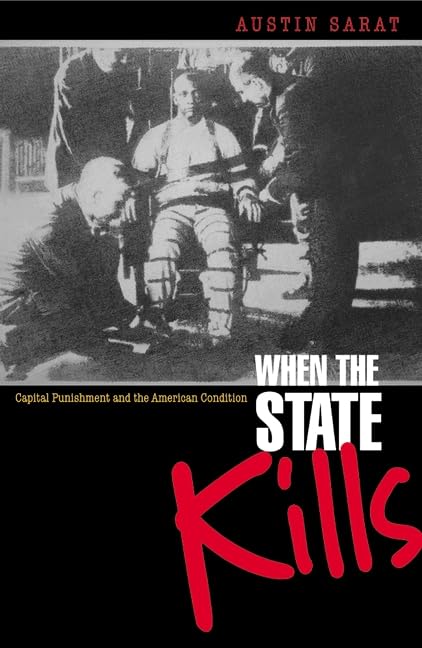

When the State Kills Austin Sarat.
Detalles de publicación: USA Princeton University Press 2001.Descripción: xii, 324 p. ill. 24 cmISBN:- 0691007268
- 364.660 S243w 2001
| Imagen de cubierta | Tipo de ítem | Biblioteca actual | Biblioteca de origen | Colección | Ubicación en estantería | Signatura topográfica | Materiales especificados | Info Vol | URL | Copia número | Estado | Notas | Fecha de vencimiento | Código de barras | Reserva de ítems | Prioridad de la cola de reserva de ejemplar | Reservas para cursos | |
|---|---|---|---|---|---|---|---|---|---|---|---|---|---|---|---|---|---|---|
| Libro | Biblioteca de Mayagüez Colección General mb | HV 8699 .U5 S27 2001 (Navegar estantería(Abre debajo)) | Disponible | 50000002179744 |
Descripciones mejoradas de Syndetics:
Is capital punishment just? Does it deter people from murder? What is the risk that we will execute innocent people? These are the usual questions at the heart of the increasingly heated debate about capital punishment in America. In this bold and impassioned book, Austin Sarat seeks to change the terms of that debate. Capital punishment must be stopped, Sarat argues, because it undermines our democratic society.
Sarat unflinchingly exposes us to the realities of state killing. He examines its foundations in ideas about revenge and retribution. He takes us inside the courtroom of a capital trial, interviews jurors and lawyers who make decisions about life and death, and assesses the arguments swirling around Timothy McVeigh and his trial for the bombing in Oklahoma City. Aided by a series of unsettling color photographs, he traces Americans' evolving quest for new methods of execution, and explores the place of capital punishment in popular culture by examining such films as Dead Man Walking, The Last Dance, and The Green Mile.
Sarat argues that state executions, once used by monarchs as symbolic displays of power, gained acceptance among Americans as a sign of the people's sovereignty. Yet today when the state kills, it does so in a bureaucratic procedure hidden from view and for which no one in particular takes responsibility. He uncovers the forces that sustain America's killing culture, including overheated political rhetoric, racial prejudice, and the desire for a world without moral ambiguity. Capital punishment, Sarat shows, ultimately leaves Americans more divided, hostile, indifferent to life's complexities, and much further from solving the nation's ills. In short, it leaves us with an impoverished democracy.
The book's powerful and sobering conclusions point to a new abolitionist politics, in which capital punishment should be banned not only on ethical grounds but also for what it does to Americans and what we cherish.
Includes bibliographical references and index.
Tabla de contenidos provista por Syndetics
- Acknowledgments(p. ix)
- Chapter 1 Introduction: "If Timothy McVeigh Doesn't Deserve to Die, Who Does?"(p. 3)
- Part 1 State Killing and the Politics of Vengeance(p. 31)
- Chapter 2 The Return of Revenge: Hearing the Voice of the Victim in Capital Trials(p. 33)
- Chapter 3 Killing Me Softly: Capital Punishment and the Technologies for Taking Life(p. 60)
- Part 2 State Killing in the Legal Process(p. 85)
- Chapter 4 Capital Trials and the Ordinary World of State Killing(p. 87)
- Chapter 5 The Role of the Jury in the Killing State(p. 126)
- Chapter 6 Narrative Strategy and Death Penalty Advocacy: Attempting to Save the Condemned(p. 158)
- Part 3 The Cultural Life of Capital Punishment(p. 185)
- Chapter 7 To See or Not To See: On Televising Executions(p. 187)
- Chapter 8 State Killing in Popular Culture: Responsibility and Representation in Dead Man Walking, Last Dance, and The Green Mile(p. 209)
- Chapter 9 Conclusion: Toward a New Abolitionism(p. 246)
- Notes(p. 261)
- Index(p. 315)
Reseñas proporcionadas por Syndetics
Library Journal Review
Sarat (political science, Amherst Coll.; The Killing State: Capital Punishment in Law, Politics, and Culture) makes a persuasive argument here for the abolition of the death penalty. Unlike Hugo Adam Bedau's more comprehensive The Death Penalty in America: Current Controversies (LJ 3/15/97), this volume does not attempt to present both sides or analyze the imposition of the penalty. The author's belief is that the death penalty harms our democracy by promoting vengeance and racial divisions. By placing crime victims foremost, he says, the state ignores the underlying causes of crime. He argues that DNA testing both exposes the failures of the criminal justice system and gives politicians a way to accept abolition of the death penalty. Using gruesome photos of executions, detailed discussions of the death penalty in the movies, and interviews with jurors and attorneys, Sarat illustrates his points. The book is not easy to read, but the author's sophisticated analysis makes it worthwhile. For specialized collections. Harry Charles, Attorney at Law, St. Louis (c) Copyright 2010. Library Journals LLC, a wholly owned subsidiary of Media Source, Inc. No redistribution permitted.Publishers Weekly Review
"[P]unishment in which citizens act in an official capacity to approve the deliberate killing of other citizens, contradicts and diminishes the respect for the worth or dignity of all persons that is the enlivening value of democratic politics," writes Sarat, professor of jurisprudence and political science at Amherst College. He critiques the manner in which the United States, unlike other Western democracies, implements the death penalty from a number of perspectives. In his view, the relevant question is not whether an individual such as Timothy McVeigh "deserves" to die; rather, a democratic society must ask whether satisfying its urge for revenge as opposed to retribution is worth the social cost. In declaring the "victim's rights" movement misguided, he asks, why should it matter whether a victim was a homeless drifter or an upstanding citizen? Yet in our current system, these considerations do influence the penalty. Sarat also tackles less theoretical questions, decrying our search for more "humane" methods of execution and arguing that executions should be televised. For the most part, this series of essays is engaging and accessible to the nonacademic, although some familiarity with the writings of Michel Foucault would be helpful. Occasionally, however, Sarat's hostility toward the death penalty leads to overreaching. For example, without any substantiated support, Sarat leaps to the conclusion that the prosecutor (of a particular capital case in Georgia against a black man) hoped to vindicate the murdered white woman's "fallen innocence and to assert the value of white life against the devaluing acts of black men." Although not always convincing, this impassioned work raises a number of provocative questions about America's love affair with the death penalty. 17 color photos not seen by PW. (May 1) Forecast: Like Michael Mello's The Wrong Man (Forecasts, Feb. 5), this will appeal primarily to anti-death penalty advocates. (c) Copyright PWxyz, LLC. All rights reservedBooklist Review
Law professor Sarat's analysis of the controversies surrounding capital punishment is both broad and deep. He cites convicted Oklahoma City bomber Timothy McVeigh as the "living, breathing endorsement of capital punishment," but he more closely examines the type of cases that raise troubling questions about the appropriateness of state-sanctioned killing. He looks at convictions overturned because of advancements in evidence gathering; the disproportionate number of black men who are executed; and the general demonizing of young black men. Equally pernicious by his lights are the politics that make capital punishment play a "major and dangerous role in the modern economy of power." Sarat discusses the ethical issues of vengeance versus punishment and whether capital punishment is compatible with democracy. Drawing on interviews of more than 40 death penalty lawyers, he explores the legal issues of adequate representation and recent moves to reduce the appeals process. He also looks at how capital punishment has influenced American culture through such movies as Dead Man Walking and The Green Mile. --Vanessa BushNotas de autor provistas por Syndetics
Austin Sarat is William Nelson Cromwell Professor of Jurisprudence & Political Science, Amherst College. Thomas R. Kearns is William H. Hastie Professor of Philosophy & Professor of Law, Jurisprudence, & Social Thought, Amherst College.(Bowker Author Biography)