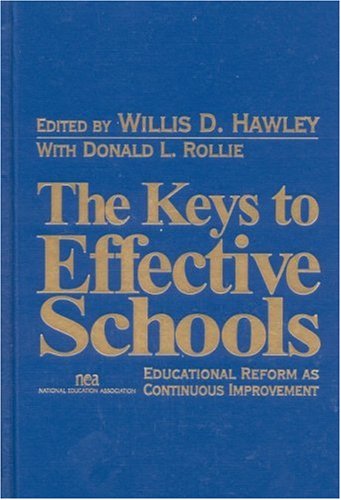

The Keys to Effective Schools Willis D. Hawley.
Detalles de publicación: Thousand Oaks, CA Corwin Press 2001.Descripción: xix, 128 p. 23 cmISBN:- 0761978399
- 371.200 H396k 2001
- LB2822.82 .K493 2002
| Imagen de cubierta | Tipo de ítem | Biblioteca actual | Biblioteca de origen | Colección | Ubicación en estantería | Signatura topográfica | Materiales especificados | Info Vol | URL | Copia número | Estado | Notas | Fecha de vencimiento | Código de barras | Reserva de ítems | Prioridad de la cola de reserva de ejemplar | Reservas para cursos | |
|---|---|---|---|---|---|---|---|---|---|---|---|---|---|---|---|---|---|---|
| Libro | Biblioteca de Mayagüez Colección General mb | LB2822.82 .K493 2002 (Navegar estantería(Abre debajo)) | Disponible | 50000002180817 |
Descripciones mejoradas de Syndetics:
The top names in school reform offer steps to solve organizational problems that limit student achievement!
The National Education Association′s KEYS Initiative (Keys to Excellence for Your Schools) is a powerful program that can transform the teaching profession and schools. The Keys to Effective Schools brings together some of the best thinkers in education to show educators at all levels, policymakers, and parents how to apply the lessons learned from KEYS research: how to change a school′s structure and organization to improve the quality of teaching and learning.
Contributors include:
Michael Fullan, Educational Reform as Continuous Improvement P. Karen Murphy, Patricia A. Alexander, The Learner-Centered Principles Fred M. Newmann, Achieving High-Level Outcomes for All Students Judith Warren Little, Professional Communication and Collaboration Eva L. Baker, Teacher Use of Formal Assessment in the Classroom Lorna M. Earl, Assessment As Learning Ann Lieberman, Lynne Miller, Transforming Professional Development Linda Valli, Willis D. Hawley, Designing and Implementing School-Based Professional Development Kenneth Leithwood, Organizational Conditions to Support Teaching and Learning Richard F. Elmore, Local School Districts and Instructional ImprovementThis effective book is an integral resource that will take you to the next level of educational excellence.
Includes bibliographical references (p. 120-121) and index.
Tabla de contenidos provista por Syndetics
- Preface
- About the Editors
- About the Contributors
- 1 Educational Reform as Continuous Improvement
- 2 The Learner-Centered Principles: Their Value for Teachers and Teaching
- 3 Achieving High-Level Outcomes for All Students: The Meaning of Staff-Shared Understanding and Commitment
- 4 Professional Communication and Collaboration
- 5 Teacher Use of Formal Assessment in the Classroom
- 6 Assessment as Learning
- 7 Transforming Professional Development: Understanding and Organizing Learning Communities
- 8 Designing and Implementing School-Based Professional Development
- 9 Organizational Conditions to Support Teaching and Learning
- 10 Local School Districts and Instructional Improvement
- Index
Reseñas proporcionadas por Syndetics
CHOICE Review
In a chapter-ending footnote contributor Newmann notes, "... an effective school is one with a record of high student achievement on either conventional tests or more authentic assessments." Even alternative educational assessment champions (readers may wish to consult Harold Berlak et. al. Toward a New Science of Educational Testing and Measurement; 1992) allow that the coin of the realm in school effectiveness is students' test scores. Therefore, one can be forgiven for assuming from the title, The Keys to Effective Schools that they are intent on documenting from the research how schools of high-performing students differ from others. Actually, the book was commissioned to support a National Educational Association initiative. Having identified what association leaders believe to be the most important characteristics of school quality, the editor has collected chapters supporting those positions. Some (notably Chapter 5) are entirely without documentation. Others (the Murphy and Alexander chapter, for instance) are very well documented. If the publication is viewed as a series of position papers rather than an objective compilation of research, it has a place in academic collections. ^BSumming Up: Recommended. Upper-division undergraduates and above. D. E. Tanner California State University, FresnoNotas de autor provistas por Syndetics
Willis D. Hawley is Professor of Education and Public Affairs at the University of Maryland, where he served as Dean of the College of Education from 1993 to 1998. He taught at Yale, Duke, and Vanderbilt universities before going to Maryland. He has published numerous books, articles, and book chapters dealing with teacher education, school reform, urban politics, political learning, organizational change, school desegregation, and educational policy. His most recent research deals with the professional development of teachers, the education of teachers (in the United States and Japan), school restructuring and effectiveness, family influences on the academic performance of Southeast Asian children in the United States, and race relations. He has served as consultant to numerous public agencies, including the Executive Office of the President, the U.S. Senate, the U.S. Department of Education, and the World Bank, as well as many state and local governments, foundations, and professional associations. He also organized and directs the Common Destiny Alliance, a coalition of national organizations and scholars interested in using research to improve intergroup relations.
Donald L. Rollie is Manager of Quality Schools, Research and Policy, for the National Education Association (NEA). He is also the President and Chief Executive Officer of Donald L. Rollie and Associates, a consulting group that combines the expertise of veteran educators and organizational development specialists. Rollie himself is both. His current work with the Teaching and Learning unit of the NEA is an important part of the NEA journey on the path of change, returning to becoming a voice for education quality in America.