Imagen de Amazon.com

Portada de Syndetics
Imagen de OpenLibrary
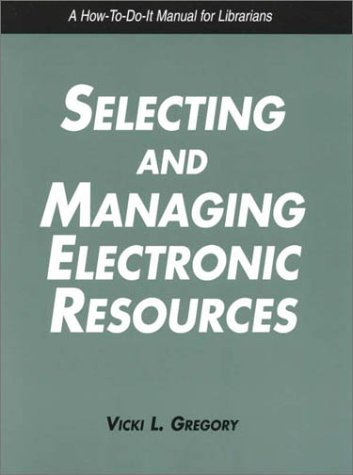
Selecting and managing electronic resources a how-to-do-it manual Vicki L. Gregory.
Series How-to-do-it manuals for librarians ; 101Detalles de publicación: New York Neal Schuman Publishers c2000.Descripción: v, 109 p. ill. 28 cmISBN:- 1555703828 (alk. paper)
- 025.284 G823s 21
- Z692.D38 G74 2000
| Imagen de cubierta | Tipo de ítem | Biblioteca actual | Biblioteca de origen | Colección | Ubicación en estantería | Signatura topográfica | Materiales especificados | Info Vol | URL | Copia número | Estado | Notas | Fecha de vencimiento | Código de barras | Reserva de ítems | Prioridad de la cola de reserva de ejemplar | Reservas para cursos | |
|---|---|---|---|---|---|---|---|---|---|---|---|---|---|---|---|---|---|---|
| Libro | Biblioteca de Mayagüez Colección General mb | Z692 .D38 G74 2000 (Navegar estantería(Abre debajo)) | Disponible | 50000002179546 | ||||||||||||||
| Libro | Biblioteca Encarnación Valdés Colección General bev | 025.284 G823s (Navegar estantería(Abre debajo)) | Disponible | 80000002103268 |
Total de reservas: 0
Descripciones mejoradas de Syndetics:
Computer-based technologies are causing both evolutionary and revolutionary changes in libraries, heavily affecting the field of collection development. Electronic publishing alone has had profound implications for all areas of collection development in all types of libraries. This practical manual addresses both traditional and modern aspects of collection development as they relate to all aspects of electronic materials. It covers collection development policies, criteria, and process; budgeting and acquisitions; organization and maintenance of electronic resources; evaluation and assessment; copyright, licensing, and intellectual property issues; and preservation.
Includes bibliographical references (p. 99-104) and index.
Tabla de contenidos provista por Syndetics
- List of Figures(p. v)
- 1 Introduction(p. 1)
- 2 Collection Development Policies(p. 7)
- Traditional Policies(p. 8)
- Separate Policies(p. 11)
- Integrated Policies(p. 12)
- Internet Resources(p. 14)
- Acceptable Use Policies(p. 15)
- Revision of Collection Development Policies(p. 15)
- Conclusion(p. 17)
- 3 Selection: Criteria and the Selection Process(p. 19)
- Selection Criteria(p. 21)
- Selection Differences for Internet Resources(p. 23)
- Selection Tools(p. 25)
- Selection Teams(p. 29)
- Conclusion(p. 34)
- 4 Budgeting and Acquisitions(p. 35)
- The Acquisitions Process(p. 35)
- Pricing Models for Electronic Resources(p. 36)
- Budgeting for Electronic Resources(p. 37)
- Consortium Purchases(p. 38)
- Information at the Article Level(p. 39)
- Web Tools(p. 42)
- Aggregator Services(p. 44)
- Conclusion(p. 45)
- 5 Organization and Access to Electronic Resources(p. 47)
- Levels of Organization of Electronic and Web Resources(p. 48)
- Authentication of Users(p. 51)
- Conclusion(p. 55)
- 6 Evaluation and Assessment(p. 57)
- Assessment Data(p. 57)
- Assessment Activities(p. 58)
- Standard Areas of Data Collection(p. 58)
- Technological Additions to Standard Data Sources(p. 58)
- Qualitative Techniques(p. 59)
- Tips on Managing an Evaluation Project(p. 62)
- Conclusion(p. 63)
- 7 Copyright and Licensing Issues(p. 67)
- Purchase versus Licensed Right of Use(p. 69)
- Aspects of Licensing Resources(p. 71)
- Considerations in License Negotiation(p. 72)
- Choosing a License Negotiator(p. 74)
- Licensing Considerations(p. 75)
- Best Practices(p. 79)
- Managing Licenses(p. 80)
- An Important Emerging Collection Development Concern in the Licensing of Electronic Resources: UCITA(p. 81)
- Conclusion(p. 85)
- 8 Preservation Issues(p. 87)
- Is Digitized Information Preserved (or Preservable) Information?(p. 88)
- Who Should Archive an Electronic Information Resource?(p. 90)
- Who Should Be Concerned with Preservation Issues?(p. 91)
- Conclusion(p. 92)
- 9 Conclusion(p. 93)
- The Selection Process(p. 93)
- Integration of Electronic Resources(p. 94)
- Handling the Stress of Change(p. 96)
- Selected Bibliography(p. 99)
- Index(p. 105)
- About the Author(p. 109)