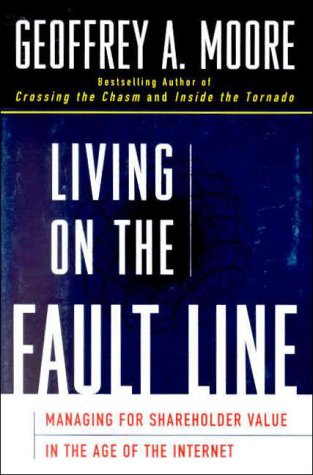

Living on the fault line managing for shareholder value in the age of the internet Geoffrey A. Moore.
Detalles de publicación: New York HarperBusiness c2000.Edición: 1st edDescripción: xx, 288 p. ill. 25 cmISBN:- 0887308880 (acid-free paper)
- 658.15/5 M8211l 21
- HD31 .M625 2000
| Imagen de cubierta | Tipo de ítem | Biblioteca actual | Biblioteca de origen | Colección | Ubicación en estantería | Signatura topográfica | Materiales especificados | Info Vol | URL | Copia número | Estado | Notas | Fecha de vencimiento | Código de barras | Reserva de ítems | Prioridad de la cola de reserva de ejemplar | Reservas para cursos | |
|---|---|---|---|---|---|---|---|---|---|---|---|---|---|---|---|---|---|---|
| Libro | Biblioteca Encarnación Valdés Colección General bev | 658.155 M8211l (Navegar estantería(Abre debajo)) | Disponible | 80000002111709 |
Descripciones mejoradas de Syndetics:
The fault line--that dangerous, unstable seam in the economy where the Internet and other powerful innovations meet and create market-shattering tremors. Every company lives on it; no manager can control it. Everyone must learn to deal with it.
Now, Geoffrey Moore, author of Crossing the Chasm and Inside the Tornado, two bestselling works that helped guide the high-tech revolution, explores the new management paradigms that will guide businesses in the twenty-first century, showing them how to survive and thrive on the fault line.
In this long-awaited new book, Moore turns his attention to the most important question for businesses: How can companies that rose to prominence prior to the age of the Internet manage for shareholder value now that the Internet is upon us?
The old management truths are dead. Business models that worked admirably until the last decade of the twentieth century must be replaced. The dotcoms are invading every sector of commerce, overturning established relationships, reengineering markets, attacking long-established price points, and disintermediating longstanding institutions.
What should management do when it is under direct assault from companies no one ever heard of even a few years ago?
In a book that will reset the management agenda in the age of the Internet, Moore shows why sensitivity to stock price is the single most important lever for managing in the future, both as a leading indicator of shifts in competitive advantage and as an employee motivator for making necessary changes in organizations heretofore impervious to change. He prescribes a new agenda for management teams that includes
New strategies for achieving and sustaining competitive advantage New metrics to keep management teams on course with these strategies A specific blueprint for how the blue-chip companies can meet the challenge of the dotcoms Models of organizational change for each stage of market development The crucial role of declaring a culture inenabling swift response to global changeToday practically every company, whether inside the high-tech sector or not, is living on the fault line. By synthesizing his groundbreaking earlier work on the dynamics of technology-based markets with a new focus on managing publicly held corporations for shareholder value, Geoffrey Moore provides a highly prescriptive guide for any company struggling to manage the disruptive forces of the new economy.
In Crossing the Chasm and Inside the Tornado, Moore created a new language for navigating the technology adoption life cycle. In Living on the Fault Line, he once again offers a brilliant set of navigational tools to help meet today's defining management challenge-managing for shareholder value in the age of the Internet.
Includes index.
Tabla de contenidos provista por Syndetics
- Acknowledgements
- Introduction
- The Age Of The Internet
- Shareholder Value
- Competitive Advantage
- Living On The Fault Line
- Triage
- Building To Last
- Epilogue
- Index