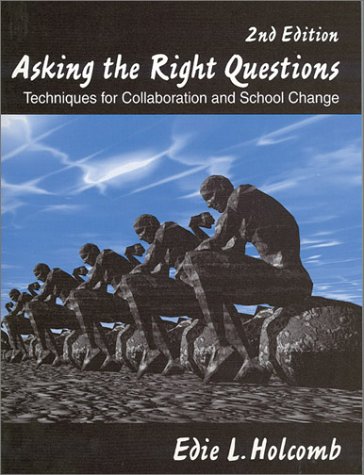

Asking the Right Questions Techniques for Collaboration and School Change Edie L. Holcomb.
Detalles de publicación: Thousand Oaks, CA Corwin 2001.Edición: 2nd edDescripción: xiv, 159 p. ill. 28 cmISBN:- 0761976752
- 371.395 H725a2 2001
| Imagen de cubierta | Tipo de ítem | Biblioteca actual | Biblioteca de origen | Colección | Ubicación en estantería | Signatura topográfica | Materiales especificados | Info Vol | URL | Copia número | Estado | Notas | Fecha de vencimiento | Código de barras | Reserva de ítems | Prioridad de la cola de reserva de ejemplar | Reservas para cursos | |
|---|---|---|---|---|---|---|---|---|---|---|---|---|---|---|---|---|---|---|
| Libro | Biblioteca de Mayagüez Colección General mb | LB 1032 .H64 2001 (Navegar estantería(Abre debajo)) | Disponible | 50000002175478 |
Descripciones mejoradas de Syndetics:
"What Edie Holcomb teaches actually works." Deb Larson and Tom Mooney, K-12 Improvement Committee, School District of McFarland McFarland, Wisconsin The essential aspects of school change in simple, straightforward language ... updated to meet today′s demands! In this second edition, Edie Holcomb builds upon the framework she presented in the first edition and offers school leaders a greater understanding of the essential aspects of school change. Simple and straightforward, Holcomb provides a common language to bridge a variety of models and facilitate collaborative work across schools, districts, and state agencies. The first edition of Asking the Right Questions provided a framework for large- and small-scale reform by offering a set of five guiding questions: * Where are we now? * Where do we want to go * How will we get there? * How will we know we are getting there? * How can we sustain the focus and momentum? The same plain language and common-sense insights will be found in this second edition ... along with a number of valuable new contributions, including: * Current issues related to academic standards and accountability * Recommendations for resolving ambiguous site-based management * How districts and schools can interact to improve student performance * More real-world stories, examples, and illustrations about collaborative work in elementary, middle, and high schools It′s an essential new resource about collaborative work in elementary, middle and high schools that will inspire readers with confidence to share leadership for school change.
Includes bibliographical references (p. 149-152) and index.
Tabla de contenidos provista por Syndetics
- Foreword
- Asking the Right Questions
- Answering the 'Where are we Now?' Question
- Answering the 'Where do we Want to Go?' Question
- Answering the 'How Will we Get There?' Question
- Answering the 'How Will we Know we are (Getting) There?' Question
- Answering the 'How Will we Sustain the Focus and Momentum?' Question
- Bonus Questions
- Using this Book
Notas de autor provistas por Syndetics
Edie L. Holcombis executive director of curriculum and instructional services for Kenosha Unified School District No. 1 in Kenosha, Wisconsin. She has experienced the challenges of improving student achievement from many perspectives:
From classroom teacher to university professor From gifted education coordinator to mainstream teacher of children with multiple disabilities From school- and district-level administration to national and international consulting From small rural districts to the challenges of urban educationShe is highly regarded for her ability to link research and practice on issues related to instructional leadership and school and district change--including standards-based curriculum, instruction, assessment, supervision, and accountability. She has taught at all grade levels, served as a building principal and central office administrator, and assisted districts as an external facilitator for accreditation and implementation of school reform designs. As associate director of the National Center for Effective Schools, she developed a training program for site-based teams and provided technical support for implementation of school improvement efforts throughout the United States and in Canada, Guam, St. Lucia, and Hong Kong. She developed a comprehensive standards-based learning system for the staff and 47,000 students of the Seattle, Washington, city district and has supervised K-12 clusters of schools and evaluated principals.
Her work received the Excellence in Staff Development Award from the Iowa Association of Supervision and Curriculum Development in 1988. In 1990, her study of the needs of beginning principals was recognized by the American Association of School Administrators with the Paul F. Salmon Award for Outstanding Education Leadership Research.
She served as an elected member-at-large on the Leadership Council for ASCD International, played an active role in Washington State's School Improvement Assistance Program, and contributed to development of the new School System Improvement Resource Guide. Holcomb is the author of four previous books and numerous articles and reviews.