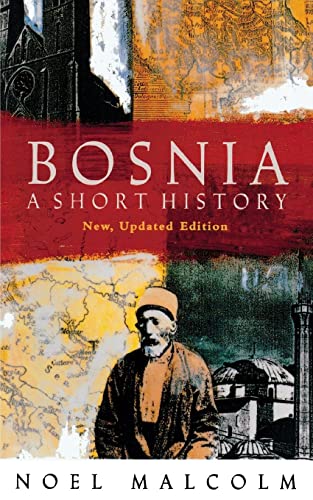

Bosnia a short history Noel Malcolm.
Detalles de publicación: New York New York University Press 1994.Descripción: xxiv, 360 p. maps 21 cmISBN:- 0814755615
- 21 949.742 M243b
| Imagen de cubierta | Tipo de ítem | Biblioteca actual | Biblioteca de origen | Colección | Ubicación en estantería | Signatura topográfica | Materiales especificados | Info Vol | URL | Copia número | Estado | Notas | Fecha de vencimiento | Código de barras | Reserva de ítems | Prioridad de la cola de reserva de ejemplar | Reservas para cursos | |
|---|---|---|---|---|---|---|---|---|---|---|---|---|---|---|---|---|---|---|
| Libro | Biblioteca Encarnación Valdés Colección General bev | 949.742 M243b (Navegar estantería(Abre debajo)) | Disponible | 80000002086786 |
Descripciones mejoradas de Syndetics:
The most comprehensive narrative history of Bosnia available in English
This updated edition of Noel Malcolm's highly-acclaimed Bosnia: A Short History provides the reader with the most comprehensive narrative history of Bosnia in the English language. Malcolm examines the different religious and ethnic inhabitants of Bosnia, a land of vast cultural upheaval where the empires of Rome, Charlemagne, the Ottomans, and the Austro-Hungarians overlapped. Clarifying the various myths that have clouded the modern understanding of Bosnia's past, Malcolm brings to light the true causes of the country's destruction. This expanded edition of Bosnia includes a new epilogue by the author examining the failed Vance-Owen peace plan, the tenuous resolution of the Dayton Accords, and the efforts of the United Nations to keep the uneasy peace.
What went wrong in the country where Christians and Muslims mingled and tolerated each other for over five centuries? It was a land with a vibrant political and cultural history, unlike any other in Europe, where great powers and religions-the empires of Rome, Charlemagne, the Ottomans; the faiths of Roman Catholicism, Eastern Orthodoxy, Judaism, and Islam overlapped and combined. In this first English-language history of Bosnia, Noel Malcolm provides a narrative chronicle of the country from its beginnings to its tragic end. Clarifying the various myths that have clouded the modern understanding of Bosnia's past, Malcolm brings to light the true causes of the country's destruction: the political strategy of the Serbian leadership, the conflict between the city and the countryside, the fatal inaction and miscalculations of Western politicians.
Putting the Bosnia war into perspective, this volume celebrates the complex history of a country whose past, as well as its future, has been all but erased. At last, here is the guide for the general reader seeking a comprehensive and accessible account of the war in the former Yugoslavia.
Includes bibliographical references and index.
Reseñas proporcionadas por Syndetics
Library Journal Review
The collapse of former Yugoslavia and the ensuing war have shifted scholarly attention to its successor states. Malcolm's success consists in demonstrating why Bosnia-Hercegovina's distinctive history demands such an approach. The mix of elements include the region's geographic "remoteness" from other centers of power, its unusual Slav and non-Slav blend of population, and its status as an object of neighboring rivalry. The author cogently dispels the myths of forcible conversion to Islam by the Ottomans as well as the notion of a "fundamentalist threat" from an Islamic Bosnia. Although Malcolm is least comfortable in dealing with the segment of Bosnia's history as a part of Yugoslavia, he makes the case that its subsequent destruction was an object of "rational strategy" rather than religious hatred. Recommended for public and academic libraries.-Zachary T. Irwin, Pennsylvania State Univ.-Erie (c) Copyright 2010. Library Journals LLC, a wholly owned subsidiary of Media Source, Inc. No redistribution permitted.Publishers Weekly Review
To explain the origins of the current conflict in Bosnia, Malcolm reaches back to Turkish occupation, Austro-Hungarian rule, both world wars and the era of Stalinist oppression under Toti. He contends that ``ethnic cleansing'' is not a by-product of the current war but a central element in the Serbian goal of creating homogeneous Serb enclaves that eventually will join together in a Greater Serbia. Malcolm condemns Western interference, singling out politicians and diplomats who attempt to suppress the war's symptoms instead of treating its causes. He argues persuasively that the United Nations-imposed arms embargo against Bosnia opened the way to that nation's destruction, and that the vaunted Vance-Owen peace plan was only slightly less disastrous. It led to a genuine Bosnian civil war, ruining the only effective barrier against the Serbs, the Croat-Muslim alliance. Political columnist for London's Daily Spectator, Malcolm has covered the Balkans for 15 years. (Sept.) (c) Copyright PWxyz, LLC. All rights reservedCHOICE Review
Malcolm's remarkably informed and balanced survey of Bosnian history should be required reading for diplomats and UN leaders. It describes the development of a unique society that straddled the historic divide between Catholic and Orthodox Christianity, and Islam. Malcolm seeks to dispel old and recent myths about Bosnia and the Bosnians, the subjects of which range from the nature of the Bosnian Church and the reasons for conversion of large parts of the population to Islam under the Ottoman Turks, to contemporary claims that Bosnia is an artificial political unit, and that the war in Bosnia-Herzegovina is a civil war sparked by ancient ethnic tensions. The author, a respected British journalist, bases his work on a wealth of published materials. The first half of the book, which covers the period before 1815, is thematic in nature and rich in social and cultural history. The second part focuses on the impact of Ottoman decline, the rise of Serbian and Croatian nationalism, the search for a modern identity, Bosnia's experience within Yugoslavia, and the destruction of Bosnia. Maps. Recommended for college, university, research, and public libraries. E. M. Despalatovic; Connecticut CollegeNotas de autor provistas por Syndetics
Noel Malcolm is a British columnist, writer and editor who was born in 1956. He was educated at Cambridge University and was a Fellow of Gonville and Caius College, Cambridge from 1981 to 1988.Malcolm left teaching to become the Foreign Editor of the Spectator and a political columnist for London's Daily Telegraph.
Malcolm has written Bosnia: A Short Story, which puts the Bosnia-Hercegovina conflict into historical context and Kosovo: A Short Story, which outlines its history from medieval Serb state into modern times.
(Bowker Author Biography)