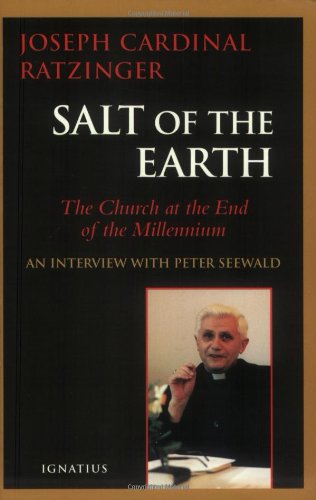

Salt of the earth Christianity and the Catholic Church at the end of the millennium : an interview with Peter Seewald Joseph Cardinal Ratzinger ; translated by Adrian Walker.
Detalles de publicación: San Francisco,Calif. Ignatius Press 1997.Descripción: 283 p. 20 cmISBN:- 0-89870-640-8
- 21 282 R238s I
| Imagen de cubierta | Tipo de ítem | Biblioteca actual | Biblioteca de origen | Colección | Ubicación en estantería | Signatura topográfica | Materiales especificados | Info Vol | URL | Copia número | Estado | Notas | Fecha de vencimiento | Código de barras | Reserva de ítems | Prioridad de la cola de reserva de ejemplar | Reservas para cursos | |
|---|---|---|---|---|---|---|---|---|---|---|---|---|---|---|---|---|---|---|
| Libro | Biblioteca Encarnación Valdés Colección General bev | 282 R238s I (Navegar estantería(Abre debajo)) | Disponible | 80000002104803 |
Descripciones mejoradas de Syndetics:
Cardinal Joseph Ratzinger, well-known Vatican prelate and head of the Congregation on the Doctrine of the Faith, gives a full-length interview to secular journalist Peter Seewald, on a host of controversial and difficult issues facing Catholicism and Christianity at the end of the millennium. Similar to his best-selling book interview in 1985, The Ratzinger Report , he responds with candor and insight, giving answers that are often surprising and always thought-provoking on a series of wide-ranging topics regarding the present and future state of Christianity.
Ratzinger begins by discussing his own life, including his family life, being a theology professor and writer, becoming a Bishop, Cardinal and the Pope's top authority on doctrine. He then discusses the problems of the Catholic Church today and talks about the challenges and hopes of the future of Church and the world at the beginning of the Third Millennium.
Translation of: Salz der erde.
Reseñas proporcionadas por Syndetics
Publishers Weekly Review
In the same style as the 1985 bestseller The Ratzinger Report, this is a question-and-answer interview with the much-loved and much-maligned head of the Vatican's Congregation on the Doctrine of the Faith, a man who, after the pope, is the most high-profile Vatican official. Peter Seewald, a secular German journalist, pops the questions, and Ratzinger replies. This book is divided into three sets of questions: on Ratzinger's personal history; on the state of the Catholic church today; and, on the future of the church. Cardinal Ratzinger comes across in ways unlikely to be thoroughly pleasing either to the right or to the left. For example, his observations on the contemporary Roman Catholic liturgy will not be easily dismissed by Catholic liberals, and his pastoral sensitivity to the use of contraceptives will startle hardline conservative Catholics. Although Seewald seems to want Ratzinger to embrace a more reactionary Catholic conservatism, Ratzinger is unwilling to be caught doing so, and the book may both surprise and humble its readers, regardless of their ideological leanings. (Oct.) (c) Copyright PWxyz, LLC. All rights reservedBooklist Review
"The Pope! How many divisions does he have?" Stalin once sneered. The pope hasn't commanded troops for centuries, yet the church's potency remains great. McClory, Messori, and Cardinal Ratzinger and Seewald take up different aspects of it. Power and the Papacy is the story of a doctrine that gestated for centuries until formulated at its strictest by a thirteenth-century Franciscan. The friar wanted the pope's pronouncements on matters of faith or morals proclaimed infallible--that is, inerrant, irrevocable, and unalterable. After further centuries of controversy, the First Vatican Council in 1870 affirmed a version of papal infallibility; one of the most violent thunderstorms in Rome's history raged while the council actually voted on it. Thereafter, the doctrine was seldom used, and never controversially, until John Paul II invoked it to undergird barring women from the priesthood. Meanwhile, the idea of the infallibility of council pronouncements, older than that of papal infallibility, was refined by many theologians, and others broached the concept that infallibility can be ascertained only when the faithful verify a matter of doctrine by obeying it. McClory relates this long history, one of ideas more than of men, with maximal clarity. Superb popular intellectual history. Messori, John Paul II's collaborator on the international best-seller Crossing the Threshold of Hope, takes up the cause of a controversial aggregation of papal loyalists. He spends the first 40 pages fending off accusations that Opus Dei is a wealthy cabal or brainwashing cult. It is instead a worldwide institution primarily of laypeople (its full-time priests constitute 2 percent of membership). It aims to help "all baptized persons" live out "normal Catholicism" in their everyday lives; members live at home yet follow "an intense sacramental life" of prayer, attendance at mass, religious reading, confession, spiritual retreat, etc., while pursuing secular careers and commitments. Messori quotes the writings of Opus Dei's founder, Monsignor Josemaria Escriva(1902^-75) of Spain, and other members extensively, so his presentation reflects the official line, so to speak. That line radiates both egalitarianism in its insistence on the openness of religious life to all believers and deep conservatism in its staunch fealty to the pope, as if he were . . . infallible. As prefect of the Congregation for the Doctrine of the Faith, Cardinal Ratzinger is considered the second most influential man in the Vatican. From his desk come the statements on abortion, homosexuality, and the ordination of women, with its citation of infallibility, that have incensed so many. In a wide-ranging interview with German journalist Seewald, Ratzinger is erudite, well informed, thoughtful, and thoroughly compassionate. The last quality may confound critics of this papacy's supposedly repressive morality, as will Ratzinger's statement that although dogma "cannot subsequently become false [,] . . . new perspectives can emerge that put it in a new light." Dogma is hardly the predominant topic of conversation; rather, Seewald leads the cardinal through questions on his own life, his relationship with the pope, the state of the church today throughout the world, and the future of Christianity at the end of the second millennium. One thing Ratzinger makes perfectly clear: the power of the faith is ultimately and eternally love. --Ray Olson.Notas de autor provistas por Syndetics
Pope Emeritus Benedict XVI (Joseph Ratzinger) is widely recognized as one of the most brilliant theologians and spiritual leaders of our age. As Pope he authored the best-selling Jesus of Nazareth ; and prior to his pontificate, he wrote many influential books that continue to remain important for the contemporary Church, such as Introduction to Christianity and The Spirit of the Liturgy .
Joseph Ratzinger (Pope Emeritus Benedict XVI) is recognized as one of the most brilliant theologians and spiritual leaders of our age. As pope he authored the best-selling Jesus of Nazareth . Prior to his pontificate, he wrote many influential books important for the contemporary Church, such as Introduction to Christianity and The Spirit of the Liturgy.