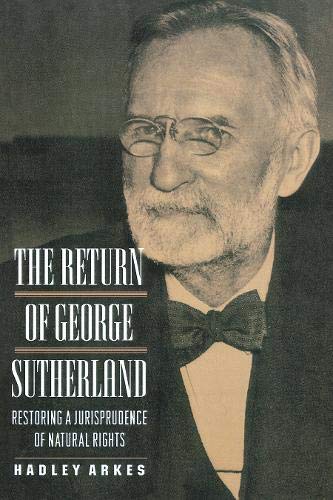

The return of George Sutherland restoring a jurisprudence of natural rights Hadley Arkes.
Detalles de publicación: Princeton, N.J. Princeton University Press 1994.Descripción: xiv, 297 p. 24 cmISBN:- 0-691-03472-9 (acid-free paper)
- 21 347.7314 A7218r
| Imagen de cubierta | Tipo de ítem | Biblioteca actual | Biblioteca de origen | Colección | Ubicación en estantería | Signatura topográfica | Materiales especificados | Info Vol | URL | Copia número | Estado | Notas | Fecha de vencimiento | Código de barras | Reserva de ítems | Prioridad de la cola de reserva de ejemplar | Reservas para cursos | |
|---|---|---|---|---|---|---|---|---|---|---|---|---|---|---|---|---|---|---|
| Libro | Biblioteca Encarnación Valdés Colección General bev | 347.7314 A7218r (Navegar estantería(Abre debajo)) | Disponible | 80000002104597 |
Descripciones mejoradas de Syndetics:
In this book, Hadley Arkes seeks to restore, for a new generation, the jurisprudence of the late Justice of the Supreme Court George Sutherland--a jurisprudence anchored in the understanding of natural rights. The doctrine of natural rights has become controversial in our own time, while Sutherland has been widely maligned and screened from our historical memory. He is remembered today as one of the "four horsemen" who resisted Roosevelt and the New Deal; but we have forgotten his leadership in the cause of voting rights for women. Both liberal and conservative jurists now deride Sutherland, yet both groups continue to draw upon his writings. Liberals look to Sutherland for a jurisprudence that protects "privacy" against the rule of majorities, as in matters concerning abortion or gay rights. Conservatives will appeal to his defense of freedom in the economy.
However, both liberals and conservatives deny the premises of natural rights that provided the ground, and coherence, of Sutherland's teaching. Arkes contends that Sutherland can supply what is missing in both conservative and liberal jurisprudence. He argues that if a new generation can look again, with unclouded eyes, at the writings of Sutherland, both liberals and conservatives can be led back to the moral ground of their jurisprudence. This compelling intellectual biography introduces readers to an urbane man, and a steely judge, who has been made a stranger to them.
Includes bibliographical references and index.