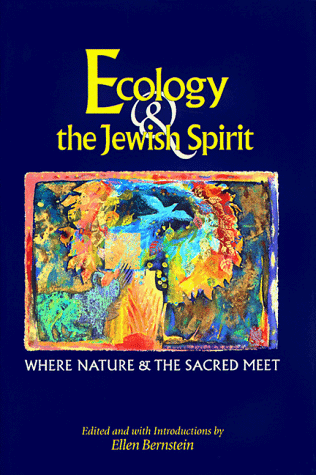
Imagen de portada de Amazon
Imagen de Amazon.com
Imagen de cubierta Syndetics
Portada de Syndetics
Imagen de OpenLibrary

Ecology & the Jewish spirit : where nature and the sacred meet / edited and with introductions by Ellen Bernstein.

Colaborador(es): Detalles de publicación: Woodstock, VT. : Jewish Lights Publishing , 1998.Edición: 1st editionDescripción: 277 p. 24 cmTipo de contenido:
Tipo de medio:
Tipo de soporte:
ISBN:
  • 1879045885 (hc) :
Otro título:
  • Ecology and the Jewish spirit
Tema(s):
Valoración
    Valoración media: 0.0 (0 votos)
Existencias
Imagen de cubierta Tipo de ítem Biblioteca actual Biblioteca de origen Colección Ubicación en estantería Signatura topográfica Materiales especificados Info Vol URL Copia número Estado Notas Fecha de vencimiento Código de barras Reserva de ítems Prioridad de la cola de reserva de ejemplar Reservas para cursos
Libro Biblioteca de Mayagüez Colección General mb BM 538 .H85 E36 1998 (Navegar estantería(Abre debajo)) Disponible 50000002092152
Total de reservas: 0

Descripciones mejoradas de Syndetics:

What is nature's place in our spiritual lives?

In today's modern culture, we've become separated from the sacredness of the natural world. This book offers a different, eye- and soul-opening way of viewing our religion: A perspective grounded in nature, and rich in insights for seekers of all faiths.

Respect for the holiness of Creation, our duty to protect the natural world, reverence for the land ... a focus on nature is part of the fabric of Jewish thought. Here, innovative contributors bring us a richer understanding of the long-neglected themes of nature that are woven through the biblical creation story, ancient texts, traditional law, the holiday cycles, prayer, mitzvot (good deeds) and community.

Ecology & the Jewish Spirit explores the wisdom that the Jewish tradition has to offer all of us, to help nature become a sacred, spiritual part of our own lives.

Contributors:

Eileen Abrams * Bradley Shavit Artson * Philip J. Bentley * Ellen Bernstein * Ellen Cohn * Eliezer Diamond * Shira Dicker * David Ehrenfeld * Charles Fenyvesi * Shamu Fenyvesi * Dan Fink * Barry Freundel * David Gedzelman * Everett Gendler * Neil Gillman * Neal Joseph Loevinger * Victor Raboy * Debra J. Robbins * Robert Sand * Marc Sirinsky * Jeff Sultar * Marc Swetlitz * Lawrence Troster

Includes bibliographical references (p. 257-268) and indexes.

Reseñas proporcionadas por Syndetics

Publishers Weekly Review

In 1988, Berrin founded Shomrei Adamah (Keepers of the Earth), an organization "dedicated to cultivating the ecological thinking and practices that are integral to Jewish life." According to Berrin, humanity's task of sustaining the environment is central to the Jewish belief that all "Creation is sacred." This splendid anthology shows just how deeply rooted ecological thinking is in ancient Jewish texts and practices. Berrin divides the collected essays into three sections‘"Sacred Place," "Sacred Time" and "Sacred Community"‘that reflect the intersections of nature and the sacred in Jewish thought. In the section on "Sacred Place," for example, Eliezer Diamond, professor of Talmud at the Jewish Theological Seminary of America, examines passages from the Torah and the Talmud that encourage Jews to partake of the earth as a divine gift and thus to limit consumption. In the section on "Sacred Time," Debra Robbins associate rabbi of Temple Emanu-El in Dallas, traces the development of the Jewish calendar in her essay to show the ways that modern Jews can use the calendar to weave ecological practice into everyday life. And, in the same section, a number of essayists explore the ecological significance implicit in the celebration of the Jewish holidays. In the final section, "Sacred Community," Modern Orthodox rabbi Barry Freundel (Kesher Israel, Washington, D.C.) examines the impact of "Judaism's environmental laws" on the formation of modern Jewish community. Drawn together by their belief that Judaism contains within itself the seeds for the practice of an environmental ethic, the variety of voices contained in this collection present lively and compelling reflections on taking care of the earth. (Feb.) (c) Copyright PWxyz, LLC. All rights reserved

CHOICE Review

The essays in this enticing, eclectic collection on a broad range of aspects of the relationship between people and creation are united by the understanding that the world--God's creation--reflects the holiness of the divine being as much as do people, who were created in God's image. How, then, are we to relate to the world? What spiritual gifts can our connection to the environment offer? Divided into the themes Sacred Place, Sacred Time, and Sacred Community, these discussions move beyond the expected concern for the Jewish legal principles that govern how we must treat the environment (though that topic is here, too). More interesting, we find memoirs of people's quests for spiritual fulfillment in natural--and even urban--landscapes, guidelines for contemporary ritual celebrations of nature, and discussions of the special meaning of community for those attuned to the spiritual vibrancy of the world in which we live. The authors' images of Judaism are decidedly modernist, but the essence of their spiritual quest and ecological self-consciousness will be of interest to Jews and non-Jews of all stripes. Recommended especially for general readers; public and academic libraries. A. J. Avery-Peck; College of the Holy Cross
Compartir
logopucpr-y-vive

Contáctanos

¡Queremos saber de ti!

Tel. 787.841.2000 Ext. 1801

bibliotecavaldes@pucpr.edu

⁣Búscanos en las redes

© 2026 Desarrollado por Ignite Online • All Rights Reserved • Powered by Koha.