Descripciones mejoradas de Syndetics:
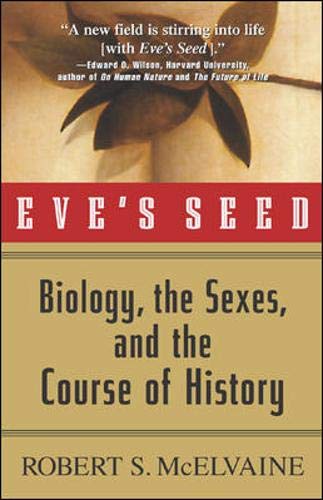
In this provocative reinterpretation of the human experience, noted historian Robert S. McElvaine bridges the gap between evolutionary biology and history to create a new approach which he terms "biohistory." Here for the first time he presents a startlingly fresh thesis: misperceptions about sexual difference and procreative power have, along with misleading sexual metaphors, been the major forces in history.
In a bold departure from the methods of conventional history, Eve's Seed shows how the interplay between our evolutionary heritage and changing environments has shaped the course of history, from the days of hunter-gatherers to the contemporary world.
Includes bibliographical references (p. 397-441) and index.
Reseñas proporcionadas por Syndetics
Publishers Weekly Review
Why has misogyny been so entrenched throughout history? McElvaine, chair of history at Millsaps College, traces it to the invention of agriculture. The cultivation of crops, he says, devalued males' social role as hunters and, at the same time, gave rise to the "conception misconception," which held that males alone possessed reproductive power while females were merely empty ground in which men sowed their seed. McElvaine argues that from this essential error arose hierarchies, dualistic thinking, competition, war, slavery, racism, individualism, consumerism and, of course, sexism. This thesis is provocative but sometimes oversimplified. McElvaine (The Depression and the New Deal, etc.) is forceful in his reading of creation myths and Western religions, as well as in his discussion of male competitiveness through dominating tactics and imagery (including "mounting" a subordinate male symbolically through languageDwhich is what "fuck you" really means). But many of his secondary themes, including the meaning of the American frontier, racism, war and rape, and the compulsive sexual behavior of powerful men like JFK, need further analysis. For a book that purports to be "biohistory," this studyDwhich takes pains to avoid any hint of biological determinism in its argumentDtends to dismiss biological theories a little too easily. But these flaws don't detract significantly from the daring of McElvaine's challenging overview. Written with passion, wit and insight, this accessible book throws down the gauntlet to academics and nonspecialists alike, daring a radical rethinking of the basic "truths" on which cultures have been constructed. Agent, David Hendin. (Nov.) (c) Copyright PWxyz, LLC. All rights reserved
CHOICE Review
Although primarily a historian, the author uses anthropology, biology, and evolutionary psychology to develop the idea that there were two "megarevolutions" that occurred during human history, and that they are responsible for the nature of human sex roles. The first of the megarevolutions came with the advent of agriculture and led to increased subordination of women and an increase in violent conflict, as compared to the preceding preagricultural, "prehistoric" way of life, which was characterized by relative sexual equality. Individualism, mobility, competition, conquest, and accumulation characterize the second megarevolution, associated with a marketplace system. Ironically, although instigated by males, this could lead to the establishment of greater equality between the sexes. McElvaine presents his arguments with clever use of metaphors, such as the planting of seeds being analogous to a male's contribution in reproduction, and the story of Genesis being allegorical for the advent of agriculture. This book is entertaining and thought-provoking; a fun read. It should be of interest to a broad audience of readers who are interested in the evolution of human nature and the sex roles. All collections. S. D. Stout formerly, University of Missouri--Columbia