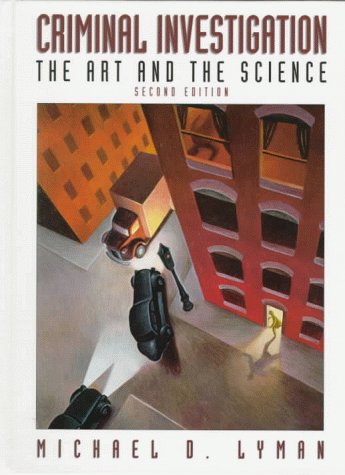
Imagen de portada de Amazon
Imagen de Amazon.com
Imagen de cubierta Syndetics
Portada de Syndetics
Imagen de OpenLibrary

Criminal Investigation the Art and the Science Michael D. Lyman.

Por: Detalles de publicación: New Jersey Prentice Hall c1999.Edición: 2nd editionDescripción: xii, 580 p. illISBN:
  • 0130809802 (casebound) :
Tema(s): Clasificación LoC:
  • HV 8073 .L94 1999
Valoración
    Valoración media: 0.0 (0 votos)
Existencias
Imagen de cubierta Tipo de ítem Biblioteca actual Biblioteca de origen Colección Ubicación en estantería Signatura topográfica Materiales especificados Info Vol URL Copia número Estado Notas Fecha de vencimiento Código de barras Reserva de ítems Prioridad de la cola de reserva de ejemplar Reservas para cursos
Libro Biblioteca de Mayagüez Colección General mb HV 8073 .L94 1999 (Navegar estantería(Abre debajo)) Disponible 50000002170164
Total de reservas: 0

Descripciones mejoradas de Syndetics:

Intended for use in lower-division college courses, this book contains 23 chapters which explain various types of crime and investigation techniques related to them. Keeping the different roles of the uniformed officer and the investigator separate, the author explores: crime scene documentation, se

Includes bibliographical references (p. 561-567) and index.

Tabla de contenidos provista por Syndetics

  • Part 1 Fundamentals of Criminal Investigation
  • Chapter 1 Criminal Investigation: An Overview
  • Chapter 2 The Preliminary Investigation
  • Part 2 The Investigative Process
  • Chapter 3 Field Notes, Documenting, & Reporting the Crime Scene
  • Chapter 4 Report Writing & Documentation of the Investigation
  • Chapter 5 Search & Seizure
  • Chapter 6 Identification of Criminal Suspects
  • Chapter 7 The Criminal Intelligence Function
  • Chapter 8 Undercover & Surveillance Operations
  • Chapter 9 Making an Arrest
  • Chapter 10 Interviews & Interrogations
  • Chapter 11 Development & Management of Informants
  • Part 3 Interpersonal Violence
  • Chapter 12 Wrongful Death
  • Chapter 13 Robbery
  • Chapter 14 Assault & Related Offenses
  • Chapter 15 Sex Offenses
  • Chapter 16 Child Abuse & Neglect
  • Part 4 Property Claims
  • Chapter 17 Burglary
  • Chapter 18 Larceny-Theft
  • Chapter 19 Motor Vehicle Theft
  • Chapter 20 Arson & Bombings
  • Part 5 Vice Crimes & Related Offenses
  • Chapter 21 Drug Offenses
  • Chapter 22 Money Laundering & Computer-Assisted Crime
  • Part 6 Prosecution
  • Chapter 23 Preparation for Court
  • Appendix A
  • Appendix B
  • Glossary
  • Index

Extracto provisto por Syndetics

Criminal investigation represents a timeless and dynamic field of scientific study. This book, now in its fourth edition, was written with the perception that crime detection is a field that relies heavily on the past experiences of investigators as well as recent practical and technological innovations. The investigator's success in crime detection can be influenced by several external variables. For example, increased pressures by public interest groups and courts of law have caused police supervisors to place greater emphasis on case management and officer accountability. In addition, because of increased social problems associated with drug abuse, criminal violence, and related gang activity, the public spotlight has focused more than ever before on methods of crime detection and successful prosecution of lawbreakers. Finally, because of the rising incidence of mass and serial murders in the last decade, more people are realizing the importance of a thoroughly investigated case and the reasons behind the occurrence of such crimes. This book is intended to meet the needs of students and others interested in criminal justice by presenting information in a logical flow, paralleling the steps and considerations observed in an actual criminal investigation. Additionally, it is designed to fulfill an ongoing need for a book that explains clearly and thoughtfully the fundamentals of criminal investigation as practiced by police officers on the job. The book is written with several observations in mind. First, as its title indicates, it is designed to blend scientific theories of crime detection with a practical approach to criminal investigation. It has been drafted on the assumption that sound criminal investigations depend on an understanding of the science of crime detection procedures and the art of anticipating human behavior. There is yet another critical observation made in the book: It recognizes that both the uniformed officer and the criminal investigator play important roles in the field of criminal investigation. The duties of each are outlined throughout the book, recognizing that there is a fundamental need for both to work in tandem throughout many aspects of the criminal investigation process. One underlying theme of the book is that as with all police endeavors, criminal investigation is a law enforcement responsibility that must be conducted within the framework of the U.S. Constitution and the practices of a democratic society. Consequently, court decisions and case studies have been quoted extensively for clarification of issues and general reader information. In summary, I am hopeful that this book will prove to be an engaging textbook that is descriptive of the duties of modern-day crime detection and police professionalism. For more efficient use, this book has been designed to follow closely standard curriculum format. Accordingly, each chapter ends with key terms, discussion questions, and a class project to aid in the instructional process. Michael D. Lyman Excerpted from Criminal Investigation: The Art and the Science by Michael D. Lyman All rights reserved by the original copyright owners. Excerpts are provided for display purposes only and may not be reproduced, reprinted or distributed without the written permission of the publisher.
Compartir
logopucpr-y-vive

Contáctanos

¡Queremos saber de ti!

Tel. 787.841.2000 Ext. 1801

bibliotecavaldes@pucpr.edu

⁣Búscanos en las redes

© 2026 Desarrollado por Ignite Online • All Rights Reserved • Powered by Koha.