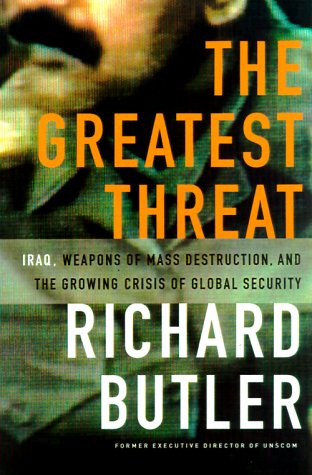
The leader of the United Nations' weapons inspection team issues a scathing indictment of the West's failure to stop Saddam Hussein--and a stern warning about the future. of photos & maps.
Includes bibliographical references and index.
Tabla de contenidos provista por Syndetics
Acknowledgments(p. xi)
Map of Iraq and Surrounding Regions(p. xiv)
Introduction(p. xv)
1. A Glimpse of Terror(p. 1)
2. Peace as a Career(p. 12)
3. To Disarm Saddam(p. 34)
4. The Summons(p. 55)
5. What Honeymoon?(p. 72)
6. The Russians Make Their Move(p. 93)
7. The Resistance Stiffens(p. 111)
8. Kofi Annan Goes to Baghdad(p. 127)
9. Road Map to Nowhere(p. 155)
10. The Five-Dollar Bet(p. 169)
11. The Final Deception(p. 187)
12. Desert Fox and the Twilight of UNSCOM(p. 200)
13. Son of UNSCOM(p. 222)
14. Conclusion: The Principle of the Exception(p. 233)
Notes on Sources(p. 243)
Index(p. 249)
Reseñas proporcionadas por Syndetics
Library Journal Review
Butler, former head of the United Nations Special Commission (UNSCOM), reviews the implosion of the UN weapons-inspection regime imposed on Saddam Hussein's Iraq at the close of the Persian Gulf War. He reminds readers that nuclear, biological, and chemical weapons are now available not only to despots such as Hussein but also to nonstate actors such as terrorist and irredentist groups. Their lethality makes these munitions the most deadly threat to human civilization. Yet diverging interest among the five permanent members of the Security Council, compounded by the feckless diplomacy of the Secretary-General, allowed Iraq to elude inspectors and preserve its covert weapons programs. Consequently, Hussein is poised to resume his quest for dominance of the Gulf region. The author demands that the international community act to halt proliferation. Despite-or perhaps because of-Butler's palpable anger, this is a chilling and persuasive work. Strongly recommended for all libraries.-James R. Holmes, Ph.D. candidate, Fletcher Sch. of Law and Diplomacy, Belmont, MA (c) Copyright 2010. Library Journals LLC, a wholly owned subsidiary of Media Source, Inc. No redistribution permitted.
Publishers Weekly Review
It has been a full year since an international team of disarmament specialists was booted out of Iraq, leaving the world with the chilling question: Who is watching Saddam Hussein? As a former chairman of UNSCOM, the body created by the United Nations to monitor Iraq for weapons violations after the Gulf War, Butler has a unique perspective on the matter. Having intimate knowledge of Iraq's programs to develop nuclear, chemical and biological weapons, Butler engaged in what he calls "an elaborate shell game" with Iraq in 1997 and 1998, as his team investigated Saddam's deadly arsenal. In this revealing and beautifully executed record of those years, Butler recounts the intransigence of Iraqi negotiators and the maddening charades they played to foil international law. As Butler makes clear, the stakes are staggering: a single warhead carrying 140 liters of VXDone of the most toxic substances ever madeDcould kill a million people. UNSCOM found that Iraq made at least 3,900 liters of VX, along with anthrax and other weapons of mass destruction. Butler also details how Russia, France and China flouted disarmament efforts to protect their own political interests, and he argues that UNSCOM's mandate was bargained away in Baghdad by U.N. Secretary-General Kofi Annan. Especially interesting is the author's stern rebuttal of claims by his chief inspector, Scott Ritter, that UNSCOM was a puppet of the Pentagon, funneling intelligence to the U.S. Certain to have a profound impact on international diplomacy, Butler's remarkable story can be ignored only at the world's peril. Maps. (June) (c) Copyright PWxyz, LLC. All rights reserved
CHOICE Review
Almost ten years after the Gulf War, Saddam Hussein survives in power and the leaders who opposed him do not, and the full extent of the Iraqi weapons complex remains unknown. Butler was the Australian diplomat who led UNSCOM, the UN commission assigned to inspect Iraq for weapons violations after the Gulf War. In this memoir he explores his life as a diplomat, the operations of the UN, and its failures in the conflict between UNSCOM and Iraq to discover and move weapons of mass destruction. The sources of failure he identifies are nothing new. He focuses on the unwillingness of great powers to put principle over short-term gain, accuses Secretary-General Annan to be more interested in saving face than in addressing the threat, and acknowledges the lack of effective enforcement mechanisms. He also demonstrates how the sanctions regime can harm the Iraqi people without effecting a change in policy. Although it is not the detailed history of UNSCOM that a specialist might prefer, this book provides insights into the day-to-day frustrations of serving in a thankless diplomatic post. Recommended for general readers and lower-division undergraduates. D. McIntosh; Slippery Rock University of Pennsylvania
Booklist Review
"The greatest threat to life on Earth is weapons of mass destruction--nuclear, chemical, biological." These words open Australian diplomat Butler's introduction, and this conviction centers his description of his career and his only partially successful effort, as executive director (1997^-98) of UNSCOM--a commission established after the Gulf War by the United Nations Security Council--to destroy Iraq's weapons of mass destruction. Rather blunt for a diplomat, Butler is brutally candid here, whether he's discussing the duplicity and cruelty of the Iraqi leadership or the UN politics that eventually pushed UNSCOM inspectors out of Iraq. Russia, China, and France come in for particular criticism for backing Iraq's lies to serve their own national aspirations. And that's where Butler's opening sentence becomes crucial. If weapons of mass destruction are in fact "the greatest threat," then the world's people have a right to demand that the permanent Security Council members reduce their own arsenals and enforce the rules when states such as Iraq and North Korea attempt to develop such weapons. --Mary Carroll
Notas de autor provistas por Syndetics
Ambassador Richard Butler was appointed to lead UNSCOM on July 1, 1997. From 1992-1997, Butler was the Australian Ambassador and permanent representative to the United Nations. In 1994 Butler was elected President of the Economic and Social Council of the United Nations, in 1995 he chaired the Canberra Commission on the Elimination of Nuclear Weapons, and in 1996 Butler led the United Nations to adopt a comprehensive nuclear test ban treaty. Butler is now Diplomat in Residence at the Council on Foreign Relations.
The greatest threat
APA
Butler R., . (2000). The greatest threat: Iraq, weapons of mass destruction, and the crisis of global security. New York: Public Affair.
Chicago
Butler Richard, . 2000. The greatest threat: Iraq, weapons of mass destruction, and the crisis of global security. New York: Public Affair.
Harvard
Butler R., . (2000). The greatest threat: Iraq, weapons of mass destruction, and the crisis of global security. New York: Public Affair.
MLA
Butler Richard, . The greatest threat: Iraq, weapons of mass destruction, and the crisis of global security. New York: Public Affair. 2000.