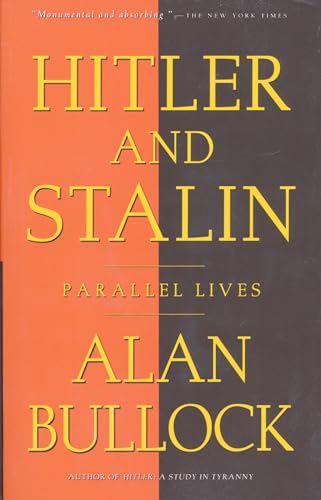

Hitler and Stalin parallel lives Alan Bullock.
Detalles de publicación: New York Vintage Books 1993.Descripción: xix, 1089 p. ill. 20 cmISBN:- 0679729941
- 21 943.086092 B9381h
- DD247 .H5B79 1993
| Imagen de cubierta | Tipo de ítem | Biblioteca actual | Biblioteca de origen | Colección | Ubicación en estantería | Signatura topográfica | Materiales especificados | Info Vol | URL | Copia número | Estado | Notas | Fecha de vencimiento | Código de barras | Reserva de ítems | Prioridad de la cola de reserva de ejemplar | Reservas para cursos | |
|---|---|---|---|---|---|---|---|---|---|---|---|---|---|---|---|---|---|---|
| Libro | Biblioteca Encarnación Valdés Colección General bev | 943.086092 B9381h (Navegar estantería(Abre debajo)) | Disponible | 80000002088279 |
Descripciones mejoradas de Syndetics:
Forty years after his Hitler: A Study in Tyranny set a standard for scholarship of the Nazi era, Lord Alan Bullock gives readers a breathtakingly accomplished dual biography that places Adolf Hitler's origins, personality, career, and legacy alongside those of Joseph Stalin--his implacable antagonist and moral mirror image.
Includes bibliographical references and index.
Reseñas proporcionadas por Syndetics
Library Journal Review
This is a huge and masterful dual biography of two of the most monstrous personalities of this century. Bullock, whose Hitler: A Study in Tyranny ( LJ 2/15/64) truly deserves its designation as a classic, has produced a smoothly written study of how these two lives ran parallel and how they intertwined to affect the lives of millions in the first half of this century. One would expect Bullock to know Hitler, but his grasp of Stalin and his times is also impressive. In chapters alternately dealing with Hitler and then Stalin, Bullock analyzes how each man achieved and then used power for his own twisted goals. It is chilling to realize that both men rose within legitimate institutions, each ``playing the game'' by the established rules. Hitler's evil empire collapsed with his death, Stalin's would live on to haunt the Soviet Union for decades. Essential for anyone seeking to understand the history of the West in this century. Highly recommended. Previewed in Prepub Alert, LJ 11/1/91.-- Ed Goedeken, Purdue Univ. Libs., West Lafayette, Ind. (c) Copyright 2010. Library Journals LLC, a wholly owned subsidiary of Media Source, Inc. No redistribution permitted.Publishers Weekly Review
This absorbing masterpiece of historical exposition and biographical art compares the lives of 20th-century Europe's two worst dictators, yielding a new perspective on evil. Illustrations. (Jan.) (c) Copyright PWxyz, LLC. All rights reservedCHOICE Review
Bullock's magisterial dual biography owes very little to social science comparativists but much to Thucydides, Aristotle, and Plutarch. Instead of treating Hitler and Stalin as examples of a general category, the distinguished British historian uses comparison "to illuminate the unique individual character." In his well-crafted and skillfully organized narrative Bullock analyzes the personalities of the dictators as well as the effect of their regimes: Stalin's brutal collectivization and purges, Hitler's despotic order in Germany and later in Europe, the generalship of the two warlords, Hitler's unprecedented genocide, and Stalin's unmerciful treatment of his associates and the Soviet people after the war. In this context, European history is examined not along the traditional Berlin-West axis but set against Berlin-Moscow relations. This assessment of Hitler's and Stalin's regimes comes at a point when the world created by the Nazi dictator's destructiveness and Stalin's legacy has come to an end. In a way, Bullock, the author of the classical biography of Hitler, had another chance to evaluate his subject but now in the broader context of the Nazi leader's principal antagonist and from a new vantage point. He has accomplished his task with accustomed verve, thorough scholarship, and style. A must for all academic libraries. G. P. Blum; University of the PacificBooklist Review
/*STARRED REVIEW*/ In a jealous contrast with the compulsory and fraudulent nature of his own popularity, Stalin, in August 1939, toasted the health of his new partner in conquest and enslavement by saying, "I know how much the German nation loves its F{{}}uhrer." For Hitler's national appeal was genuine--and how he achieved it and (in the 1930s at least) drew inspiration from it for a phantasmagoric racial program differs in almost every respect from the general secretary's rise and the great mission he had conceived for himself. Where they trod the same path was in sharing an attitude, one "exempt from ordinary canons of human conduct," in a typically portentous Bullock phrase that, combined with agit-prop and organizational machinery, could effect their implacable malevolence toward opponents. Yet for all their power, both were ultimately utter failures, their claims as providential agents of necessity unvindicated, their only legacies pyres by the tens of millions and opprobrium from historians. As Clio's servant, Bullock most frequently jousts with the latter, presenting evidence, weighing rival theses, dilating on the tyrants' psychological or political situations. The victims appear furtively, paradoxically strengthening the sinister tone of this monumental and gripping narrative, if only because of the difficulty in grasping the debasing magnitude of the crimes inflicted on them. What is easier to see, in retrospect, is the dictators' steely will to power, tactical finesse in obtaining it, and brutality in keeping it. This belongs at the summit of interpretations of the Third Reich and the former USSR, and seals Bullock's superb reputation (Reviewed Jan. 1, 1992)0394586018Gilbert TaylorNotas de autor provistas por Syndetics
A fellow of St. Catherine's College, Oxford University, and a former administrator of the university, Alan Bullock established himself as a historian with the publication of his biography of Adolf Hitler: A Study in Tyranny (1952). Although he had the advantage of being the first person to write a scholarly study of the German leader, his work remains one of the best, if not the best, biography of the dominant political personality of the first half of the twentieth century.Bullock also produced a major work in British history, The Life and Times of Ernest Bevin (1960-1983), a three-volume biography of the British transport-union leader and foreign secretary. He also has written a number of books on broad themes and was coeditor of the Oxford History of Modern Europe. His latest work, Hitler and Stalin: Parallel Lives (1992) compares the two great dictators at different stages of their lives.
(Bowker Author Biography)