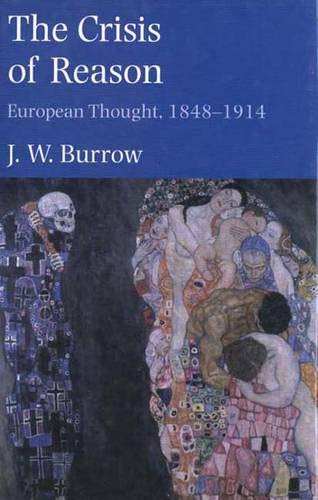

the crisis of reason European thought, 1848-1914 J.W. Burrow.
Series Yale intellectual history of the WestDetalles de publicación: New Haven Yale University Press 2000.Descripción: xv, 271 p. ill. 23 cmISBN:- 0300083904
- 21 940.8 B9723c
- CB204 B87 2000
| Imagen de cubierta | Tipo de ítem | Biblioteca actual | Biblioteca de origen | Colección | Ubicación en estantería | Signatura topográfica | Materiales especificados | Info Vol | URL | Copia número | Estado | Notas | Fecha de vencimiento | Código de barras | Reserva de ítems | Prioridad de la cola de reserva de ejemplar | Reservas para cursos | |
|---|---|---|---|---|---|---|---|---|---|---|---|---|---|---|---|---|---|---|
| Libro | Biblioteca Encarnación Valdés Colección General bev | 940.8 B9723c (Navegar estantería(Abre debajo)) | Disponible | 80000002088345 |
Descripciones mejoradas de Syndetics:
This elegant and skilful book explores the history of ideas in Europe from the revolutions of 1848 to the beginning of the First World War. Broader than a straight survey, deeper and richer than a textbook, the work seeks to place the reader in the position of 'an informed eavesdropper on the intellectual conversations of the past'. After an introductory chapter which introduces the mental world of the mid-nineteenth century, Burrow explores the impact of science and social thought on European intellectual life, considering ideas in physics, through social evolution and Social Darwinism, to anxieties about modernity and personal identity. His discussion also takes in powerful and fashionable concepts in evolution, art, myth, the occult and the unconscious mind, considers the rise of the great cities of Berlin, Paris and London, and the work of literary writers, philosophers and composers. The text is populated by most of the great and many of the lesser known intellectual figures of the age, from Mill, Bakunin, Nietzsche, Bergson and Renan to Pater, Proust, Clough, Flaubert, Wagner and Wilde. A work of rare distinction and considerable erudition, the book is written in a graceful,
Includes bibliographical references and index,
Tabla de contenidos provista por Syndetics
- List of Illustrations(p. ix)
- Preface(p. x)
- Acknowledgements(p. xvi)
- Prologue: 1848-49: The Disillusionment of the Intellectuals(p. 1)
- 1 The Stuff of the World and the Promises of Science(p. 31)
- 1.1 The New Generation(p. 31)
- 1.2 The Conservation of Matter and Energy; Materialist Reductionism(p. 34)
- 1.3 The Enigma of Consciousness and the Impact of Evolution(p. 42)
- 1.4 The Claims of Science: Science as Vocation(p. 52)
- 1.5 The Reaction against Materialism: Phenomenalism, Pragmatism and Pan-psychism(p. 56)
- 2 Social Evolution and the Sciences of Culture(p. 68)
- 2.1 A Classified World(p. 68)
- 2.2 Social Evolution as the Division of Labour(p. 72)
- 2.3 Sciences of Religion and Culture: France, Britain, Germany(p. 77)
- 2.4 Social Darwinism, Eugenics and Race(p. 92)
- 3 Community and Modernity(p. 109)
- 3.1 The Market and Modernity(p. 109)
- 3.2 Community: The Mark, the Mir and the Guild(p. 113)
- 3.3 The Ethical State(p. 124)
- 3.4 Nation and State in Germany(p. 132)
- 3.5 Nationalism and the Critique of Modernity: Myth and Charisma(p. 136)
- 4 The Elusive Self(p. 147)
- 4.1 The Burden of Freedom(p. 147)
- 4.2 'Character'(p. 152)
- 4.3 The Flux of Experience(p. 160)
- 4.4 The Unconscious(p. 164)
- 5 Constructing the Self(p. 170)
- 5.1 Work of Art and Microcosm(p. 170)
- 5.2 'Decadence' and 'Life'(p. 181)
- 5.3 The Calling and the Deed(p. 190)
- 6 Immanence, Revelation and Transcendence(p. 197)
- 6.1 Incarnation(p. 197)
- 6.2 Myth and Revelation(p. 208)
- 6.3 The Occult(p. 219)
- Epilogue: Avant-garde(p. 234)
- Select Bibliography(p. 254)
- Index(p. 264)
Reseñas proporcionadas por Syndetics
CHOICE Review
A blurb on the book jacket correctly states that Burrow's book is broader than a narrative survey and deeper than a textbook. What, then, is it? A personal synthesis by a seasoned scholar (Oxford Univ.) based on years of reading, lecturing, and reflecting. His organizing motifs are admirably adapted to synthesis: the claims of science, sciences of culture as expressions of various theories of social evolution, nationalism and the state (together with the myths that support both), efforts to construct a "self," and attempts to respond to a loss of religious faith and a sense of transcendence. All these ideas are variously illustrated by a wide array of writers from England, France, and Germany whose debts to each other (and to some predecessors--Kant, for example) crisscross throughout. Burrows expounds no writer systematically but comments on many in relation to the congeries of notions under review (some favorites--Nietzsche and Wagner particularly--appear and reappear). This is therefore not a book for the uninitiated. But those already intimately familiar with Freud, Marx, Mill, and others equally famous, not to speak of numerous writers less well known, might well find the commentary stimulating. Graduate students, faculty and researchers, professionals. A. Rabil, Jr.; emeritus, SUNY College at Old WestburyNotas de autor provistas por Syndetics
J.W. Burrow was, until his recent retirement, professor of European thought at Oxford University.