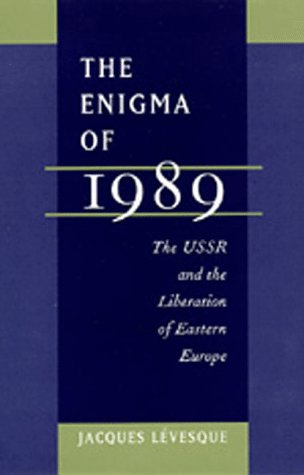
Imagen de portada de Amazon
Imagen de Amazon.com
Imagen de cubierta Syndetics
Portada de Syndetics
Imagen de OpenLibrary

The enigma of 1989 the USSR and the liberation of Eastern Europ Jacques Levesque ; translated by Keith Martin.

Por: Detalles de publicación: Berkeley University of California Press 1997.Descripción: ix, 267 p. 23 cmISBN:
  • 0520206312
Títulos uniformes: Tema(s): Clasificación CDD:
  • 21 327.47047 L662u E
Valoración
    Valoración media: 0.0 (0 votos)
Existencias
Imagen de cubierta Tipo de ítem Biblioteca actual Biblioteca de origen Colección Ubicación en estantería Signatura topográfica Materiales especificados Info Vol URL Copia número Estado Notas Fecha de vencimiento Código de barras Reserva de ítems Prioridad de la cola de reserva de ejemplar Reservas para cursos
Libro Biblioteca Encarnación Valdés Colección General bev 327.47047 L662u E (Navegar estantería(Abre debajo)) Disponible 80000002088337
Total de reservas: 0

Descripciones mejoradas de Syndetics:

The Soviet external empire fell in 1989 virtually without bloodshed. The domino-like collapse of the communist regimes of Eastern Europe was not anticipated by political experts in either the East or the West. Most surprising of all was the Soviet Union's permissive reactions to the secession. For the first time in modern history, such an epochal upheaval could take place not only without war but also without major international tensions.


This book is the first comprehensive scholarly attempt to elucidate Soviet behavior toward Eastern Europe in 1989. Jacques Lévesque thoroughly analyses the policies of the USSR toward Eastern Europe during the Gorbachev era and clarifies the goals that underpinned these policies.


Based on interviews with political leaders and exhaustive research in Russia, Czechoslovakia, Hungary, Poland, and the other ex-Warsaw Pact countries, this book traces the nuances of each country's case as a set of continually changing, mutually reinforcing causes and effects.

Includes bibliographical references and index.

Reseñas proporcionadas por Syndetics

CHOICE Review

Levesque's first-rate study examines the remarkable process of Soviet withdrawal from Eastern Europe in 1989. The author (Univ. du Quebec `a Montreal) points out that this transformation was neither foretold by nor necessary in the development of Soviet foreign policy at the time, even given the reformist initiatives of Gorbachev and his advisors. The investigation is informed by interviews with key figures both from the Gorbachev Kremlin (including written responses from Gorbachev himself) and from the political regimes of Eastern Europe, and also by access to primary documentation from the period. The result is a rich analytical account that illustrates how Gorbachev's initiatives were supported by ideological arguments ("the ideology of transition"); demonstrates the key role that Gorbachev himself played (both positively in determinedly encouraging change in Eastern Europe and negatively in repeated instances of indecision when decisiveness was called for); and points out the lack of vision that plagued the formation of the Soviet position. The author concludes that, in the end, the events of 1989 were a consequence of the fact that Eastern Europe was a low priority for the Soviet leadership as compared to perestroika. Gorbachev and his advisors remained convinced that the process of socialist reform in the Soviet Union (itself failing) would be persuasive to the Eastern European nations. Highly recommended for general and academic readers at all levels. B. T. Trout; University of New Hampshire

Notas de autor provistas por Syndetics

Jacques Lévesque is Professor of Political Science, Université du Québec á Montréal, and author of The USSR and the Cuban Revolution (1978), among many other works.
Compartir
logopucpr-y-vive

Contáctanos

¡Queremos saber de ti!

Tel. 787.841.2000 Ext. 1801

bibliotecavaldes@pucpr.edu

⁣Búscanos en las redes

© 2026 Desarrollado por Ignite Online • All Rights Reserved • Powered by Koha.