Reseñas proporcionadas por Syndetics
Library Journal Review
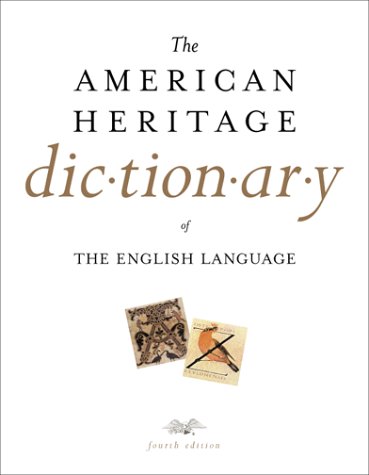
Rewritten to "reflect contemporary knowledge and culture," this edition defines some 10,000 new words and senses not in the previous work (2000). Notes on usage, history, synonyms, variations, and changes have been added. Providing both biographical and geographical entries, the dictionary uses quotes to show a word in context as well as for usage guidance. Photographs and illustrations, more than 4000 in all, abound. An essay on Indo-European and its speakers introduces Appendix 1, which traces the derivations of English words that come from selected Indo-European roots. Appendix 2 is preceded by an essay on proto-Semitic language and culture. The meaning of the Semitic root is given, followed by explanations of words that have that root. Aesthetically, this edition is pleasing; bold, blue entry words contrast sharply with pronunciations, definitions, and usage notes printed in black ink. The slightly older New Oxford American Dictionary (3d ed., Oxford Univ., 2010) is about the same length and is the same price, but its arrangement is slightly different, as it concentrates on the "core" senses of words. BOTTOM LINE This dictionary is highly recommended for its comprehensiveness, its pleasing layout, and its currency.-Marilyn S. Lary, San Bernardino, CA (c) Copyright 2011. Library Journals LLC, a wholly owned subsidiary of Media Source, Inc. No redistribution permitted.
Publishers Weekly Review
Since its 1969 first edition, the American Heritage has battled Webster's for desk, library and classroom space. Against its older rival, American Heritage boasts better looks, more frequent updates and a 200-member Usage Panel with verbal all-stars like novelists Alice Munro and Sherman Alexie. The third edition of the American Heritage appeared only in 1992; what's new about this edition? For one thing, 10,000 more words, frequently colloquial ones or new coinages; all dictionaries delete when they add, but here additions seem to outnumber cuts. Another new feature is color: with polychromatic photographs down broad margins, and entry words in greenish-black, the fourth edition looks like the well-dressed offspring of an older reference book and a Web siteÄan appearance likely to please younger users. The fourth does well with '90s cultural termsÄ"permatemp" and "McJob," "techno" and "indie" (rock). It's good with compounds, especially new onesÄ"celestial longitude," "jewel box" (for CDs), "crack baby," "poetry slam." Coverage of slang has also improved: the third made "dick" "a guy" and a male organ; the fourth gives the noun as an insult and five senses for "dick" as a verb. Occasional boxes offer long paragraphs on (for example) when and where "party" can mean "person," why the Usage Panel hates "hopefully," and the evolution of the word "circus." As in the third, a substantial appendix guides readers through Indo-European roots. American Heritage's examples and etymologies still can't compare to the Oxford English DictionaryÄnor should they. Instead, the volume strikes a commendable, practical balance between depth of coverage and ease of use. (The CD-ROM contains all the text of the bound book, with less art, but also the words retired from the third edition; it can be purchased separately for $24.95.) (Sept.) (c) Copyright PWxyz, LLC. All rights reserved
School Library Journal Review
Gr 9 Up-Five hundred entries have been added to this update of the 2000 edition, bringing the total to 10,500. Many of the new words come from the fields of technology (blogosphere, Easter egg, LOL), current events (SARS, Amber Alert), and pop culture (speed dating, shout-out). The dictionary follows standard arrangement, but is enhanced by notes on usage, history, regionalisms, social aspects of language, and nuances of meaning, as well as illustrations (most in full color) and a pronunciation guide on every page. Proper names and famous people are also included, considerably expanding this book's usefulness. A solid, up-to-the-minute resource and a worthwhile purchase for libraries.-Kathleen Kelly MacMillan, Carroll County Public Library, MD (c) Copyright 2010. Library Journals LLC, a wholly owned subsidiary of Media Source, Inc. No redistribution permitted. All rights reserved.
CHOICE Review
Readers today want reputable, informative, and user-friendly reference sources; the fourth edition of this dictionary is all three. More than 10,000 new entries address recent vocabulary in fields related to information technology, medicine, business, and popular culture. Five types of descriptive notes cover synonyms, usage, word history, regionalisms, and "our living language." An expanded appendix of Indo-European roots and a new appendix of Semitic roots are included. The introduction of color in 4,000 drawings and photographs and the blue-green color of each headword make the dictionary attractive and easier to use. Like previous editions, it contains biographical and geographical entries, slang, and colloquial terms. Some may think that including slang and colloquial terminology weakens a dictionary's ability to validate proper usage, but their inclusion supports the editorial goal of providing a dictionary that traditionally and progressively captures the living language. A CD-ROM version, which can be purchased separately, has fewer illustrations, but readers gain interactive capabilities such as pronunciation and search features. At home or in the office or library, this edition is a pleasure to use. M. D. Collins; Mississippi State University
Booklist Review
*Starred Review* The marketing slogan for the fifth edition of The American Heritage Dictionary of the English Language (AHD) is You are your words. Make the most of them. Perhaps this will encourage the public to use the dictionary to improve their speaking and writing. The fourth edition was published 10 years ago, and, of course, there have been many new words since that time, so 10,000 have been added. Additions include quad bike, fracking, podcast, spaghettification, flash mob, and fashionista. AHD continues to have color photos in the margin to illustrate the definitions. Countries all have a small map with their location and major cities. AHD is known for its usage notes, which are based on the opinions of a panel of respected authors, scholars, journalists, politicians, and even the cartoonist Ed Koren. Many of these notes have been updated, including one for unique, which admits that the word being an absolute term with no comparison or modification by an adverb is waning. AHD also includes example sentences, and many of these have been lengthened with the addition of quotations from writers, including Philip Roth and Jean Rhys. Synonyms for words have been added four for imbue alone. There are also updates to selected word histories. A new entry for Our Living Language describes the different words used for seesaw in southeast New England. There have been questions about how many more print dictionaries will be published, but the purchase of this print edition contains a passkey for a free app version, and there is a free online version at www.ahdictionary.com, so the American Heritage title brand continues. The New Oxford American Dictionary (3rd ed., 2010) and the AHD are considered comprehensive dictionaries in the middle between college dictionaries and those that are unabridged. Both are priced at $60, which is still a bargain, assuming patrons use them. For libraries that do not have the Oxford American, AHD is more current and may be popular in schools and colleges because of the color illustrations and two-column format.--Bulson, Christine Copyright 2010 Booklist