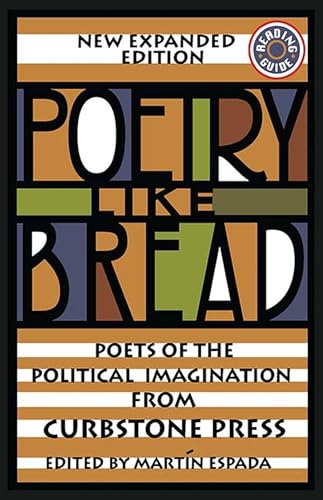

Poetry like bread poets of the political imagination from Curbstone Press edited by Martín Espada.
Detalles de publicación: Willimantic, Conn. Curbstone Press 2000.Edición: New and expanded edDescripción: 330 p. 23 cmISBN:- 1-880684-74-8
- 21 808.81 P7457 2000
| Imagen de cubierta | Tipo de ítem | Biblioteca actual | Biblioteca de origen | Colección | Ubicación en estantería | Signatura topográfica | Materiales especificados | Info Vol | URL | Copia número | Estado | Notas | Fecha de vencimiento | Código de barras | Reserva de ítems | Prioridad de la cola de reserva de ejemplar | Reservas para cursos | |
|---|---|---|---|---|---|---|---|---|---|---|---|---|---|---|---|---|---|---|
| Libro | Biblioteca Encarnación Valdés Colección General bev | 808.81 P7457 2000 (Navegar estantería(Abre debajo)) | Disponible | 80000002100520 |
Descripciones mejoradas de Syndetics:
Poetry Like Bread contains poems by nearly forty poets published by the Curbstone Press during the last twenty years. These poets are probably unlike any you have studied. Their engagement with everyday political and economic realities is as direct as a newspaper, their language as familiar as conversation. Their motto, taken from Roque Dalton for the title of the collection, is that "poetry, like bread, is for everyone."
These poems were not written to be studied. They were meant to be read. Or better yet, heard. Whole or in part. Alone or among friends and strangers. Reading and hearing them, you must respond and react. Some may inspire you, knock the wind out of you--make you indignant, sad, joyous, ashamed. Whether you drop this book, seek out others, join a social action group, write letters to your elected representatives, or write poems of your own, your reaction to the poems will be as political as the poems themselves.
Some of the subjects of these poems may be unfamiliar to you, or very familiar to you. Many relate stories from war-torn Central and South America, where U. S. policy has had a huge impact on people's lives. The rest are the voices of the voiceless here in the U.S: Latinos and African Americans, Vietnam veterans and Vietnamese, prison inmates, blue collar workers, migrant workers, women, the homeless. It's the poet's job to open up and validate these worlds to us. Our job, once roused, is to learn. To learn and to act.
Tabla de contenidos provista por Syndetics
- Prefatory Note(p. 3)
- Dedicatory Poem
- Patria abnegada(p. 4)
- My Martyred Homeland(p. 5)
- Foreword(p. 9)
- Ars Poetica(p. 16)
- Ars Poetica(p. 17)
- Visitas nocturnas(p. 18)
- Nocturnal Visits(p. 19)
- Los rios(p. 20)
- The Rivers(p. 21)
- Carmen Bomba(p. 24)
- Carmen Bomba: Poet(p. 25)
- Desde el puente(p. 26)
- From the Bridge(p. 27)
- Blues for Unemployed Mercenaries(p. 34)
- The Torturer's Apprentice(p. 38)
- Colonial Album(p. 40)
- Town Meeting(p. 42)
- Poverty(p. 43)
- Lawns(p. 45)
- Sweeping(p. 46)
- The Night I Walk into Town(p. 47)
- What's Happening(p. 48)
- I Applied for the Board(p. 51)
- Who Understands Me But Me(p. 52)
- Ah Rain!(p. 54)
- Steel Doors of Prison(p. 55)
- La sangre de otros(p. 56)
- The Blood of Others(p. 57)
- In Memoriam(p. 58)
- In Memoriam(p. 59)
- Conjuncion(p. 62)
- Conjunction(p. 63)
- Incoming(p. 66)
- Playing Basketball with the Viet Cong(p. 67)
- Gelatin Factory(p. 68)
- In the Village of Yen So(p. 70)
- Banking Lesson, 1970(p. 71)
- Non Vedra Mai Piu Forse(p. 72)
- Maybe He'll Never See Again(p. 73)
- Non Ditemi Di Non Disturbarvi(p. 74)
- Don't Tell Me Not To Bother You(p. 75)
- A Julia de Burgos(p. 76)
- To Julia de Burgos(p. 77)
- Las voces de los muertos(p. 80)
- The Voices of the Dead(p. 81)
- Ecologia(p. 88)
- Ecology(p. 89)
- Las loras(p. 92)
- The Parrots(p. 93)
- Las campesinas del Cua(p. 94)
- The Peasant Women from Cua(p. 95)
- Hartford Daylight(p. 98)
- To a Cautious Poet(p. 99)
- Frente al balance, manana(p. 100)
- Before the Scales, Tomorrow(p. 101)
- Intelectuales apoliticos(p. 102)
- Apolitical Intellectuals(p. 103)
- Vamonos patria a caminar(p. 106)
- Let's Go, Country(p. 107)
- Amelia, Mrs. Brooks of My Old Childhood(p. 114)
- Para un mejor amor(p. 124)
- Toward a Better Love(p. 125)
- Como tu(p. 128)
- Like You(p. 129)
- Sobre el negocio biblico(p. 130)
- On Biblical Business(p. 131)
- La certeza(p. 132)
- The Certainty(p. 133)
- Dat Do-Nuoc Xanh(p. 134)
- Red Earth-Blue Water(p. 135)
- Buoi Sang Sau Chien Tranh(p. 136)
- The Morning After the War Was Over(p. 137)
- Do Len(p. 138)
- Do Len(p. 139)
- La tumba de Buenaventura Roig(p. 140)
- La tumba de Buenaventura Roig(p. 141)
- Federico's Ghost(p. 144)
- El fantasma de Federico(p. 145)
- Jorge the Church Janitor Finally Quits(p. 148)
- Por fin renuncia Jorge el conserje de la iglesia(p. 149)
- The Scientist(p. 152)
- Neighborhood Watch(p. 153)
- Sea of Tranquility(p. 154)
- At Saint Anthony's(p. 155)
- For Pablo Neruda(p. 156)
- Among The Yurok(p. 157)
- 9:40pm(p. 158)
- 3:45am(p. 159)
- Human Interlude(p. 160)
- In Memoriam, Ray Thompson (1943-1990)(p. 161)
- Undone Day(p. 163)
- Haiti(p. 165)
- This Neruda Earth(p. 167)
- Desconcierto(p. 168)
- Confusion(p. 169)
- Despliegue de asombros ante un dios(p. 170)
- Unfurling of Amazements Before God(p. 171)
- De repente(p. 172)
- All of a Sudden(p. 173)
- Refranes(p. 176)
- Proverbs(p. 177)
- Blood Knot(p. 178)
- Mastectomy(p. 179)
- Le nageur noir traverse les profondeurs bleues(p. 180)
- A black swimmer crosses blue depths of underwater(p. 181)
- Le grand guignol du pays ou Le pays du grand guignol(p. 182)
- The Grand Guignol of Countries or Country of The Grand Guignol(p. 183)
- The Meadow(p. 184)
- Cash Register(p. 185)
- Ordinary Human Arms(p. 187)
- Fillmo'e street woman(p. 188)
- The blood of Colorado miners(p. 191)
- You northamerican poets(p. 192)
- There will be a time(p. 193)
- Maybe because I stand behind(p. 194)
- Histories: Part I Europe and America(p. 195)
- Histories: Part II The New World(p. 196)
- El perro(p. 198)
- The Dog(p. 199)
- Poem for Our Dog Afraid of Thunder on a Rainy Day(p. 200)
- Poem for U-Haul(p. 201)
- Sharks(p. 202)
- Etymology: Chicano(p. 204)
- What It Was Like(p. 205)
- The Gloves(p. 206)
- Immigration Law(p. 208)
- Then Comes a Day(p. 209)
- The Concrete River(p. 211)
- The Blast Furnace(p. 215)
- Carrying My Tools(p. 216)
- La tierra es un satelite de la luna(p. 218)
- The Earth is a Satellite of the Moon(p. 219)
- Medicine Woman(p. 222)
- Looking For Indians(p. 224)
- Hanging Clothes In The Sun(p. 226)
- Department of Labor Haiku(p. 228)
- Why They Do It(p. 229)
- My Daddy's Tattoo(p. 230)
- The Prisoners(p. 231)
- Now Sing(p. 233)
- The Day of the Night(p. 234)
- Toque de Queda(p. 236)
- First and Last Poems(p. 237)
- Grandfather Buffalo(p. 239)
- Postcard(p. 241)
- Blue Cloud Rides Horses(p. 243)
- The Pumpkin Field(p. 245)
- The Burning of Malmaison, iii (excerpt)(p. 248)
- Los pesares juntos(p. 250)
- The Common Grief(p. 251)
- Recuerdos numero 1-2(p. 252)
- Memories Numbers 1-2(p. 253)
- Envio(p. 254)
- Dispatch(p. 255)
- Las tias(p. 256)
- The Aunts(p. 257)
- Pobres de nosostros(p. 258)
- Poor Us(p. 259)
- Asesinato del campeon de polo(p. 260)
- Assassination of the Polo Champ(p. 261)
- #3 de Caballo de palo(p. 262)
- #3 from The Wooden Horse(p. 263)
- #4 de Caballo de palo(p. 264)
- #4 from The Wooden Horse(p. 265)
- #35 de La tierra prometida(p. 274)
- #35 from The Promised Land(p. 275)
- Scene from the Movie GIANT(p. 284)
- The Existence of Sarge(p. 286)
- Fight Scene Beginning(p. 288)
- Fight Scene, Part II(p. 290)
- Fight Scene: Final Frames(p. 292)
- Era una escuadra desperdigada(p. 294)
- It Was a Ragged Squadron(p. 295)
- Querida tia Chofi(p. 296)
- Dear Aunt Chofi(p. 297)
- Precisamente(p. 304)
- Precisely(p. 305)
- Biographical Notes(p. 307)
- Reading Guide: A Companion for Readers, by Hugh Blumenfeld(p. 319)
Notas de autor provistas por Syndetics
MARTÍN ESPADA , born in Brooklyn in 1957, has been called the Latino poet of his generation. The author of fourteen collections of poetry, he is also an editor, essayist, and translator. He is currently a professor in the Department of English at the University of Massachusetts-Amherst.