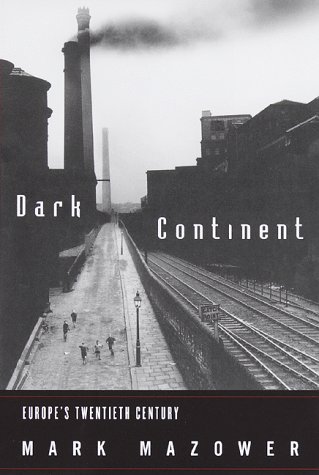

Dark continent Europe's twentieth century Mark Mazower.
Detalles de publicación: New York, N.Y. Alfred A. Knopf 1999.Descripción: xvi, 487, [4] p. 24 cmISBN:- 0-679-43809-2 (hardcover : alk. paper)
- 21 940.55 M4766d
| Imagen de cubierta | Tipo de ítem | Biblioteca actual | Biblioteca de origen | Colección | Ubicación en estantería | Signatura topográfica | Materiales especificados | Info Vol | URL | Copia número | Estado | Notas | Fecha de vencimiento | Código de barras | Reserva de ítems | Prioridad de la cola de reserva de ejemplar | Reservas para cursos | |
|---|---|---|---|---|---|---|---|---|---|---|---|---|---|---|---|---|---|---|
| Libro | Biblioteca Encarnación Valdés Colección General bev | 940.55 M4766d (Navegar estantería(Abre debajo)) | Disponible | 80000002099037 |
Descripciones mejoradas de Syndetics:
Dark Continentis a searching history of Europe's most brutal century. Stripping away the comforting myths and illusions that we have grown up with since the Second World War, Mark Mazower presents an unflinching account of a continent locked in a finely balanced struggle between tolerance and racial extermination, imperial ambition and national self-determination, liberty and the tyrannies of Right and Left. It is an attempt to trace the origins of "Western values"--the ideological terms we now live by--and to ask what remains of the struggles of previous generations. Instead of seeing Europe as the natural home of freedom and democracy, Mazower argues that it was a frequently nightmarish laboratory for social and political engineering, inventing and reinventing itself through war, revolution and ideological competition. Fascism and communism should be regarded not as exceptions to the general rule of democracy, but as alternative forms of government that attracted many Europeans by offering different solutions to the challenges of the modern world. By 1940 the prospects for democratic government looked bleak, and Europe's future seemed to lie in Hitler's hands. Yet freedom was given another chance with the defeat of the Nazi New Order, and it prevailed decades later across the continent with the collapse of the Iron Curtain. Mazower's extraordinarily skilled and insightful analysis provides us with a new perspective on the events of the century now drawing to a close. From the beginnings of the First World War to the establishment of the European Union, he depicts a battle for hearts and minds that reached more deeply than ever before into the daily lives of ordinary people. Vividly written and vigorously argued,Dark Continentpresents both a comprehensive history of twentieth-century Europe and a provocative vision of its future.
Includes bibliographical references (p. 417-469) and index.
Reseñas proporcionadas por Syndetics
Publishers Weekly Review
Mazower (Inside Hitler's Greece) shapes his well-written history of Europe's 20th century as a struggle among liberal democracy, communism and fascism. Avoiding the pitfalls of Marxist interpretation on the one hand and capitalist triumphalism on the other, he shows how the failure of liberal democracy after WWI led to the experiment with fascism, which was defeated (principally by the Communists) at an enormous cost. In the first half of this century, he writes, between 60 million and 70 million Europeans died violently in wars or civil unrest, but the figure for the period after the defeat of fascism is under one million. Mazower takes this as evidence that the Cold War was a social and economic, rather than a military, conflict. While this may be true of the Cold War in Europe, the assertion fails to take into account the proxy wars fought by the superpowers in Asia, Africa and Latin America. But this omission doesn't detract from the overall excellence of Mazower's work. The defeat of fascism and the fall of communism have left the field to liberal democracy, which is now faced with the problem it failed to solve in the beginning of the century: how to create a workable relationship between capitalism and representative government. Mazower argues that Europeans can best work this out if they realize that their national differences are greater than any common culture and that Europe has enjoyed its greatest period of peace and prosperity precisely during the period in which it has lost its primacy in world affairs. Maps. Tables not seen by PW. (Jan.) (c) Copyright PWxyz, LLC. All rights reservedCHOICE Review
Europe's 20th century seems too neatly divided, its first half one of conflict and slaughter, marked by a tripartite ideological struggle among liberalism, fascism, and communism, the second half one of relative peace and the ascendancy of democracy and capitalism. Mazower's massive essay, which might be mistaken for a highly sophisticated textbook, offers challenging insights and interpretations. Although intended to be wide-ranging, much of the work addresses Germany, the Soviet Union, and Eastern Europe, with more modest attention to Britain, France, and Italy. The years 1933-1945 receive particular and penetrating scrutiny, as does the immediate postwar period, 1945-1948, marked by aspirations for social change as well as disappointments. For the interwar years the author struggles to explain why peoples would prefer violence to reason, bloodshed to compromise, and why so many were eager to jettison liberal institutions and individual rights altogether. Following the threads of continuity, Mazower argues that the apparent triumph of democracy does not mean that it was inevitable because of its advertised superior values. Rather, its victory was that of a renovated capitalism over a stagnating communism. Overall, a very readable and thoughtful interpretation of a century that promised so much and yielded unprecedented disasters. All levels. N. Greene Wesleyan UniversityBooklist Review
Historian Mazower rejects both the triumphalism of capitalist democracy's partisans and the economic reductionism of some Marxist scholars in favor of the recognition that within Europe over the past 9 or 10 decades, liberal democracy, fascism, and communism competed for dominance and that it was not at all foreordained that capitalist democracy would "win." Thus, he explores the remarkable burgeoning of democracy after World War I, the collapse of that democratic experiment as Europe faced Communist revolution to the east and the global economic disaster of the Depression, and the post^-World War II restoration of democracy under a new social contract, with capitalism encompassing both regulation and social welfare provisions. Mazower sees fascism as "pos[ing] the most serious challenge to liberal democracy this century" and demonstrates that Nazism's "racial-nationalist welfare system simply pushed to extremes tendencies visible in European thought more generally." His analysis of the complex reality of Europe's recent past forms a more solid basis for Europeans' current efforts to forge a more unified future. --Mary CarrollNotas de autor provistas por Syndetics
Mark Mazower is a professor of history at Princeton University and has recently been appointed professor of history at Birkbeck College, London. He is the author of several books, most recently Dark Continent: Europe's Twentieth Century.(Bowker Author Biography)