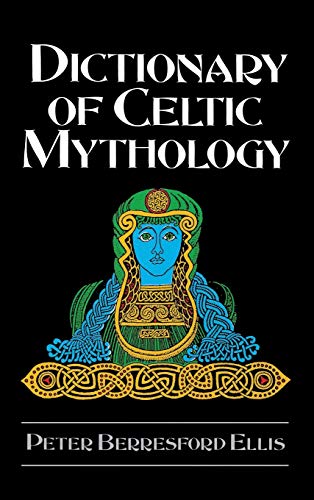

Dictionary of Celtic mythology / Peter Berresford Ellis.
Idioma: Español Detalles de publicación: Santa Barbara : ABC-CLIO c1992.Descripción: viii, 232 p. 24 cmISBN:- 0874366097 (alk. paper)
- 299/.16 20
- BL900 .E45 1992
| Imagen de cubierta | Tipo de ítem | Biblioteca actual | Biblioteca de origen | Colección | Ubicación en estantería | Signatura topográfica | Materiales especificados | Info Vol | URL | Copia número | Estado | Notas | Fecha de vencimiento | Código de barras | Reserva de ítems | Prioridad de la cola de reserva de ejemplar | Reservas para cursos | |
|---|---|---|---|---|---|---|---|---|---|---|---|---|---|---|---|---|---|---|
| Libro | Biblioteca de Mayagüez Sala de Referencia mb | BL900 .E45 1992 (Navegar estantería(Abre debajo)) | Disponible | 50000001955714 | ||||||||||||||
| Referencia | Biblioteca Encarnación Valdés Sala de Referencia bev | 299.1603 E47d (Navegar estantería(Abre debajo)) | Disponible | 80000001868846 |
Descripciones mejoradas de Syndetics:
A fascinating and accessible guide to the gods and goddesses, heroes and heroines, magical weapons, fabulous beasts, and otherworld entities of Celtic Mythology.
Predated only by Greek and Roman legend by virtue of the fact that the Celtic languages were not written until the early Christian era, Celtic mythology developed from a far earlier oral tradition, which preserves voices from the dawn of European civilization. The peoples of these Celtic cultures survive today on the western seaboard of Europe: the Irish, Manx, and Scots who make up the Goidelic (Gaelic) speaking branch of Celts, and the Welsh, Cornish, and Bretons, who represent the Byrthonic-speaking branch.
In his introduction, Ellis discusses the roles of these six cultures, the evolution (or demise) of the languages, and the relationship between the legends, especially the Irish and Welsh, the two major Celtic cultures. The Dictionary of Celtic Mythology is an easy to read handbook, and presents a fascinating window to centuries of rich oral and written tradition from the mists of Europe's origins.
Includes bibliographical references (p. [225]-232).
Reseñas proporcionadas por Syndetics
Library Journal Review
Celtic language and mythology, which predates the Greeks and Romans, descends from an ancient oral tradition. Celtic culture was the first to develop a philosophy of immortality. Ellis, author of A Dictionary of Irish Mythology (ABC-Clio, 1991) here dissects the scope of Celtic myth and legend. Comparisons are offered among the six cultures: Irish, Welsh, Manx, Scottish, Cornish, and Breton. A very good introduction discusses the roles of the cultures, the evolution (or demise) of the language, and the legends. The entries are thorough and well written. An excellent selected bibliography rounds out this interesting reference. For large mythology collections.-- Gail Wood, Montgomery Coll. Lib., Germantown, Md. (c) Copyright 2010. Library Journals LLC, a wholly owned subsidiary of Media Source, Inc. No redistribution permitted.CHOICE Review
The popularity of the author's A Dictionary of Irish Mythology, (CH, Oct'89) led ABC-Clio to request of him a volume to cover Celtic mythology, not intended to be comprehensive, nor for a scholarly audience, but as a quick reference for general readers. Ellis has compiled a list of characters and a few concepts drawn exclusively from the written texts of Ireland and Wales (omitting Scotland, Cornwall, the Isle of Man, Brittany, and the early Celts of northern Europe) which were recorded from the oral tradition by Christian scribes, and thus influenced by them. The result is essentially a catalog of characters, quite similar to the first book in content, with little or no information on culture, ritual, or belief. Given the intended audience, the scarcity of cross-references is unfortunate (how many "lay readers" will look for Iseult under "Esylt" without some assistance?), as is the lack of cited sources in the entries, although Ellis concludes the work with a selective bibliography. While satisfactory for Irish and Welsh literary mythology, a much better choice for Celtic mythology is Miranda J. Green's Dictionary of Celtic Myth and Legend (CH, Jul'92), which covers a wider geographic region (and thus is more truly Celtic in scope), has cross-references in each entry, includes archaeological and contemporary classical sources as well as the literary texts, and costs a third less. General; undergraduate. M. R. Pukkila; Colby CollegeBooklist Review
This volume is a companion to A Dictionary of Irish Mythology [RBB N 1 89] by the same expert; some entries are drawn from that book. Irish and Welsh traditions are emphasized in this handbook of gods, heroes, magical weapons and beasts, and otherworld figures. In addition, there is some coverage of Scottish, Gaulish, Manx, and other Celtic mythology. The introduction provides a brief cultural and literary history of the Celts. The entries that follow are brief: one line to a page in length. Definitions are narrow; characters are described in terms of their own identity, and the reader must look under a more general myth to find the broader context. For example, Torc Triath is described as "King of Boars"; he is discussed in Animal Cults in a broader context. Some cross-references are given, though there are no internal cross-references for entries that can be found elsewhere in the text. Some Celtic figurative names are translated into English (e.g., "Brigantia. The High One"). A lengthy select bibligraphy guides the scholar to main sources on Celtic mythology. There is no index. This volume complements Miranda Green's Dictionary of Celtic Myth and Legend [RBB Ap 15 92]. This latter book has more general entries and includes numerous illustrations. Both reference tools would benefit academic library users; public libraries may opt for the more attractive Dictionary of Celtic Myth and Legend. (Reviewed Aug. 1992)Notas de autor provistas por Syndetics
Peter Berresford Ellis was born in Coventry, Warwickshire, England on March 10, 1943. Even though he received a BA and an MA in Celtic Studies, he decided to become a journalist and worked at numerous weekly newspapers throughout England and Ireland. In 1968, he published is first book, Wales: A Nation Again, about the Welsh struggle for political independence. He became a full-time writer in 1975 and has published over 90 books under his own name and the pseudonyms Peter Tremayne and Peter MacAlan. One of his best known works under his real name is The Cornish Language and its Literature, which is considered the definitive history of the language. In 1988, he received an Irish Post Award in recognition of his services to Irish historical studies. Under the pseudonym Peter Tremayne, he writes the Sister Fidelma Mystery series. He received the French Prix Historia for the best historical mystery novel of 2010 for Le Concile des Maudits (The Council of the Cursed).(Bowker Author Biography)