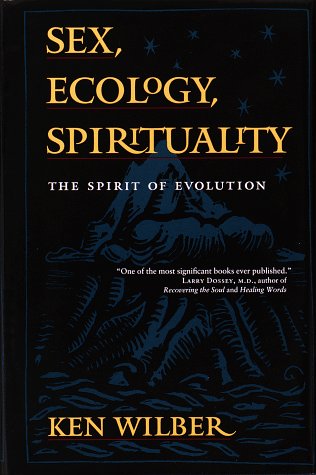
Imagen de portada de Amazon
Imagen de Amazon.com
Imagen de cubierta Syndetics
Portada de Syndetics
Imagen de OpenLibrary

Sex, ecology, spirituality the spirit of evolution Ken Wilber.

Por: Detalles de publicación: Boston Shambhala [New York, N.Y.] Distributed in the USA by Random House, Inc. 1995.Edición: 1st edDescripción: xi, 831 p. ill. 24 cmISBN:
  • 1570620725 (alk. paper)
Tema(s): Clasificación CDD:
  • 110 20
Clasificación LoC:
  • BD311 .W54 1995
Valoración
    Valoración media: 0.0 (0 votos)
Existencias
Imagen de cubierta Tipo de ítem Biblioteca actual Biblioteca de origen Colección Ubicación en estantería Signatura topográfica Materiales especificados Info Vol URL Copia número Estado Notas Fecha de vencimiento Código de barras Reserva de ítems Prioridad de la cola de reserva de ejemplar Reservas para cursos
Libro Biblioteca de Mayagüez Colección General mb BD311 .W54 1995 (Navegar estantería(Abre debajo)) Disponible 50000001811875
Total de reservas: 0

Descripciones mejoradas de Syndetics:

In this tour de force of scholarship and vision, Ken Wilber traces the course of evolution from matter to life to mind and describes the common patterns that evolution takes in all three of these domains. From the emergence of mind, he traces the evolution of human consciousness through its major stages of growth and development. He particularly focuses on modernity and postmodernity: what they mean; how they impact gender issues, psychotherapy, ecological concerns, and various liberation movements; and how the modern and postmodern world conceive of Spirit. This second edition features forty pages of new material, new diagrams, and extensively revised notes.

Includes bibliographical references (p. [765]-797) and index.

Reseñas proporcionadas por Syndetics

Publishers Weekly Review

This is the first in a projected set of three volumes charting recent thought in the title's interrelated areas, the title itself being a slight misnomer since sex and ecology are the foci of the forthcoming volumes. Here, however, Wilber elaborates at great length several contemporary systematic theories concerned with the biological, psychological, spiritual and metaphysical aspects of life and the various evolutionary stages of each. He then offers an overview of spiritual practices that can lead to an evolved ``omega point'' of consciousness. Wilber, a transpersonal psychologist and the author of No Boundary, among other works, has unfortunately tried too hard to cram everything possible into this massive undertaking. The result is that even the hundreds of pages of notes (sometimes useful, sometimes merely repetitive) become a mass of ideas and names. Wilber is a well-read, sophisticated and energetic thinker; yet his style veers from the discursively expansive to the overly condensed. Those seeking A Theory of Everything will be more than satisfied. For others, the book's sheer length and lack of organization may make this a very frustrating read. (Feb.) (c) Copyright PWxyz, LLC. All rights reserved

CHOICE Review

This is the first volume of Wilber's promised "Kosmos Trilogy," which aims to rediscover the "Deeper Order" in nature that modern evolutionary theory seems to have lost. This ponderous text includes 238 pages of notes, 30 pages of references, and a 32-page index. Much of it is drawn from the history of philosophy (especially Schelling, Hegel, Plotinus), outlining traditional debate over issues such as monism versus pluralism, the mind-body problem, and the nature of God. The title, however, is a bit deceiving, since there is much more on spirituality than sex and ecology. Although it is interesting and well written (if occasionally dense), this book is not a priority acquisition for academic collections. Despite its broad coverage of numerous philosophical points of view (Eastern and Western), it lacks depth and rigor in any one area. Any aspiring contemporary scholarly book on evolution that omits discussion of the works of E.O. Wilson and Richard Dawkins will certainly alienate contemporary academics. Strictly for popular audiences seeking a palatable mix of science, philosophy, and theology. General. R. F. White; College of Mount St. Joseph

Booklist Review

This is a sprawling synthesis of evolutionary and "systems" theory from the Presocratics to Piaget, permeated by the mysticism of Plotinus. Odd as it may seem for a book with more than 500 pages of text and 200 of notes, it suffers from a tendency to make unsubstantiated or inadequately referenced claims, especially in passing references to various feminisms and postmodernisms. But the reader can take this to be one aspect of the book's oral character: it reads like a composition dictated and transcribed. That is a strength as well as a weakness, since it imparts a lively and passionate tone to a text that could become simply tedious. The book's greatest strengths are its ambitious scope and its relentless attention to the materialist flattening of evolutionary and developmental theories in Western tradition. Wilber follows earlier devotees of Plotinus in insisting on a world composed not of parts and wholes but of wholes that are also parts and parts that are also wholes--wholes within wholes, remarkably similar to the "monads" of Anne Conway and Leibniz. Given a widespread hunger for spirituality and a widespread misunderstanding of materialist readings of development, even a flawed attempt to deepen developmental perspectives with developmental insights from mysticism is a step in the right direction. ~--Steve Schroeder
Compartir
logopucpr-y-vive

Contáctanos

¡Queremos saber de ti!

Tel. 787.841.2000 Ext. 1801

bibliotecavaldes@pucpr.edu

⁣Búscanos en las redes

© 2026 Desarrollado por Ignite Online • All Rights Reserved • Powered by Koha.