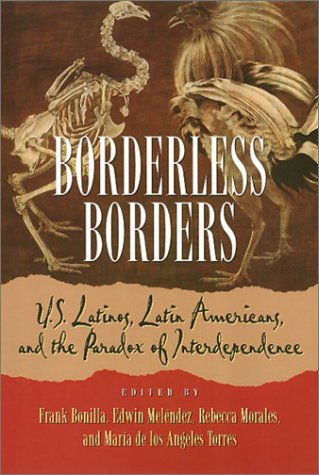

Borderless borders U.S. Latinos, Latin Americans, and the paradox of interdependence edited by Frank Bonilla ... [et al.].
Detalles de publicación: Phiadelphia Temple University Press 1998.Descripción: xiii, 290 p. ill. 24 cmISBN:- 1566396190 (cloth : alk. paper)
- 1566396204 (paper : alk. paper)
- 305.868073 21
- E184.S75 B674 1998
| Imagen de cubierta | Tipo de ítem | Biblioteca actual | Biblioteca de origen | Colección | Ubicación en estantería | Signatura topográfica | Materiales especificados | Info Vol | URL | Copia número | Estado | Notas | Fecha de vencimiento | Código de barras | Reserva de ítems | Prioridad de la cola de reserva de ejemplar | Reservas para cursos | |
|---|---|---|---|---|---|---|---|---|---|---|---|---|---|---|---|---|---|---|
| Libro | Biblioteca Mons. Iñaki Mallona (Arecibo) Colección General bev | Disponible | mq329725 |
Descripciones mejoradas de Syndetics:
This new reality -- the Latinization of the United States -- is driven by forces that reach well beyond U.S. borders. It asserts itself demographically, politically, in the workplace, and in daily life. The perception that Latinos are now positioned to help bring about change in the Americas from within the United States has taken hold, sparking renewed interest and specific initiatives by hemispheric governments to cultivate new forms of relationships with emigrant communities.
Borderless Borders describes the structural processes and active interventions taking place inside and outside U.S. Latino communities. After a context-setting introduction by urban planner Rebecca Morales, the contributors focus on four themes. Economist Manuel Pastor Jr., urban sociologist Saskia Sassen, and political scientist Carol Wise look at emerging forms of global and transnational interdependence and at whether they are likely to produce individuals who are economically independent or simply more dependent. Sociologist Jorge Chapa, social anthropologist Maria P. Fernandez Kelly, and economist Edwin Melendez examine the negative impact of economic and political restructuring within the United States,especially within Latino communities. Performance artist Guillermo Gomez-Pena, legal scholar Gerald Torres, political scientist Maria de los Angeles Torres, and modern language specialist Silvio Torres-Saillant consider the implications -- for community formation, citizenship, political participation, and human rights -- of the fact that individuals are forced to construct identities for themselves in more than one sociopolitical setting. Finally, sociologist Jeremy Brecher, sociologist Frank Bonilla, and political scientist Pedro Caban speculate on new paths into international relations and issue-oriented social movements and organizations among these mobile populations. To supplement the written contributions, Painter Bibiana Suarez has chosen several artworks that contribute to the interdisciplinary scope of the book.
Includes bibliographical references (p. 231-275) and index.
Notas de autor provistas por Syndetics
Frank Bonilla is Professor Emeritus and former Director of the Center for Puerto Rican Studies at Hunter College as well as former Managing Director of the Inter University Program in Latino Research.Edwin Melendez is Professor and Director of the Mauricio Gaston Institute for Latino Community Development and Public Policy at the University of Massachusetts, Boston.
Rebecca Morales is Research Associate at San Diego's Center for U.S. Mexican Studies and former Director of the Center for Urban Economic Development at the University of Illinois, Chicago.
Maria de los Angeles Torres is Associate Professor of Political Science at DePaul University.
CONTRIBUTORS: Jeremy Brecher, Pedro Caban, Jorge Chapa, Maria P. Fernandez Kelly, Guillermo Gomez-Pena, Manuel Pastor Jr., Saksia Sassen, Gerald Torres, Silvio Torres-Saillant, Carol Wise, and the editors.