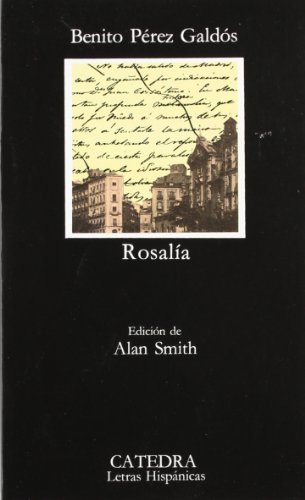

(Rosalía) Benito Pérez Galdós ; edición de Alan Smith.
Series Letras hispánicas ; 190Detalles de publicación: Madrid Cátedra c1984.Edición: 2a edDescripción: 440 p. facsims. 18 cmISBN:- 8437604230
- PQ6555 .R6x 1984
| Imagen de cubierta | Tipo de ítem | Biblioteca actual | Biblioteca de origen | Colección | Ubicación en estantería | Signatura topográfica | Materiales especificados | Info Vol | URL | Copia número | Estado | Notas | Fecha de vencimiento | Código de barras | Reserva de ítems | Prioridad de la cola de reserva de ejemplar | Reservas para cursos | |
|---|---|---|---|---|---|---|---|---|---|---|---|---|---|---|---|---|---|---|
| Libro | Biblioteca Encarnación Valdés Colección General bev | 863 P438ra (Navegar estantería(Abre debajo)) | Disponible | 80000000957897 |
Descripciones mejoradas de Syndetics:
En 1979, un joven investigador norteamericano consultaba unos manuscritos de los Episodios nacionales en la Biblioteca Nacional de Madrid. En el dorso de una cuartilla descubrio, de la misma mano, situaciones y personajes desconocidos en la obra galdosiana. Varios anos de trabajo han permitido reconstruir casi integra Rosalia (1872).
Based on the editor's thesis (Ph. D.--Harvard University, 1981) under the title: "Rosalía," una novela inédita de Galdós.
"Estudio-Epílogo": p. [383]-438.
Bibliography: p. 439-440.
Notas de autor provistas por Syndetics
Perez Galdos was Spain's outstanding nineteenth-century novelist. At a time when most Spanish novelists were limited by their regional backgrounds, Galdos possessed the intellect and vision to embrace the Spanish people as a nation. In 1873 he began the Episodios nacionales (National Episodes), a 46--volume series of historical novels in which he was concerned less with details and facts of history than with their impact on the lives of ordinary people.His works are sometimes divided into two periods: novels of the first period and contemporary Spanish novels. His early novels, Dona Perfecta (1876), Gloria (1877), Marianela (1878), and The Family of Leon Roch (1879), may be characterized as realistic with touches of romanticism. The novels are united by common characters and themes in the manner of Balzac's Human Comedy. Dona Perfecta is a denunciation of intolerance. Marianela explores the irony and tragedy of the destruction of love by scientific progress. Fortunata and Jacinta (1886-87), a four-volume masterpiece of the second period, contrasts two women - Jacinta, wife of the wealthy middle-class Juanito Santa Cruz, and Fortunata, his mistress. Both are admirable characters, but it is Fortunata who bears a son, demonstrating the vitality of the lower classes. The character of Maxi reveals Galdos's interest in mental illness and his naturalistic strain.
Born and educated in the Canary Islands, Perez Galdos studied law briefly and spent most of his adult life in Madrid. His study of lower-class Spanish life and his attempts to improve it led him to the advocacy of more equal distribution of wealth and outspoken opposition to the Catholic church. While always popular with the people, he fared less well in literary circles. In 1889 he sought admission to the Royal Academy, an honor he was refused until 1897, and the Nobel Prize went to a contemporary, Jose Echegaray, a writer of considerably less talent. Galdos died poor and blind. Although the government refused him a state funeral, the entire Spanish nation mourned him. English translations of his novels now out of print are The Disinherited Lady (1881), Miau (1888), Compassion (1897), and Tristana.
(Bowker Author Biography)