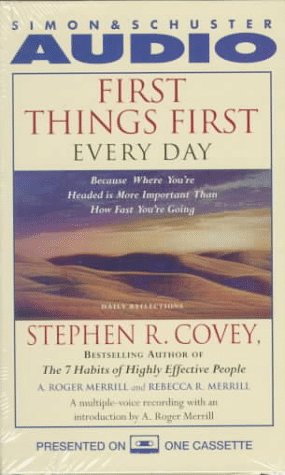
Imagen de portada de Amazon
Imagen de Amazon.com
Imagen de cubierta Syndetics
Portada de Syndetics
Imagen de OpenLibrary

Primero lo primero. Reflexiones diarias : porque lo importante es saber dónde se va y no cuán deprisa se llega / Stephen R. Covey ; traducción de: Alejandra Bolanca y Adolfo Negrotto.

Por: Colaborador(es): Series Paidos empresa ; 65Detalles de publicación: Barcelona : Paidós , 1999.Tipo de contenido:
Tipo de medio:
Tipo de soporte:
ISBN:
  • 0671576976
Tema(s):
Valoración
    Valoración media: 0.0 (0 votos)
Existencias
Imagen de cubierta Tipo de ítem Biblioteca actual Biblioteca de origen Colección Ubicación en estantería Signatura topográfica Materiales especificados Info Vol URL Copia número Estado Notas Fecha de vencimiento Código de barras Reserva de ítems Prioridad de la cola de reserva de ejemplar Reservas para cursos
Libro Biblioteca de Mayagüez Colección General mb BJ1581.2 .C66218 1999 (Navegar estantería(Abre debajo)) Disponible 50000002090453
Libro Biblioteca Encarnación Valdés Colección General bev 158.1 C8736f E (Navegar estantería(Abre debajo)) Disponible 80000002034646
Total de reservas: 0

Descripciones mejoradas de Syndetics:

FIRST THINGS FIRST EVERY DAYBecause Where You're Headed is More Important Than How Fast You're GoingSTEVEN R. COVEYA. ROGER MERRILL AND REBECCA R. MERRILLA multiple-voice recording with an introduction by A. Roger MerrillFIRST THINGS FIRST HELPS YOU UNDERTAND WHAT'S MOST IMPORTANT EVERY DAY...Stephen R. Covey and the Merrills have shown millions of listeners how to balance the demands of a schedule with the desire for fulfillment. Now the principles they introduced inFirst Things Firstare distilled for everyday listening. LetFirst Things First Every Daybe your guide to the rich relationships, the inner peace, and the confidence that come from knowing where you're headed, and why.

Translation of: First things first every day .

Extracto provisto por Syndetics

Chapter 1 January 1 Basing our happiness on our ability to control everything is futile. While we do control our choice of action, we cannot control the consequences of our choices. Universal laws or principles do. Thus, we are not in control of our lives; principles are. p. 12* All page references are to First Things First. January 2 We live in a modern society that loves shortcut techniques. Yet quality of life cannot be achieved by taking the right shortcut. There is no shortcut. But there is a path. The path is based on principles revered throughout history. If there is one message to glean from this wisdom, it is that a meaningful life is not a matter of speed or efficiency. It's much more a matter of what you do and why you do it than how fast you get it done. p. 12 January 3 The power is in the principles. p. 14 January 4 Be governed by your internal compass, not by some clock on the wall. p. 16 January 5 If the thing you've committed to do is principle-centered, you gradually become a little more principle-centered. You keep the promise to yourself and your own integrity account goes up. One of the best ways to strengthen our independent will is to make and keep promises. Each time we do, we make deposits in our Personal Integrity Account. This is a metaphor that describes the amount of trust we have in ourselves, in our ability to walk our talk. It's important to start small. p. 68 January 6 For most of us, the issue is not between the "good" and the "bad," but between the "good" and the "best." So often, the enemy of the best is the good. p. 18 January 7 In the absence of "wake-up calls," many of us never really confront the critical issues of life. Instead of looking for deep chronic causes, we look for quick-fix Band-Aids and aspirin to treat the acute pain. Fortified by temporary relief, we get busier and busier doing "good" things and never even stop to ask ourselves if what we' re doing really matters most. p. 21 January 8 Paradigms are like maps. They' re not the territory; they describe the territory. And if the map is wrong -- if we're trying to get to someplace in Detroit and all we have is a map of Chicago -- it's going to be very difficult for us to get where we want to go. We can work on our behavior -- we can travel more efficiently, get a different car with better gas mileage, increase our speed -- but we're only going to wind up in the wrong place fast. We can work on our attitude -- we can get so "psyched up" about trying to get there that we don't even care that we're in the wrong place. But the problem really has nothing to do with attitude or behavior. The problem is that we have the wrong map. p. 25 January 9 Our problem, as one put it, "is to get at the wisdom we already have." p. 73 January 10 We're not in control; principles are. We can control our choices, but we can't control the consequences of those choices. When we pick up one end of the stick, we pick up the other. p. 25 January 11 While you can be efficient with things, you can't be efficient -- effectively -- with people. p.26 January 12 The way we see (our paradigm) leads to what we do (our attitudes and behaviors), and what we do leads to the results we get in our lives. So if we want to create significant change in the results, we can't just change attitudes and behaviors, methods or techniques; we have to change the basic paradigms out of which they grow. p. 28 January 13 One thing's for sure: If we keep doing what we're doing, we' re going to keep getting what we' re getting. p.30 January 14 We need to move beyond time management to life leadership. p.31 January 15 It's important to realize that urgency itself is not the problem. The problem is that when urgency is the dominant factor in our lives, importance isn't. What we regard as "first things" are urgent things. We're so caught up in doing, we don't even stop to ask if what we're doing really needs to be done. p.36 January 16 While management is problem-oriented, leadership is opportunity-oriented. p. 48 January 17 Values will not bring quality-of-life results.., unless we value principles. p.52 January 18 All the wishing and even all the work in the world, if it's not based on valid principles, will not produce quality-of-life results. It's not enough to dream. It's not enough to try. It's not enough to set goals or climb ladders. It's not enough to value. The effort has to be based on practical realities that produce the result. p.52 January 19 The power of principles is that they' re universal, timeless truths. If we understand and live our lives based on principles, we can quickly adapt; we can apply them anywhere. p.53 January 20 To understand the application may be to meet the challenge of the moment, but to understand the principle is to meet the challenge of the moment more effectively and to be empowered to meet a thousand challenges of the future as well. p.53 January 21 The problems in life come when we're sowing one thing and expecting to reap something entirely different. p.56 January 22 Trust grows out of trustworthiness, out of the character to make and keep commitments, to share resources, to be caring and responsible, to belong, to love unconditionally. p.57 January 23 Quality of life is inside-out. Meaning is in contribution, in living for something higher than self. p.58 January 24 Between stimulus and response, there is a space. In that space is our power to choose our response. In our response lies our growth and our freedom. p.59 January 25 Stand apart from your dreams. Look at them. Write about them. Wrestle with them until you're convinced they're based on principles that will bring results. Then use your creative imagination to explore new applications, new ways of doing things that have the principle-based power to translate dreaming to doing. p. 64 January 26 To hear conscience clearly often requires us to be "still" or "reflective" or "meditative" -- a condition we rarely choose or find. p. 65 January 27 Make and keep a promise -- even if it means you' re going to get up in the morning a little earlier and exercise. Be sure you don't violate that commitment and be sure you don't overpromise and underdeliver. Build slowly until your sense of honor becomes greater than your moods. Little by little, your faith in yourself will increase. p. 68 January 28 Our lives are the results of our choices. To blame and accuse other people, the environment, or other extrinsic factors is to choose to empower those things to control us. p. 70 January 29 We choose -- either to live our lives or to let others live them for us. p.70 January 30 The best way to predict your future is to create it. p.72 January 31 If a goal isn't connected to a deep "why," it may be good, but it usually isn't best. p.142 Copyright © 1997 by Covey Leadership Center, Inc. Excerpted from First Things First Every Day: Daily Reflections- Because Where You're Headed Is More Important Than How Fast You Get There by Stephen R. Covey All rights reserved by the original copyright owners. Excerpts are provided for display purposes only and may not be reproduced, reprinted or distributed without the written permission of the publisher.

Notas de autor provistas por Syndetics

Stephen R. Covey was born on October 24, 1932, in Salt Lake City, Utah. He received a degree in business administration from the University of Utah, an M.B.A. from Harvard Business School, and a D.R.E. from Brigham Young University. He was a teacher and administrator at Brigham Young University. In 1983, he founded the Covey Leadership Center, a training and consulting concern.

He wrote numerous books on leadership, personal and organizational effectiveness, and family and interpersonal relationships. His best known book, The Seven Habits of Highly Effective People: Restoring the Character Ethic, first published in 1989. His other books include Principle Centered Leadership; First Things First: To Live, to Love, to Learn, and to Leave a Legacy; Daily Reflections for Highly Effective People; Seven Habits of Highly Effective Families; The 8th Habit: From Effectiveness to Greatness; and The 3rd Alternative. He received the Thomas More College Medallion and the Utah Symphony Fiftieth Anniversary Award in 1990, and the McFeely Award of the International Management Council for contributions and service in 1991. He died from injuries sustained in a bicycle accident on July 16, 2012 at the age of 79.

(Bowker Author Biography)

Compartir
logopucpr-y-vive

Contáctanos

¡Queremos saber de ti!

Tel. 787.841.2000 Ext. 1801

bibliotecavaldes@pucpr.edu

⁣Búscanos en las redes

© 2026 Desarrollado por Ignite Online • All Rights Reserved • Powered by Koha.