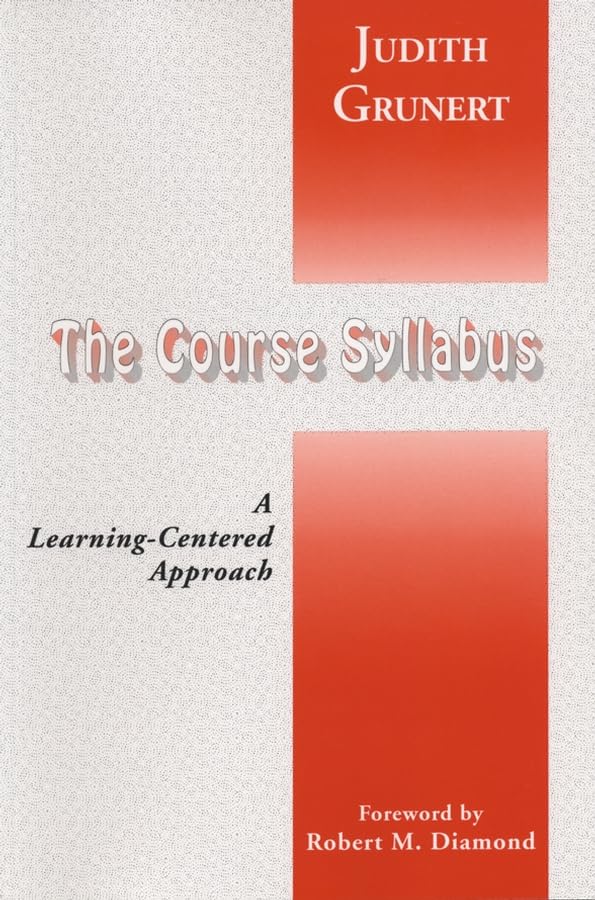

The course syllabus learning-centered approach.
Detalles de publicación: Bolton, Mass. Anker Pub. Co. 1997.Descripción: xiv , 97 p . ill. 23 cmISBN:- 1882982185
- Learning centered approach
| Imagen de cubierta | Tipo de ítem | Biblioteca actual | Biblioteca de origen | Colección | Ubicación en estantería | Signatura topográfica | Materiales especificados | Info Vol | URL | Copia número | Estado | Notas | Fecha de vencimiento | Código de barras | Reserva de ítems | Prioridad de la cola de reserva de ejemplar | Reservas para cursos | |
|---|---|---|---|---|---|---|---|---|---|---|---|---|---|---|---|---|---|---|
| Libro | Biblioteca de Derecho Mons. Fremiot Torres Oliver Colección General biblioteca derecho | LB2361 .G78 1997 (Navegar estantería(Abre debajo)) | Disponible | 70000000622923 |
Descripciones mejoradas de Syndetics:
This practical manual is meant to assist anyone interested in planning and constructing a learning-centered course syllabus. It presents why and how to construct a syllabus that shifts from what material a course will cover (the traditional syllabus) to one that reflects what tools and information an instructor can provide students to help them learn (the learning-centered syllabus). The book's underlying assumption is that good teaching helps students understand how to actively acquire, use, and extend knowledge in an ongoing process of learning.
The book begins by guiding readers through the planning stages of developing a learning-centered syllabus, using eight principles of designing a course that fosters critical thinking and a checklist for the content of a learning-centered syllabus. The discussions in each section include brief consideration of computer technology related to syllabus form, function, and use.
The book then moves into actual samples of learning-centered syllabi that cover: the letter to students; purpose of the course; course descriptions, goals, and objectives; resources for students; readings; evaluation and self-evaluation; learning contract form; learning style inventory; purpose of syllabus; and how to study for the course. Finally, the book concludes with a section of helpful references and suggested further readings.
This concise, practical, and straightforward guide is an immediately applicable resource for those who are constructing or revising a syllabus that focuses on student learning. It is a valuable resource for all instructors from new faculty, junior faculty, and teaching assistants to tenured faculty, faculty mentors or developers, department chairs, and deans.
Includes bibliographical references (p. 91 - 93 ) and index .
Spine title : the course syllabus .
Part I . Focus on learning - - Part II . Examples - - Part III . Resources .
Tabla de contenidos provista por Syndetics
- Foreword
- Preface
- Acknowledgments
- Part I Focus on Learning.Planning Your Learning-Centered Syllabus: An Overview of the Process
- Composing a Learning-Centered Syllabus
- Using a Learning-Centered Syllabus
- Part II Examples
- Checklist
- Title Page
- Table of Contents
- Instructor Information
- Letter to the Student
- Purpose of the Coarse
- Course Description
- Course and Unit Objectives
- Resources
- Readings
- Course Calendar
- Course Requirements
- Evaluation
- Grading Procedures
- How to Use the Syllabus
- How to Study for this Course
- Content Information
- Learning Tools
- Checklist
- Part III Resources
- Suggested Readings
- References
- Index
Notas de autor provistas por Syndetics
JUDITH GRUNERT 'S current research is concerned with how faculty across disciplines in higher education approach their research. She is presently at the Syracuse University Center for Instructional Development where she works with faculty in various disciplines to improve learning. Grunert's interest center on the ways that instructors in higher education can help students to become the agents of their own education. She draws upon her experience as a member of the School of Art faculty, College of Visual and Performing Arts, Syracuse University, and as a Lilly Endowment Fellow, when she developed curricular and instructional materials that would help students assume increasing responsibility over planning, implementing, and evaluating their learning experiences.Grunert has coordinated and contributed to the design and development of national educational projects for education, government, and not-for-profit organizations, She exhibits her sculpture and drawings at museums and galleries.