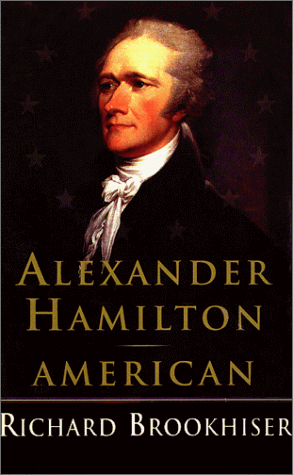
Alexander Hamilton is one of the least understood, most important, and most inspiring of the founding fathers. An impoverished immigrant when he first came to America at fifteen, Hamilton defined what it meant to be American when the definition was up for grabs. He pounced on opportunities and rose rapidly as a patriot, war hero, lawyer, journalist and author. His vision was expansive, idealistic and yet pragmatic. Killed in a duel with Vice President Aaron Burr at the age of forty-seven, Alexander Hamilton's story is brought to full-blooded life by biographer Richard Brookhiser.
Includes bibliographical references and index.
Tabla de contenidos provista por Syndetics
Introduction(p. 1)
1 St. Croix/Manhattan(p. 13)
2 War(p. 29)
3 Laws(p. 51)
4 Treasury Secretary(p. 75)
5 Fighting(p. 101)
6 Losing(p. 127)
7 Words(p. 155)
8 Rights(p. 169)
9 Passions(p. 183)
10 Death(p. 197)
Notes(p. 219)
Index(p. 233)
Reseñas proporcionadas por Syndetics
Library Journal Review
Brookhiser is a senior editor at the National Review and an acolyte of conservative political commentators William F. Buckley Jr. and William Rusher. Given these credentials, it is not surprising to find that he admires Alexander Hamilton and other early Federalists. Even readers who do not share Brookhiser's political views, however, will find his new book authoritative and great fun to read. Brookhiser manages to make accessible even the most arcane financial policies of America's first secretary of the treasury. As in his earlier Founding Father: Rediscovering George Washington (LJ 2/1/96), Brookhiser manages in relatively few pages to offer a persuasive portrait of a founding father. Avoiding hagiography, he demonstrates that Hamilton was not an evil agent of big money and big government but genuinely an American in his devotion to the interests of the entire nation rather than to particular states, regions, or classes. Highly recommended for all academic and public libraries.Thomas J. Schaeper, St. Bonaventure Univ., NY (c) Copyright 2010. Library Journals LLC, a wholly owned subsidiary of Media Source, Inc. No redistribution permitted.
Publishers Weekly Review
Brookhiser (Founding Father: Rediscovering George Washington) rediscovers another founding father. Hamilton was one of the epochal figures of the Revolutionary periodhe collaborated with Madison on the Federalist papers, served as secretary of the treasury under Washington and, along with Jefferson, is largely responsible for the modern two-party systembut he was also one of the most controversial. John Adams called Hamilton a "bastard" and a "foreigner" (both charges held some degree of truth); Jefferson thought he was secretly "against the liberty of the country," an accusation Brookhiser emphatically disproves. Hamilton's death only increased his infamy; he fell in a duel with then Vice President Aaron Burr, an event that remains one of the most bizarre in American history. ("Imagine Al Gore shooting Donald Regan," Brookhiser writes.) In this slim but rewarding book, Brookhiser traces the entire course of Hamilton's professional and personal life. Though he doesn't shrink from the more unsavory episodes, such as Hamilton's adulterous affair with a married woman and her subsequent blackmail of him, the author clearly admires his subject. The only blemish is Brookhiser's occasional use of bubblegum psychology, as when he writes of Hamilton's desire to "be his father" as a driving force behind Hamilton's infidelity. Although he doesn't provide a substantive analysis of Hamilton's work (just four pages are given to the Federalist papers, arguably the most important contribution of Hamilton's career), Brookhiser gives us a valuable, incisive portrait both of Hamilton's character and of the character of young America. (Mar.) (c) Copyright PWxyz, LLC. All rights reserved
CHOICE Review
A self-avowed Hamiltonian, Brookhiser considers his subject "greater" than every contemporary American except Washington, about whom Brookhiser has also written. The problems Hamilton observed during the Revolution convinced him that a strong economic foundation was vital to the success of any government. From his 1780s study of the Bank of England and the writings of French finance minister Jacques Necker, Hamilton developed the policies he instituted as Secretary of the Treasury. He left the cabinet when he had accomplished his goals but continued to serve Washington, most notably by drafting his farewell address, a task for which he claimed no credit. Indeed, Brookhiser depicts Hamilton as driven less by personal ambition than by a nationalism that exceeded that of his contemporaries, and by a commitment to the sanctity of contracts and the rule of law. After 1796 Hamilton's disappointments and defeats resulted largely from his own misjudgments, but he continued to contribute to society as a constitutional lawyer. Gracefully and pithily written, this well-balanced study will replace Forrest McDonald's Alexander Hamilton: A Biography (CH, Feb'80) as the standard single-volume study of the least understood or written about Founding Father. All levels. J. C. Bradford Texas A&M University
Booklist Review
Brookhiser, prominent among tastemakers of conservative opinion, ventures this reappraisal of American conservatism's icon. A figure who excites debate now as he did in life, Hamilton undoubtedly has a sympathetic advocate in Brookhiser. Not challenging the standard biography (Alexander Hamilton by Forrest McDonald, 1979), Brookhiser compacts the highlights of Hamilton's career into a bright, interesting narrative, the approach taken in his successful Founding Father: Rediscovering George Washington (1996). Unlike other founders to the plantation born, Hamilton rose from penury on the outlands of empire. Having made his own money (as a lawyer), Hamilton, argues the author, valued it as the means of personal advancement and as the sinew of nascent American nationalism. His convictions about government finance conflicted with Jefferson's national vision, providing Brookhiser's account of their polemics and those of their political supporters with its dramatic peak. Criticizing aspects of Hamilton's rhetoric, Brookhiser displays his independent judgment in a generally admiring work. Its felicitous composition and insights about Hamilton's adopted American identity make it eminently readable for buffs and historians alike. --Gilbert Taylor
Notas de autor provistas por Syndetics
Richard Brookhiser is a Senior Editor at The National Review and a New York Observer columnist. He writes for numerous magazines and newspapers including Time, Vanity Fair, and The New York Times, and he appears frequently on Charlie Rose, Politically Incorrect, and C-SPAN. He lives in New York City.
Alexander Hamilton, American
APA
Brookhiser R., . (1999). Alexander Hamilton, American. Thorndike, ME: Thorndike Press.