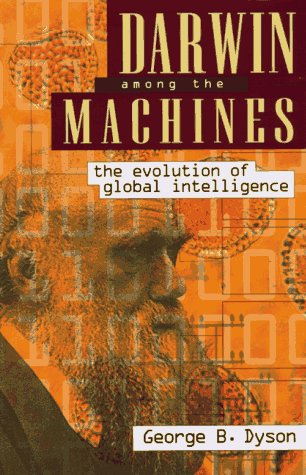
Imagen de portada de Amazon
Imagen de Amazon.com
Imagen de cubierta Syndetics
Portada de Syndetics
Imagen de OpenLibrary

Darwin among the machines the evolution of global intelligence George B. Dyson.

Por: Detalles de publicación: Reading, Massachusetts Addsion-Wesley Pub.Co. 1997.Descripción: xii, 286 pISBN:
  • 0201406497
Tema(s): Clasificación CDD:
  • 006.3
Clasificación LoC:
  • Q335.D97 1997
Premios: Haga clic para abrir en una nueva ventana
Valoración
    Valoración media: 0.0 (0 votos)
Existencias
Imagen de cubierta Tipo de ítem Biblioteca actual Biblioteca de origen Colección Ubicación en estantería Signatura topográfica Materiales especificados Info Vol URL Copia número Estado Notas Fecha de vencimiento Código de barras Reserva de ítems Prioridad de la cola de reserva de ejemplar Reservas para cursos
Libro Biblioteca Mons. Iñaki Mallona (Arecibo) Colección General ab 006.3 D997d (Navegar estantería(Abre debajo)) Disponible 60000002014527
Total de reservas: 0

Includes biliographical reference and index.

Reseñas proporcionadas por Syndetics

Library Journal Review

Dyson, son of scientist Freeman and brother of computer guru Esther, sees the World Wide Web as a major evolutionary development in the creation of "a globally networked, electronic, sentient being." Using historical fact as well as fiction, he explains how we have arrived at this juncture. He reveals an impressive literary and scientific background as he moves from Thomas Hobbes, Samuel Butler, and Leibniz to Turing, von Neumann, and others. However, it is not always obvious what point he is making, and he finds mythology as useful in explaining this evolution as historical fact. Dyson provides substantial detail about the development of intelligent machines as he traces the history of modern computing from the ballistics computations of the 1940s and 1950s to the SAGE project and other military applications, which had spinoffs and by-products culminating in today's network-based system. Certainly, computer technology is having a revolutionary effect on how we do many things and, in fact, what we do. But whether we are seeing Darwinian evolution among the machines remains unproved to this reviewer. Recommended for larger collections.‘Hilary D. Burton, Lawrence Livermore National Lab., Livermore, Cal. (c) Copyright 2010. Library Journals LLC, a wholly owned subsidiary of Media Source, Inc. No redistribution permitted.

CHOICE Review

Anyone interested in how computers are affecting our society, or how computers themselves are changing in an evolutionary sense, will want to read this book. Dyson takes a look at the symbiotic relationship between computers and humans from the perspective of evolution. How is computing evolving? How are computers affecting human evolution? This reviewer found the preface and acknowledgment sections very useful in understanding Dyson's ideas, which arose from his experiences while one of his parents was at the Institute for Advanced Study at Princeton. The author's descriptions and understanding of the works of von Neumann, G"odel, and others lends credence to his speculation about the future of humans and the machines they create. The book is composed of 12 well-focused chapters. For those who wish to delve into the author's premises, the book contains an excellent collection of references and endnotes. Very helpful index. General readers; undergraduates through professionals. J. Beidler; University of Scranton

Notas de autor provistas por Syndetics

George Dyson, the son of distinguished physicist Freeman Dyson, grew up immersed in the world of groundbreaking science. His previous books include the acclaimed Darwin Among the Machines. He lives in Washington.
Compartir
logopucpr-y-vive

Contáctanos

¡Queremos saber de ti!

Tel. 787.841.2000 Ext. 1801

bibliotecavaldes@pucpr.edu

⁣Búscanos en las redes

© 2026 Desarrollado por Ignite Online • All Rights Reserved • Powered by Koha.