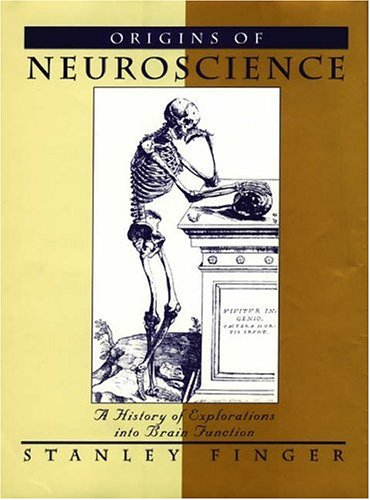

Origins of neuroscience a history of explorations into brain function Stanley Finger.
Detalles de publicación: New York Oxford University Press 1994.Descripción: xviii, 462 p. ill. 29 cmISBN:- 0195065034 (alk. paper)
- 612.8/09 20
- QP353 .F55 1994
- WL 11.1 F497o
| Imagen de cubierta | Tipo de ítem | Biblioteca actual | Biblioteca de origen | Colección | Ubicación en estantería | Signatura topográfica | Materiales especificados | Info Vol | URL | Copia número | Estado | Notas | Fecha de vencimiento | Código de barras | Reserva de ítems | Prioridad de la cola de reserva de ejemplar | Reservas para cursos | |
|---|---|---|---|---|---|---|---|---|---|---|---|---|---|---|---|---|---|---|
| Libro | Biblioteca Encarnación Valdés Colección General bev | 612.809 F497o (Navegar estantería(Abre debajo)) | Disponible | 80000002045725 |
Descripciones mejoradas de Syndetics:
With over 350 illustrations, this impressive volume traces the rich history of ideas about the functioning of the brain from its roots in the ancient cultures of Egypt, Greece, and Rome through the centuries into relatively modern times. In contrast to biographically oriented accounts, this book is unique in its emphasis on the functions of the brain and how they came to be associated with specific brain regions and systems. Among the topics explored are vision, hearing, pain, motor control, sleep, memory, speech, and various other facets of intellect. The emphasis throughout is on presenting material in a very readable way, while describing with scholarly acumen the historical evolution of the field in all its amazing wealth and detail. From the opening introductory chapters to the concluding look at treatments and therapies, this monumental work will captivate readers from cover to cover. It will be valued as both an historical reference and as an exciting tale of scientific discovery. It is bound to attract a wide readership among students and professionals in the neural sciences as well as general readers interested in the history of science and medicine.
Includes bibliographical references and index.
Tabla de contenidos provista por Syndetics
- 1 Ostracism: Ubiquitous and Powerful(p. 1)
- Ostracism: A Review of the Literature(p. 7)
- Previous Social Psychological Investigations of Ostracism(p. 15)
- Limitations of Early Social Psychological Research(p. 17)
- Conclusions(p. 18)
- 2 Forty Years of Solitude: Cases of Ostracism(p. 19)
- Forty Years of Solitude(p. 20)
- Targets' Perspectives(p. 21)
- Sources' Perspectives(p. 34)
- Conclusions(p. 42)
- 3 A Model of Ostracism(p. 43)
- The Model(p. 45)
- Taxonomic Dimensions(p. 47)
- Antecedents(p. 57)
- Moderators and Mediators(p. 58)
- Ostracism Threatens Four Fundamental Human Needs(p. 59)
- Reactions to Ostracism: Temporal Stages(p. 64)
- Application of the Model to Sources(p. 65)
- Conclusion(p. 69)
- 4 Forty Minutes of Silence: Narratives of Short-Term Episodes of the Silent Treatment(p. 70)
- Some Background into the Silent Treatment(p. 71)
- Study 1. The Silent Treatment: Perceptions of Its Behaviors and Associated Feelings(p. 73)
- Study 2. Perceptions and Self-Ratings of the Silent Treatment(p. 78)
- Summary of Studies 1 and 2(p. 81)
- Where Is the Silent Treatment in the Taxonomy?(p. 82)
- Narratives of the Silent Treatment(p. 83)
- Study 3. Narratives of Younger University Students(p. 86)
- Study 4. Narratives of Older University Students(p. 91)
- Combining the Common Results of Studies 3 and 4(p. 93)
- Examining the Role of Self-Esteem in the Use of and Reactions to the Silent Treatment(p. 94)
- Why Do Targets Experience More Control When the Cause Is Unclear?(p. 95)
- Conclusions(p. 96)
- 5 The Scarlet Letter Study: Five Days of Ostracism(p. 99)
- The Scarlet Letter Study(p. 101)
- Summary of Findings(p. 120)
- Conclusions(p. 123)
- 6 Laboratory Experiments: The Ball-Tossing Paradigm(p. 125)
- Experiments 1 and 2. Effects of Ostracism on the Loss and Reclamation of Control(p. 129)
- Experiment 3. Effects of Ostracism on Belonging and Reinclusion into the Group(p. 135)
- Conclusions(p. 140)
- 7 More Laboratory Experiments: The Train Ride(p. 142)
- Study 1. Ostracism Can Cause Targets to Overestimate Consensus(p. 144)
- Study 2. Causally Unclear Ostracism Is Worse Than Causally Clear Ostracism(p. 147)
- Study 3. Ostracism Is Worse Than Argument(p. 148)
- Study 4. Effects of Ostracism, Argument, and Inclusion on Needs, Stress, and Anxiety(p. 151)
- Study 5. Effects of Ostracism and Argument on Stress, Mood, and Eating(p. 157)
- Conclusions(p. 159)
- 8 Cyberostracism: Getting Silenced on the Internet(p. 162)
- Cyberostracism(p. 165)
- The Online Flying Disc and Cyberball Experiments(p. 166)
- Chat-Room Paradigms(p. 184)
- Conclusions(p. 188)
- 9 Ostracism in and by Organizations(p. 189)
- Ostracism and the Whistleblower(p. 191)
- Ostracism and the Temp(p. 205)
- The Company Ostracizing the Consumer(p. 210)
- Conclusions(p. 216)
- 10 Everyday Ostracism over Days, Months, and Years(p. 218)
- The Sydney Ostracism Record(p. 219)
- The SOR-S Study(p. 222)
- The SOR-T Study(p. 226)
- Summary of Diary Findings(p. 229)
- Structured Interviews of Individuals with Long-Term Experience with Ostracism(p. 229)
- Conclusions(p. 238)
- 11 Reflections and Future Aims(p. 240)
- Support for the Model(p. 240)
- Recent Research by Other Investigators(p. 248)
- Future Research(p. 251)
- Conclusions(p. 258)
- References(p. 259)
- Index(p. 275)