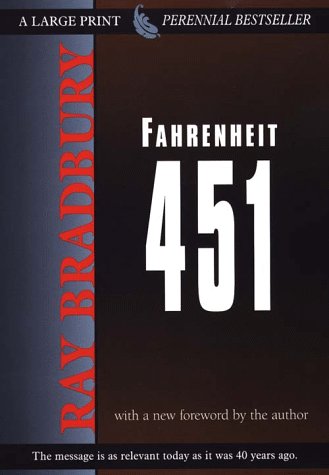

Fahrenheit 451 Ray Bradbury ; with a new foreword by Ray Bradbury.
Detalles de publicación: Thorndike, Me. G.K. Hall 1997.Descripción: 227 p. (large print) 24 cmTipo de contenido:- 0783883137 (lg. print : hc : alk. paper)
- Fahrenheit four hundred fifty-one
- 813/.54 21
- PS3503.R167 F3 1997
| Imagen de cubierta | Tipo de ítem | Biblioteca actual | Biblioteca de origen | Colección | Ubicación en estantería | Signatura topográfica | Materiales especificados | Info Vol | URL | Copia número | Estado | Notas | Fecha de vencimiento | Código de barras | Reserva de ítems | Prioridad de la cola de reserva de ejemplar | Reservas para cursos | |
|---|---|---|---|---|---|---|---|---|---|---|---|---|---|---|---|---|---|---|
| Libro | Biblioteca Encarnación Valdés Colección General bev | 813.54 B798f (Navegar estantería(Abre debajo)) | Disponible | 80000002055146 |
Descripciones mejoradas de Syndetics:
A totalitarian regime has ordered all books to be destroyed, but one of the book burners suddenly realizes their merit.
"The 40th anniversary edition."
"G.K. Hall large print perennial bestseller collection"--T.p. verso.
Extracto provisto por Syndetics
Reseñas proporcionadas por Syndetics
Library Journal Review
In Bradbury's dystopian future, Guy Montag works as a fireman. Instead of putting out fires, however, he sets books ablaze in a world that prohibits independent thought, where walls are giant TV screens, and everyone is the same. But one fateful fire changes everything for Montag as he unexpectedly discovers the true pleasure and the life-changing knowledge offered by books. He goes on the run, leaving behind his career and wife, and finds a community of people dedicated to preserving books. Bradbury's classic novel is a stark reminder of the importance of reading, individual thought, and the dangers of censorship and technology. Actor Badgley from the Netflix series You portrays Montag as he transitions from a rule follower to a rule breaker, and his narration effectively captures his growth as he begins to understand the true depths and ramifications of his actions. Though Bradbury's words are well-known to many, Badgley's narration packs a punch, highlighting the chilling relevance of the 1953 novel. VERDICT Badgley's potent narration brings this classic story to a modern audience in a time when it is needed more than ever.--Elyssa EverlingPublishers Weekly Review
After years of working as a fireman-one who burns books and enjoys his work-Guy Montag meets a young girl who makes him question his profession and the values of the society in which he lives. Stephan Hoye's narration is perfectly matched to the subject matter: his tone is low and ominous, and his cadence shifts with the prose to ratchet up tension and suspense. He produces spot-on voices, and his versions of the gruff Captain Beatty, the playful Clarisse, and the fearful professor Faber are especially impressive. A Ballantine paperback. (Aug.) (c) Copyright PWxyz, LLC. All rights reserved.School Library Journal Review
In this foremost example of dystopian fiction, Bradbury twists the heroic role of firefighters. In a futuristic society, firemen don't put out fires, they start them. Specifically, they burn books and the subversive ideas contained within their pages. The trouble begins when one fireman, Guy Montag, begins to question the system and seeks to escape the control of the city. Hoye is a superb guide through this terrifying world, moving both action and reflection along with exactly the right pacing. First published in 1953, the story remains disturbingly contemporary and the ending, with its determination to keep books alive by memorizing them and speaking them aloud, is well suited to the audio medium. The 1996 film, directed by Francois Truffaut and starring Julie Christie and Oskar Werner, veers from the original story, making it particularly useful as a student exploration of the differences between Hoye's interpretation of Bradbury's words and Truffaut's greater liberties with the text. (c) Copyright 2013. Library Journals LLC, a wholly owned subsidiary of Media Source, Inc. No redistribution permitted.Spanish Review
"Fahrenheit 451 es el más convincente de todos los infiernos conformistas."Notas de autor provistas por Syndetics
Ray Bradbury was born in Waukegan, Illinois on August 22, 1920. At the age of fifteen, he started submitting short stories to national magazines. During his lifetime, he wrote more than 600 stories, poems, essays, plays, films, television plays, radio, music, and comic books. His books include The Martian Chronicles, Fahrenheit 451, The Illustrated Man, Dandelion Wine, Something Wicked This Way Comes, and Bradbury Speaks. He won numerous awards for his works including a World Fantasy Award for Life Achievement in 1977, the 2000 National Book Foundation Medal for Distinguished Contribution to American Letters, the 2004 National Medal of Arts, and the 2007 Pulitzer Prize Special Citation.He wrote the screen play for John Huston's classic film adaptation of Moby Dick, and was nominated for an Academy Award. He adapted 65 of his stories for television's The Ray Bradbury Theater, and won an Emmy for his teleplay of The Halloween Tree. The film The Wonderful Ice Cream Suit was written by Ray Bradbury and was based on his story The Magic White Suit.
He was the idea consultant and wrote the basic scenario for the United States pavilion at the 1964 World's Fair, as well as being an imagineer for Walt Disney Enterprises, where he designed the Spaceship Earth exhibition at Walt Disney World's Epcot Center. He died after a long illness on June 5, 2012 at the age of 91.
(Bowker Author Biography)