Descripciones mejoradas de Syndetics:
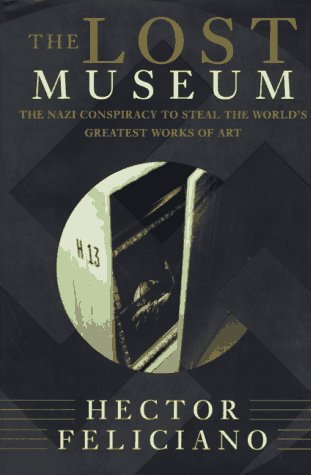
Between 1939 and 1944, as the Nazis overran Europe, they were also quietly conducting another type of pillage. The Lost Museum tells the story of the Jewish art collectors and gallery owners in France who were stripped of rare works by artists such as Vermeer, Rembrandt, Degas, Cézanne, and Picasso. Before they were through, the Nazis had taken more than 20,000 paintings, sculptures, and drawings from France. The Lost Museum explores the Nazis' systematic confiscation of these artworks, focusing on the private collections of five families: Rothschild, Rosenberg, Bernheim-Jeune, David-Weill, and Schloss. The book is filled with private family photos of this art, some of which has never before been seen by the public, and it traces the fate of these works as they passed through the hands of top German officials, unscrupulous art dealers, and unwitting auction houses such as Christie's and Sotheby's.
Includes bibliographical references (p. 257-265) and index.
Reseñas proporcionadas por Syndetics
Library Journal Review
The systematic looting of Europe's art treasures by Nazi Germany was on a scale rivaled since Napoleon's time. Tracing Germany's methodical confiscation of French collections, journalist Feliciano tells a compelling story. He focuses on French private collections that were either appropriated outright by the German government or "purchased" at fire-sale prices. Though many of these works were returned at the close of the war, Feliciano carefully tracks a number that have yet to be restored. Feliciano does a good job of keeping the various collections, works, and German governmental agencies distinct. Well written and thoroughly documented, the book is a useful addition to the growing literature on this subject. In a work that is part mystery, part crime thriller, and part art history, New York Times reporter Honan tells how he helped track down the priceless medieval treasures of Quedlinburg, missing since the end of World War II. The treasuresjewel-encrusted manuscripts and reliquarieswere last seen shortly before the end of the war and were suspected stolen by an American soldier. Following leads from a German cultural agent, Honan methodically tracks the treasures to a small Texas town. Unraveling the mystery of how they got there and who the culprit was makes for page-turning reading. His account, unlike Feliciano's, is of a relatively isolated incident. Their shared storythe loss of cultural heritage in wartimeis, however, too common. For a more scholarly history of Nazi German cultural theft, see Lynn H. Nicholas's The Rape of Europa (LJ 5/1/94). Both reviewed works are highly recommended for public and academic libraries with an interest in art or World War II.Martin R. Kalfatovic, Smithsonian Inst. Libs., Washington, D.C. (c) Copyright 2010. Library Journals LLC, a wholly owned subsidiary of Media Source, Inc. No redistribution permitted.
Publishers Weekly Review
Feliciano focuses on five major collectionsof the Rothschilds, the Paul Rosenbergs, the Bernheim-Jeunes, the David-Weills and the Schlossesto illustrate how Nazis (and many others) took advantage of anti-Jewish laws to confiscate Jewish art. Between ideological programs (such as Otto Kümmel's list of German art in France to be repatriated), the personal rapaciousness of officials (Goering being a particularly famous example) and the greed of collaborators such as the Parisian antique dealers Yves Perdoux and Cunt de Lestang, major works were dispersed, sold for profit and, on occasion, destroyed. The fate of cultural artifacts in France during the occupation has been Feliciano's preoccupation for some time, and he has certainly done his legwork, tracking down original owners of such works as Leger's Woman in Red and Green at the Musée National d'Art Moderne in Paris. The problem is, he doesn't seem to quite believe that his subject is important. The result is a style that is sometimes breathless, sometimes self-aggrandizing, whether in declarations such as "I took a deep breath"; the praises for his own work (he likens his book to "the discovery of an archipelago"); or generally excitable prose. Also, Feliciano is first and foremost a journalist (he is a contributor to the L.A. Times, the Washington Post and the New York Times), and the longer book length shows up jarring jumps in chronology and an overall choppiness. This is a slightly augmented translation by the author of his own book, published in Paris in 1995. (June) (c) Copyright PWxyz, LLC. All rights reserved
Booklist Review
Feliciano, a journalist based in Paris, focuses on the Nazi confiscation of the extraordinary collections of five renowned French Jewish families: the Paul Rosenbergs, the Rothschilds, the Bernheim-Jeunes, the David-Weills, and the Schlosses. He begins his account with a shrewd analysis of Hitler's twisted fascination with art and grandiose plan for an immense Nazi museum stocked with looted masterpieces but is soon awash in disturbing facts pertaining to the shameful postwar policies of French museum officials who concealed the sources of paintings and obstructed owner research that would have returned hundreds of precious works to their rightful owners. Feliciano became so incensed by his discoveries that he turned himself into an art detective to track the fate of stolen paintings by such masters as Vermeer, Rembrandt, and Degas, a mission of great import in terms of both justice and historical verity. Honan, a reporter for the New York Times, found himself investigating the disappearance, during World War II, of the treasures of Quedlinburg, Germany--priceless medieval manuscripts bound with covers of gold, ivory, and jewels, including the Samuhel Gospels, and a group of extraordinary reliquaries. Heinrich Himmler stashed them in a cave; the Americans found them right away and posted guards, but the treasures vanished without a trace until 1990, when Honan received a phone call from an insistent German named Willi Korte. Initially skeptical about Korte's claims that the objects had been taken by an American GI, Honan soon found himself committed to an exciting and risky investigation. All tips pointed to the dilapidated town of Whitewright, Texas, so Honan persevered, following the trail of a deceased veteran named Joe Tom Meador, a kleptomaniac with a passion for art and orchids. Honan achieves the perfect mix of self-deprecating humor and suspense as he relates his adventures solving one of the century's biggest art crimes. --Donna Seaman