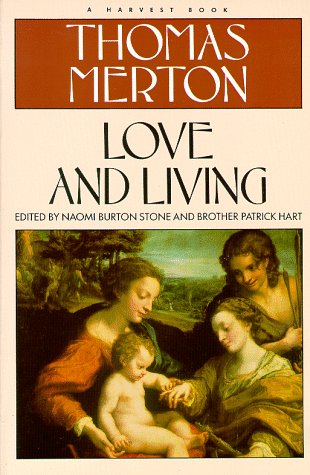

Amar y vivir el testamento espiritual de Merton Thomas Merton ; traducción de Joaquín Adsuar.
Detalles de publicación: Barcelona Ediciones Paidos 1997.Descripción: 137 pISBN:- 0156538954 (pbk.)
- 230/.2 19
- BX1751.2 .M47 1985
| Imagen de cubierta | Tipo de ítem | Biblioteca actual | Biblioteca de origen | Colección | Ubicación en estantería | Signatura topográfica | Materiales especificados | Info Vol | URL | Copia número | Estado | Notas | Fecha de vencimiento | Código de barras | Reserva de ítems | Prioridad de la cola de reserva de ejemplar | Reservas para cursos | |
|---|---|---|---|---|---|---|---|---|---|---|---|---|---|---|---|---|---|---|
| Libro | Biblioteca Encarnación Valdés Colección General bev | 230.2 M575l E (Navegar estantería(Abre debajo)) | Disponible | 80000002057894 |
Descripciones mejoradas de Syndetics:
A posthumously published collection of Merton's essays and meditations centering on the need for love in learning to live. "Love is the revelation of our deepest personal meaning, value, and identity." Edited by Naomi Burton Stone and Brother Patrick Hart.
Reprint. Originally published: New York : Farrar Straus Giroux, c1979.
Translation of : Love and Living
Extracto provisto por Syndetics
Notas de autor provistas por Syndetics
Born in France, Thomas Merton was the son of an American artist and poet and her New Zealander husband, a painter. Merton lost both parents before he had finished high school, and his younger brother was killed in World War II. Something of the ephemeral character of human endeavor marked all his works, deepening the pathos of his writings and drawing him close to Eastern, especially Buddhist, forms of monasticism.After an initial education in the United States, France, and England, he completed his undergraduate degree at Columbia University. His parents, nominally friends, had given him little religious guidance, and in 1938, he converted to Roman Catholicism. The following year he received an M.A. from Columbia University and in 1941, he entered Gethsemani Abbey in Kentucky, where he remained until a short time before his death.
His working life was spent as a Trappist monk. At Gethsemani, he wrote his famous autobiography, "The Seven Storey Mountain" (1948); there he labored and prayed through the days and years of a constant regimen that began with daily prayer at 2:00 a.m. As his contemplative life developed, he still maintained contact with the outside world, his many books and articles increasing steadily as the years went by. Reading them, it is hard to think of him as only a "guilty bystander," to use the title of one of his many collections of essays. He was vehement in his opposition to the Vietnam War, to the nuclear arms race, to racial oppression.
Having received permission to leave his monastery, he went on a journey to confer with mystics of the Hindu and Buddhist traditions. He was accidentally electrocuted in a hotel in Bangkok, Thailand, on December 10, 1968.
(Bowker Author Biography)