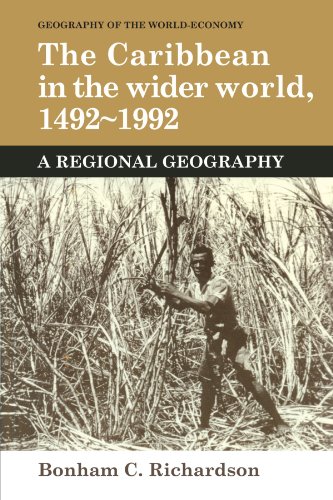

The Caribbean in the wider world, 1492-1992 A regional geography Bonham C. Richardson.
Series Geography of the world-economyDetalles de publicación: New York, NY Cambridge University Press 1992.Descripción: xvi, 235 pISBN:- 0521359775
- F2175 .R49 1992
| Imagen de cubierta | Tipo de ítem | Biblioteca actual | Biblioteca de origen | Colección | Ubicación en estantería | Signatura topográfica | Materiales especificados | Info Vol | URL | Copia número | Estado | Notas | Fecha de vencimiento | Código de barras | Reserva de ítems | Prioridad de la cola de reserva de ejemplar | Reservas para cursos | |
|---|---|---|---|---|---|---|---|---|---|---|---|---|---|---|---|---|---|---|
| Libro | Biblioteca de Mayagüez Colección General mb | F2175 .R49 1992 (Navegar estantería(Abre debajo)) | Disponible | 50000002082955 |
Descripciones mejoradas de Syndetics:
This major textbook survey, first published in 1992, explains how the Caribbean's present geography is intimately tied to the past. The Caribbean was Europe's first colony, its landscapes transformed to produce tropical staples and its decimated aboriginal populace replaced with African slaves. As European power has waned in the Caribbean, it has been replaced by the geopolitical domination of the United States. Professor Richardson examines this colonisation and recolonisation of the Caribbean during the past half millennium, portraying a region victimised by natural hazards, soil erosion, over population and gunboat diplomacy. Most importantly, he explains the ways in which Caribbean peoples have reacted and adapted to their external influences. No other single survey of the region provides equivalent breadth - ranging from aboriginal ecologies to today's narcotic traffic - or harnesses so effectively elements of the past to illuminate the present.
Includes index.
Includes bibliographical references (p. 208-224).
Tabla de contenidos provista por Syndetics
- List of maps and tables(p. xiii)
- Acknowledgements(p. xv)
- 1. The creation of the Caribbean(p. 1)
- 2. A colonized environment(p. 13)
- The physical background(p. 15)
- Pre-Columbian ecology(p. 20)
- Spanish transformations(p. 24)
- The great clearing(p. 28)
- The geographical legacy(p. 34)
- 3. Plantations and their peoples to 1900(p. 38)
- Plantation fields and factories(p. 40)
- Trade, war, and politics(p. 50)
- Slavery and the slave trade(p. 62)
- Emancipation and its aftermath(p. 70)
- 4. The American century(p. 78)
- The Caribbean rim of Central America(p. 81)
- Domination of the Greater Antilles(p. 83)
- Revolutionary Cuba and the United States(p. 90)
- Military intervention in the Dominican Republic(p. 94)
- The Grenada invasion(p. 96)
- The Caribbean Basin Initiative(p. 101)
- 5. Economic dependency(p. 106)
- The agricultural dilemma: Subsistence production versus cash cropping(p. 109)
- Minerals(p. 115)
- Industry(p. 120)
- Tourism(p. 124)
- The narcotics traffic(p. 127)
- 6. Human migrations(p. 132)
- The evolution of a regional migration tradition(p. 134)
- Twentieth-century migrations(p. 138)
- Migration's effects in the Caribbean(p. 148)
- The drift to Caribbean cities(p. 152)
- 7. Resistance and political independence(p. 158)
- Resisting slavery(p. 161)
- The Haitian revolution(p. 165)
- Insurgency in the Greater Antilles(p. 170)
- Riots, trade unions, and political independence in the British Caribbean(p. 178)
- 8. Towards a geography of Caribbean nationhood(p. 184)
- Caribbean control of Caribbean lands(p. 187)
- Overcoming insularity: The regional vision(p. 191)
- Coping with the wider world(p. 199)
- "We're in nobody's backyard"(p. 205)
- Bibliography(p. 208)
- Index(p. 225)