Reseñas proporcionadas por Syndetics
Library Journal Review
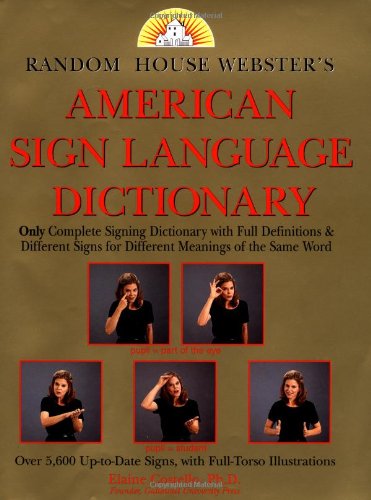
Costello, the director and editor in chief of Gaullaudet University Press, has compiled over 5000 signs in this massive dictionary. Each sign is illustrated with a full-torso picture showing hand configuration and movement, and both the common and alternate meanings are given where necessary. Arranged like a typical dictionary, this work is easy to use and very detailed. Even the end sheets provide ready reference to the manual alphabet and more common handshapes. Sign language, now the fourth most commonly used language, has changed in response to a more enlightened time, and these changes are evident here. Not only have the signs for homosexual, China, and Japan been updated, for instance, but new words reflecting the computer age, such as disk and byte, have been included. Of immense value to the nonhearing and the hearing alike; highly recommended for all libraries.-Neal Wyatt, Mary Washington Coll. Lib., Fredricksburg, Va. (c) Copyright 2010. Library Journals LLC, a wholly owned subsidiary of Media Source, Inc. No redistribution permitted.
CHOICE Review
This first edition defines and illustrates over 5,600 American Sign Language (ASL) signs. Costello (director and editor in chief at Gallaudet Univ. Press) has been involved in the field of deafness for more than 25 years. Her experience contributes to the quality of this volume, which offers a rich vocabulary and will encourage many to learn this beautiful and powerful language. Excellent illustrations, modeled by more than 80 deaf models and drawn by three deaf artists, capture the overall gesture without sacrificing attention to detail: users see how each sign begins and ends and the motion that occurs in between. Multiple meanings (e.g., to ring a bell versus to wear a ring) are provided and defined. Martin L.A. Sternberg's American Sign Language: A Comprehensive Dictionary (CH, Oct'81) includes an extensive bibliography, a subject index, and indexes for translating seven other languages into sign. Costello's dictionary does not include these features; however, it does provide an introduction that discusses core issues and places ASL in context. Costello also offers a larger vocabulary and the currency so critical for this language that constantly changes. Highly recommended. M. Caterson; American University
Booklist Review
This compendium of more than 5,600 words and signs is a valuable resource for users of American Sign Language (ASL) and those who are attempting to learn it. The author is director of the Gallaudet University Press. The dictionary begins with a detailed introduction to ASL, including information about its primary users. The point is made that the deaf community sees itself as a cultural group with a common language. ASL is the first language of 300,000 to 500,000 people. The introduction contains information about the origins and use of ASL and its structure, including phonology (the parts of a sign) and morphology (meaning). The functions of space, classifiers, and nonmanual cues are discussed. Also covered are fingerspelling, signing numbers, abstract symbols, and changes in ASL through the years. The main part of the book contains the dictionary entries. Each entry (word or phrase) has a definition, since different meanings of the same English words may be represented by entirely different signs in ASL, followed by an example sentence. Related forms, cross-references, and "same sign used for" information are also given. Each entry includes a drawing of a person making the sign along with written instructions on how to form it. The visual representation includes the head, hands, and torso of the figure. This is particularly useful given the importance of space in ASL. These drawings are varied as to gender, race, and age. Included in the dictionary are common slang words and expressions and new words, such as microwave and computer terms. Attention is also given to words and phrases that could be considered offensive, and suggestions are offered regarding the use of alternative signs. American Sign Language: A Comprehensive Dictionary (Harper, 1981) has been the standard source in libraries. It gives pronunciation for some words but has briefer definitions and no example sentences. It contains some insensitive and/or racist signs; a new edition will be published by HarperCollins in October. The Random House American Sign Language Dictionary belongs in academic and public libraries. High-school libraries will also find it useful. (Reviewed August 1994)