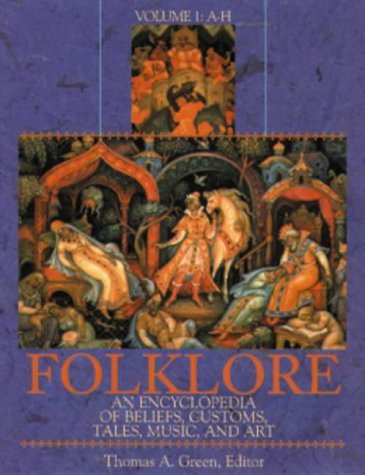

Folklore : an encyclopedia of beliefs, customs, tales, music, and art / edited by Thomas A. Green.
Detalles de publicación: Santa Barbara, CA : ABC-CLIO , 1997.Descripción: 2 v. ill. 26 cmTipo de contenido:- 087436986X
| Imagen de cubierta | Tipo de ítem | Biblioteca actual | Biblioteca de origen | Colección | Ubicación en estantería | Signatura topográfica | Materiales especificados | Info Vol | URL | Copia número | Estado | Notas | Fecha de vencimiento | Código de barras | Reserva de ítems | Prioridad de la cola de reserva de ejemplar | Reservas para cursos | |
|---|---|---|---|---|---|---|---|---|---|---|---|---|---|---|---|---|---|---|
| Libro | Biblioteca de Mayagüez Sala de Referencia mb | GR35 .F63 1997 (Navegar estantería(Abre debajo)) | v.1 | Disponible | 50000002081361 | |||||||||||||
| Libro | Biblioteca de Mayagüez Sala de Referencia mb | GR35 .F63 1997 (Navegar estantería(Abre debajo)) | v.2 | Disponible | 50000002081379 |
Descripciones mejoradas de Syndetics:
Designed for students, scholars, and general readers, this work focuses on folklore forms and methods from a cross-cultural, theoretical perspective.
Folklore emphasizes those bodies of North American and European scholarship that have influenced each other most profoundly since the discipline's inception. The entries provide an introduction that facilitates the pursuit of more specialized topics and other bodies of scholarship.
Topics range from such traditional subjects as "festival" and "folktale" to cutting-edge entries such as "computer-mediated folklore" and "postmodernism." In most cases, a longer, more comprehensive essay format for entries has been favored over shorter entries. Entries are cross-referenced, and each includes a select bibliography to serve as a guide to in depth research.
* Entries are cross referenced, and each includes a select bibliography to serve as a guide to in depth research
Includes bibliographical references and index.
v. 1. A-H -- v. 2. I-Z.
"From anecdotes, boasts, and children<U+2019>s stories to urban tall tales, vampires, and Xerox-lore, this superb scholarly dictionary illuminates the historical and contemporary form, figures, and fields of folklore. In over 240 in-depth articles by leading scholars, basic cultural concepts, academic theories and methodologies, supernatural creatures and stereotypical characters are discussed with regard to the field of folklore. This cross-cultural study emcompasses literary and oral traditions as well as music, art, architecture, foodways, and other customs."--"Outstanding Reference Sources : the 1999 Selection of New Titles", American Libraries, May 1999. Comp. by the Reference Sources Committee, USA, ALA.
Reseñas proporcionadas por Syndetics
Library Journal Review
This lucid, specialized reference work draws on the extraordinary scholarship of 77 authorities to provide more than 200 definitive essays on North American and European folklore. The splendidly illustrated references and in-depth, signed articles offer information on the forms of folk culture (e.g., ballad, riddle, legend, tales, myth), define the standard conceits of the discipline (e.g., hero, fool, trickster), and present extensive discussion of the methodology of the professional folklorist (e.g., comparative mythology, field work, semiotics). The comprehensive reference covers new approaches to folk study (e.g., gender studies, gay literature, minorities), as well as traditional topics like music, dance, storytelling, and folk art. The geographic scope embraces Eastern Europe, the United Kingdom, Scandinavia, and the United States. The work provides not only a fundamental understanding of folklore but also insights into the more general story of culture and society. Editor Green (anthropology, Texas A&M Univ.) has compiled a thoroughly referenced and excellently arranged guide to essential resources and ready reference citations for folklorists, social scientists, historians, journalists, and interested readers. Superseding Maria Leach's Standard Dictionary of Folklore, Mythology, and Legend (HarperCollins, 1984), this is now the standard source.Richard K. Burns, MSLS, Hatboro, Pa. (c) Copyright 2010. Library Journals LLC, a wholly owned subsidiary of Media Source, Inc. No redistribution permitted.CHOICE Review
Most encyclopedias of folklore are intended to help locate information about a particular tale, proverb, superstition, or other relevant genre. The best known, Funk and Wagnalls Standard Dictionary of Folklore, Mythology and Legend, ed. by Maria Leach (1949), is especially strong in genre definitions, biographies of major scholars, and country surveys of folklore scholarship. Although minor revisions were made in the early 1970s, the basic work is more than 40 years old. Of the many compilations since 1949, none has attempted to bring Leach up to date for theoretical topics except American Folklore: An Encyclopedia, ed. by Jan Brunvand (CH, Oct'96), which is not international but, as its title states, focuses on American themes. Green (Texas A&M) in effect replaces Leach with regard to genres and theoretical perspectives. Each signed essay, by a noted folklore scholar (usually, the perfect author is chosen), ends with a select bibliography. The essays are superb for both academics and nonprofessionals, and will prove helpful to undergraduates who need clear explanations of theory. If the bibliographies were annotated, they could function as reading lists; some could have been longer. Indispensable for academic libraries. D. S. Azzolina University of PennsylvaniaBooklist Review
Green, who previously edited issues of the Journal of American Folklore, has put his skills to good use in this new encyclopedia. Its purpose is to "provide an introduction to the scholarship in general and facilitate the pursuit of more specialized topics." There are approximately 240 articles varying in length from one to ten pages and covering forms, themes, and methods of inquiry. Each entry begins with a basic definition that situates the topic in the field of folklore and folkloric research. This is generally followed by a historical overview with information and analysis of the important studies and research. Each entry contains a bibliography or reference list for further reading, as well as see also references. Front matter in each volume includes a list of entries in both volumes. An index to both volumes appears at the end of volume 2. This resource offers much more in-depth and scholarly treatment of the forms of folklore, such as ballads, tales, and legends, than the Larousse Dictionary of World Folklore [RBB F 1 96]. For example, the six-page entry children's folklore details not only the different kinds of play, playground lore, and folklore related to childhood but also the history of scholarship in the field and problems associated with the study of this type of folklore. Other entries, such as evolutionary theory, delve into theories that have been abandoned. Noted authorities in the field contributed many of the entries; conduit theory/multiconduit theory, for example, was written by Linda Degh, who originally developed the theory. Entries generally take a cross-cultural perspective, such as the excellent article on the chapbook, written by Michael Preston, who examines both historical and contemporary chapbooks, and includes information about Brazil, Portuguese chapbooks, and other works from outside the Western tradition. Although there are no biographical entries, information on the contributions of key individuals can be found in relevant entries. This resource will have many uses in high-school, public, and academic libraries with an interest in the field of folklore. It is an excellent one-stop source for information and background on the state of research in folklore and customs. (Reviewed April 1, 1998)Notas de autor provistas por Syndetics
Thomas A. Green is associate professor of anthropology at Texas A & M University, College Station, TX.