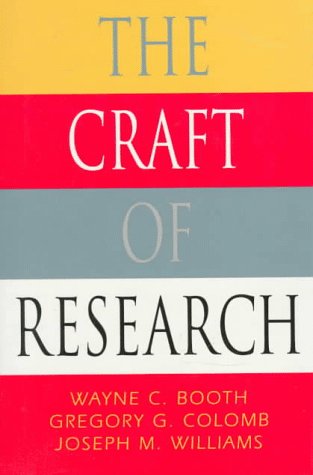

The craft of research Wayne C. Booth, Gregory G. Colomb, Joseph M. Williams.
Series Chicago guides to writing, editing, and publishingDetalles de publicación: Chicago University of Chicago Press c1995.Descripción: xii, 294 p. ill. 22 cmISBN:- 0226065839 (cloth : alk. paper)
- 0226065847 (paper : alk. paper)
- 001.4/2 20
- Q180.55.M4 B66 1995
| Imagen de cubierta | Tipo de ítem | Biblioteca actual | Biblioteca de origen | Colección | Ubicación en estantería | Signatura topográfica | Materiales especificados | Info Vol | URL | Copia número | Estado | Notas | Fecha de vencimiento | Código de barras | Reserva de ítems | Prioridad de la cola de reserva de ejemplar | Reservas para cursos | |
|---|---|---|---|---|---|---|---|---|---|---|---|---|---|---|---|---|---|---|
| Libro | Biblioteca Encarnación Valdés Colección General bev | 001.42 B725c (Navegar estantería(Abre debajo)) | Disponible | 80000002053356 |
Descripciones mejoradas de Syndetics:
This manual offers practical advice on the fundamentals of research to college and university students in all fields of study. The Craft of Research teaches much more than the mechanics of fact gathering: it explains how to approach a research project as an analytical process. The authors chart every stage of research, from finding a topic and generating research questions about it to marshalling evidence, constructing arguments, and writing everything up in a final report that is a model of authority. Their advice is designed for use by both beginners and seasoned practitioners, and for projects from class papers to dissertations.
This book is organized into four parts. Part One is a spirited introduction to the distinctive nature, values, and protocols of research. Part Two demystifies the art of discovering a topic. It outlines a wide range of sources, among them personal interests and passions. Parts Three and Four cover the essentials of argument--how to make a claim and support it--and ways to outline, draft, revise, rewrite, and polish the final report. Part Three is a short course in the logic, structure, uses, and common pitfalls of argumentation. The writing chapters in Part Four show how to present verbal and visual information effectively and how to shape sentences and paragraphs that communicate with power and precision.
"A well-constructed, articulate reminder of how important fundamental questions of style and approach, such as clarity and precision, are to all research."-- Times Literary Supplement
Includes bibliographical references (p. 265-270) and index.