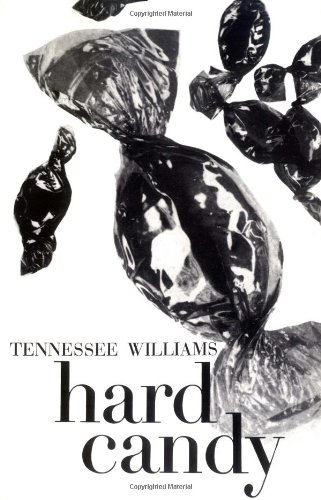

Hard candy a book of stories Tennessee Williams.
Series [A New Directions paperbook, 133] ; 225Detalles de publicación: New York New Directions 1967, c1954.Descripción: 220 p. 20 cmISBN:- 0811202216
| Imagen de cubierta | Tipo de ítem | Biblioteca actual | Biblioteca de origen | Colección | Ubicación en estantería | Signatura topográfica | Materiales especificados | Info Vol | URL | Copia número | Estado | Notas | Fecha de vencimiento | Código de barras | Reserva de ítems | Prioridad de la cola de reserva de ejemplar | Reservas para cursos | |
|---|---|---|---|---|---|---|---|---|---|---|---|---|---|---|---|---|---|---|
| Libro | Biblioteca Mons. Iñaki Mallona (Arecibo) Colección General ab | 812 W727h (Navegar estantería(Abre debajo)) | Disponible | 60000002015938 |
Descripciones mejoradas de Syndetics:
Hard Candy contains Tennessee Williams's short stories written after the publication of his first collection of short fiction, One Arm, and before the stories appearing in The Knightly Quest. These volumes have established him as an original, compelling, and honest master of the short story. The stories in Hard Candy display Mr. Williams's mastery of several very different styles. "Three Players of a Summer Game," for instance, is as powerful and moving a study of the disintegration of an individual as A Streetcar Named Desire. The delicate and luminous nostalgia of "The Resemblance Between a Violin Case and a Coffin" will remind readers of The Glass Menagerie. Other stories, like "Two on a Party," are more colloquial and brittle; and one--"The Coming of Something to the Widow Holly"--is an excursion into ironical fantasy. Yet each of the stories demonstrates, in its different way, the characteristic blend of psychological penetration with compassion and understanding that has marked Tennessee Williams's successes in the theater.
"A New Directions Book"
Three players of a summer game.--Two on a party.--The resemblance between a violin case and a coffin.--Hard candy.--Rubio y Morena.--The mattress by the tomato patch.--The coming of something to the widow Holly.--The vine.--The mysteries of the Joy Rio.
Notas de autor provistas por Syndetics
After O'Neill, Williams is perhaps the best dramatist the United States has yet produced. Born in his grandfather's rectory in Columbus, Mississippi, Williams and his family later moved to St. Louis. There Williams endured many bad years caused by the abuse of his father and his own anguish over his introverted sister, who was later permanently institutionalized. Williams attended the University of Missouri, and, after time out to clerk for a shoe company and for his own mental breakdown, also attended Washington University of St. Louis and the University of Iowa, from which he graduated in 1938. Williams began to write plays in 1935. During 1943 he spent six months as a contract screenwriter for MGM but produced only one script, The Gentleman Caller. When MGM rejected it, Williams turned it into his first major success, The Glass Menagerie (1945). In this intensely autobiographical play, Williams dramatizes the story of Amanda, who dreams of restoring her lost past by finding a gentleman caller for her crippled daughter, and of Amanda's son Tom, who longs to escape from the responsibility of supporting his mother and sister.After The Glass Menagerie,Williams wrote his masterpiece, A Streetcar Named Desire, (1947), along with a steady stream of other plays, among them such major works as Summer and Smoke(1948), Cat on a Hot Tin Roof (1954), and Suddenly Last Summer (1958). His plays celebrate the "fugitive kind," the sensitive outcasts whose outsider status allows them to perceive the horror of the world and who often give additional witness to that horror by becoming its victims. Stephen S. Stanton has summed up Williams's "virtues and strengths" as "a genius for portraiture, particularly of women, a sensitive ear for dialogue and the rhythms of natural speech, a comic talent often manifesting itself in "black comedy,' and a genuine theatrical flair exhibited in telling stage effects attained through lighting, costume, music, and movements." After The Night of the Iguana (1961), Williams continued to write profusely---and constantly to revise his work---but it became more difficult to get productions of his plays and, if they were produced, to win critical or popular acclaim for them.
Williams won the Pulitzer Prize for drama for A Streetcar Named Desire and Cat on a Hot Tin Roof. He won the New York Drama Critics Circle Award for these two and for The Glass Menagerie and The Night of the Iguana.
(Bowker Author Biography)