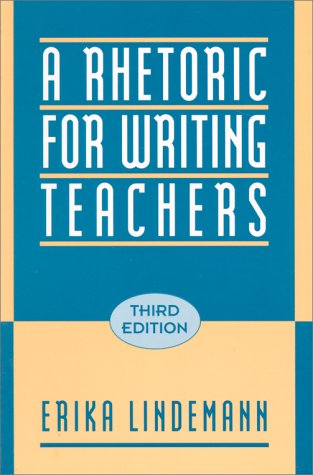

A rhetoric for writing teachers Erika Lindemann.
Detalles de publicación: New York Oxford University Press 1995.Edición: 3rd edDescripción: xix, 306 p. ill., maps 24 cmISBN:- 0195088441 (alk. paper)
- 808/.042/0711 20
- PE1404 .L53 1995
| Imagen de cubierta | Tipo de ítem | Biblioteca actual | Biblioteca de origen | Colección | Ubicación en estantería | Signatura topográfica | Materiales especificados | Info Vol | URL | Copia número | Estado | Notas | Fecha de vencimiento | Código de barras | Reserva de ítems | Prioridad de la cola de reserva de ejemplar | Reservas para cursos | |
|---|---|---|---|---|---|---|---|---|---|---|---|---|---|---|---|---|---|---|
| Libro | Biblioteca Mons. Iñaki Mallona (Arecibo) Colección General ab | 808.042 L743r3 (Navegar estantería(Abre debajo)) | Disponible | 60000002015854 |
Descripciones mejoradas de Syndetics:
From answering the question "Why teach writing?" to offering guidance in managing group work and responding to assignments, this remarkably successful text provides a comprehensive introduction to the teaching of writing. Now updated to incorporate the latest developments in the field, A Rhetoric for Writing Teachers describes in straightforward terms the cross-disciplinary scholarship that has reinvigorated composition teaching. Reflecting current views of writing as social interaction, this edition emphasizes workshops, collaborative learning, and holistic evaluation. Chapters on prewriting techniques, organizing material, paragraphing, sentence structure, words, and revising describe how the teacher can guide students through composing, while sections on rhetoric, cognition, and linguistics discuss theoretical principles that support classroom practices and make the teacher's performance effective. Treating both the theory and practice of writing, the author encourages teachers to adopt the methods that best meet their students' needs and to develop a style of teaching informed by knowledgeable decisions. Over forty percent of the text's material is new to this edition, offering composition scholars a broad range of techniques to encourage and motivate their students. Complete with an updated bibliography and a table of important dates in the history of composition, this classic work offers both prospective and seasoned writing teachers convenient access to recent scholarship in the field and inspires them to examine what it means to teach well.
Includes bibliographical references (p. 283-300) and index.
Tabla de contenidos provista por Syndetics
- 1 The Composing Process
- 1 Why Teach Writing?
- Writing as Economic Power
- Writing as Social Necessity
- Writing as Knowing
- The Humanistic Perspective
- An Overview of This Book
- 2 What Is Writing?
- The Addresser
- The Addressee
- Context
- Code
- Summary and Applications
- 3 What Does the Process Involve?
- What Experience Tells Us
- Published Accounts of the Process
- Prewriting
- Writing
- Rewriting
- Writing as Social Interaction
- 2 Rhetorical Theory and Practice
- 4 What Do Teachers Need to Know about Rhetoric?
- Preliminary Questions
- What Is Rhetoric?
- Classical Rhetoric
- Medieval and Renaissance Rhetoric
- The Renaissance to the Twentieth Century
- Contemporary Rhetoric
- Conclusion
- 5 What Do Teachers Need to Know about Linguistics?
- Writing and Speech
- The Nature of Language
- Grammar and Usage
- Approaches to Grammar
- Structural Grammar
- Generative-Transformational Grammar
- Th Association Model
- 6 What Do Teachers Need to Know about Cognition?
- Creativity
- Perception
- Conception
- Piaget
- Moffett
- Conclusion
- 7 Prewriting Techniques
- Perception Exercises
- Brainstorming and Clustering
- Freewriting
- Journals
- Heuristics
- Models
- 8 Shaping Discourse
- Form Consciousness
- Discovering for Teaching Form
- Strategies for Teaching Form
- Blocking
- D'Angelo's Paradigms
- 9 Teaching Paragraphing
- Traditional Views of the Paragraph
- How Writers Paragraph
- Relating
- Part to Whole
- Generative Rhetoric of the Paragraph
- A Sequence of Lessons
- 10 Teaching about Sentences
- Sentence Combining
- Cumulative Sentences
- 11 Teaching about Words
- Parts of Speech
- Active and Passive Voice
- Derivational and Inflectional Affixes
- Style
- Additional Resources
- Suggestions for Teaching Students about Language
- 12 Teaching Rewriting
- Changing Attitudes
- Writing Strategies Applied to Rewriting: Finding the Subject
- Rewriting: Finding the Shape of Discourse
- Rewriting: Finding Relationships in Paragraphs
- Rewriting: Finding Sentence Problems
- Writing Workshops
- Student-Generated Criteria
- 3 Teaching as Rhetoric
- 13 Developing Writing Assignments
- Traditional Assignments
- Defining a Rhetorical Problem
- 14 Responding to Student Writing
- The Basics and Testing
- Describing, Measuring, Judging
- Diagnostic Reading
- Teaching through Comments
- Self-Evaluation
- Atomistic Evaluation
- Holistic Evaluation
- Handling the Paper Load
- 15 Designing Writing Courses
- Teaching as Rhetoric
- General Principles of Course Design
- Course Models
- Active and Collaborative Learning
- Course Outlines
- Lesson Plans
- The Teaching Performance
- Some Important Dates in the History of Composition
- A Selected Bibliography
- List of Works Consulted
- Index