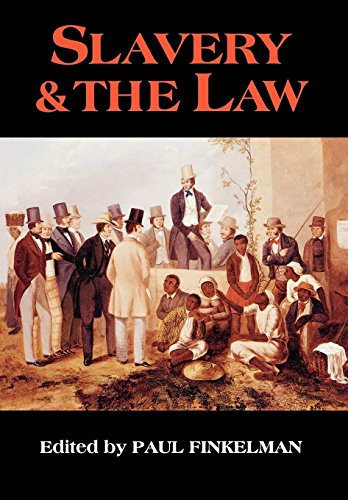

Slavery & the law edited by Paul Finkelman.
Detalles de publicación: Madison, Wis. Madison House 1997Edición: 1st edDescripción: viii, 465 p. 24 cmISBN:- 0945612362
- Slavery and the law [Otro título]
- KF4545.S5 S577 1997
| Imagen de cubierta | Tipo de ítem | Biblioteca actual | Biblioteca de origen | Colección | Ubicación en estantería | Signatura topográfica | Materiales especificados | Info Vol | URL | Copia número | Estado | Notas | Fecha de vencimiento | Código de barras | Reserva de ítems | Prioridad de la cola de reserva de ejemplar | Reservas para cursos | |
|---|---|---|---|---|---|---|---|---|---|---|---|---|---|---|---|---|---|---|
| Libro | Biblioteca de Derecho Mons. Fremiot Torres Oliver Colección General biblioteca derecho | KF 4545 .S5 S577 1996 (Navegar estantería(Abre debajo)) | Disponible | 70000000539556 |
Descripciones mejoradas de Syndetics:
Central to the development of the American legal system, writes Professor Finkelman in Slavery & the Law , is the institution of slavery. It informs us not only about early concepts of race and property, but about the nature of American democracy itself.
Prominent historians of slavery and legal scholars analyze the intricate relationship between slavery, race, and the law from the earliest Black Codes in colonial America to the passage of the Fugitive Slave Law and the Dred Scott decision prior to the Civil War. Slavery & the Law 's wide-ranging essays focus on comparative slave law, auctioneering practices, rules of evidence, and property rights, as well as issues of criminality, punishment, and constitutional law.
What emerges from this multi-faceted portrait is a complex legal system designed to ensure the property rights of slave-holders and to institutionalize racism. The ultimate result was to strengthen the institution of slavery in the midst of a growing trend toward democracy in the mid-nineteenth-century Atlantic community.
Includes bibliographical references and index.
Tabla de contenidos provista por Syndetics
- Acknowledgments(p. ix)
- Introduction: The Centrality of Slavery in American Legal Development(p. 3)
- Part I Theories of Democracy and the Law of Slavery(p. 27)
- 1 Learning the Three "I"s of America's Slave Heritage(p. 29)
- 2 Ideology and Imagery in the Law of Slavery(p. 43)
- Part II Constitutional Law and Slavery(p. 87)
- 3 Slavery in the Canon of Constitutional Law(p. 89)
- 4 Chief Justice Hornblower of New Jersey and the Fugitive Slave Law of 1793(p. 113)
- 5 A Federal Assault: African-Americans and the Impact of the Fugitive Slave Law of 1850(p. 143)
- 6 The Crisis Over The Impending Crisis: Free Speech, Slavery, and the Fourteenth Amendment(p. 161)
- Part III Criminal and Civil Law of Slavery(p. 207)
- 7 Slaves and the Rules of Evidence in Criminal Trials(p. 209)
- 8 "Details are of a Most Revolting Character": Cruelty to Slaves as Seen in Appeals to the Supreme Court of Louisiana(p. 241)
- The Unreported Case of Humphreys v. Utz(p. 269)
- 9 Pandora's Box: Slave Character on Trial in the Antebellum Deep South(p. 291)
- 10 Slave Auctions on the Courthouse Steps: Court Sales of Slaves in Antebellum South Carolina(p. 329)
- Part IV Comparative Law and Slavery(p. 365)
- 11 Seventeenth-Century Jurists, Roman Law, and Slavery(p. 367)
- 12 The British Constitution and the Creation of American Slavery(p. 379)
- 13 Thinking Property at Rome(p. 419)
- 14 Thinking Property at Memphis: An Application of Watson(p. 437)
- Notes on Contributors(p. 453)
- Index(p. 455)