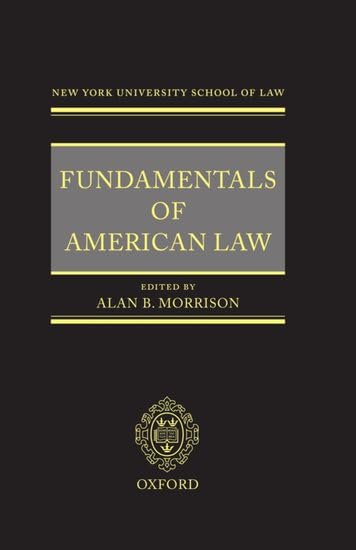

Fundamentals of American law New York University School of Law ; general editor, Alan B. Morrison.
Detalles de publicación: New York Oxford University Press 1996.Descripción: lxviii, 666 p. 24 cmISBN:- 0198764049
- KF385 .F86 1996
| Imagen de cubierta | Tipo de ítem | Biblioteca actual | Biblioteca de origen | Colección | Ubicación en estantería | Signatura topográfica | Materiales especificados | Info Vol | URL | Copia número | Estado | Notas | Fecha de vencimiento | Código de barras | Reserva de ítems | Prioridad de la cola de reserva de ejemplar | Reservas para cursos | |
|---|---|---|---|---|---|---|---|---|---|---|---|---|---|---|---|---|---|---|
| Libro | Biblioteca de Derecho Mons. Fremiot Torres Oliver Colección General biblioteca derecho | KF 385 .F86 1996 (Navegar estantería(Abre debajo)) | Disponible | 70000000575485 |
Descripciones mejoradas de Syndetics:
The American legal system today is the most significant in the world, yet until the publication of Fundamentals of American Law, there has been no book that provides both the basic rules on the theoretical understanding necessary to comprehend. This book is not simply the work of a single author, but a collection of especially written essays, each by an expert in the field, all of whom are on the faculty of New York University School of Law, which is recognized as one of the elite law schools in America and which offers this book as an element of its unique Global Law School Programme. The book is written specifically for foreign lawyers and law students who have a need to deal with American Law generally, but are not seeking to become specialists in any one area. For them, it is vital to understand the basic principles of a wide range of American legal fields so they can act as informed intermediaries between their public or private clients and their American counterparts. the book not only provides the reader with a solid foundation in American law, but will also serve as a basic reference book for the fundamentals, even as some of the details change over the years. Although initially conceived to fill a void for foreign lawyers, the book is also ideally suited for others who have a significant need to understand the basic principles of American Law and to interact with American lawyers. For this reason it will be an ideal course text for students of business, accountancy, political science, or public administration, where the enquiring student will constantly find intersections with the law. The book is more than a compendium of legal principles. Each chapter explains not only what the law is, but why it is that way. It sets forth the policy considerations in institutional factors that produce a particular law so the reader can make an independent judgement about its wisdom and perhaps its adaptibility to other cultures.
Includes bibliographical references and index.
1. Common law systems / Graham Hughes -- 2. The source and limits of legal authority / Lawrence G. Sager -- 3. Courts / Alan B. Morrison -- 4. Litigation / Alan B. Morrison -- 5. An overview of the bill of rights / Burt Neuborne -- 6. Administrative law / Bernard Schwartz -- 7. The American legal profession / Stephen Gillers -- 8. Conflict of laws / Lea Brilmayer -- 9. Contract law / Charles L. Knapp -- 10. Torts / Sylvia A. Law -- 11. Property / William Nelson -- 12. Criminal law, criminal procedure, and criminal justice / James B. Jacobs -- 13. Corporations and other business organizations /.
Stanley Siegel -- 14. Commercial law / Donald J. Rapson -- 15. Family law / Martin Guggenheim -- 16. Antiturst / Harry First -- 17. Bankruptcy and other insolvency remedies / Lawrence P. King --.
18. Environmental law / Richard B. Stewart -- 19. Intellectual property law / Rochelle Cooper Dreyfus -- 20. Labor and employment law / Samuel Estreicher -- 21. Regulation of banks / Michael Klausner -- 22. Federal regulation of securities / Heln S. Scott -- 23. Taxation / Deborah H. Schenk.
Tabla de contenidos provista por Syndetics
- Preface(p. v)
- List of Contributors(p. xxv)
- Foreword(p. xxvii)
- Table of Cases(p. xxxiii)
- Table of Legislation(p. liii)
- Introduction(p. 1)
- I. General Principles(p. 7)
- 1. Common Law Systems(p. 9)
- I. Introduction(p. 9)
- II. The Reception of the Common Law in America(p. 12)
- III. The Growth of Legislation and Regulation(p. 14)
- IV. The Continued Vitality of the Common Law(p. 15)
- V. Precedent and the Growth of the Law(p. 18)
- VI. The Institutions and Method of the Common Law(p. 21)
- VII. Interpretation of Statutes(p. 23)
- VIII. The Future of the Common Law(p. 25)
- 2. The Sources and Limits of Legal Authority(p. 27)
- I. Introduction: Federalism and Separation of Powers(p. 27)
- II. The Basic Allocation of State Federal Authority(p. 28)
- III. Protection from the Burdens of Multi-State Legal Authority(p. 36)
- IV. The Distinct Character of Separation of Powers Issues in the United States(p. 41)
- V. The Robust Constitutional Judiciary(p. 52)
- VI. Conclusion(p. 56)
- 3. Courts(p. 57)
- I. Introduction(p. 57)
- II. Methods of Selecting Judges(p. 57)
- III. Division of Judicial Workload(p. 58)
- IV. Parallel Systems of Adjudication(p. 60)
- 4. Litigation(p. 61)
- I. Starting a Lawsuit(p. 62)
- II. Responses to the Complaint(p. 64)
- III. Multi-Party Actions(p. 67)
- IV. Discovery(p. 70)
- V. Summary Judgment(p. 73)
- VI. Trial(p. 75)
- VII. Appeals(p. 79)
- VIII. Conclusion(p. 81)
- 5. An Overview of the Bill of Rights(p. 83)
- I. Introduction(p. 83)
- II. The First Amendment: The Founders' Ideal Commonwealth(p. 86)
- III. The Fourth Through Eighth Amendments: Control of the Law Enforcement Function(p. 104)
- IV. The Ninth and Tenth Amendments: the Enigma of the Closing Amendments(p. 112)
- V. The Thirteenth, Fourteenth, and Fifteenth Amendments: Equality and the Second Bill of Rights(p. 115)
- VI. Conclusion(p. 127)
- 6. Administrative Law(p. 129)
- I. Administrative Agencies(p. 130)
- II. Independent Agencies and Separation of Powers(p. 132)
- III. Delegation(p. 133)
- IV. Administrative Procedure(p. 136)
- V. Judicial Review(p. 143)
- VI. Freedom of Information(p. 148)
- 7. The American Legal Profession(p. 151)
- I. A Statistical Portrait(p. 151)
- II. Entering the Profession(p. 152)
- III. Regulating the Profession(p. 154)
- IV. Malpractice and Related Claims(p. 157)
- V. Court Sanctions(p. 159)
- VI. Right to Counsel(p. 160)
- VII. Conflicts of Interest(p. 161)
- VIII. Confidentiality(p. 164)
- IX. Adversary Justice(p. 166)
- X. Legal Fees(p. 168)
- XI. Lawyers Employed by Corporations(p. 170)
- XII. Marketing Legal Services(p. 171)
- XIII. The Judiciary(p. 173)
- XIV. The Future: More Competition(p. 175)
- 8. Conflict of Laws(p. 177)
- I. Personal Jurisdiction(p. 178)
- II. Choice of Law(p. 184)
- III. Judgments Enforcement(p. 193)
- IV. Conclusion(p. 196)
- II. State Based Laws(p. 199)
- 9. Contract Law(p. 201)
- I. Introduction(p. 201)
- II. Sources of Obligation(p. 204)
- III. Contract Formation(p. 207)
- IV. Identifying the Contract(p. 213)
- V. Defenses Against Enforcement(p. 217)
- VI. Performance(p. 223)
- VII. Remedies for Breach of Contract(p. 228)
- 10. Torts(p. 239)
- I. Negligence(p. 241)
- II. Negligence Principles Applied to Some Common Activities(p. 252)
- III. Intentional Torts(p. 257)
- IV. Strict Products Liability(p. 259)
- V. Conclusion(p. 261)
- 11. Property(p. 263)
- I. The Nature of Ownership in America(p. 264)
- II. Taxation of Real Property(p. 266)
- III. The Power of Eminent Domain(p. 268)
- IV. Government Regulation of Land(p. 270)
- V. The Ultimate Protection of Property Rights(p. 291)
- 12. Criminal Law, Criminal Procedure, and Criminal Justice(p. 293)
- I. Overview of the Systems(p. 293)
- II. Substantive Criminal Law(p. 295)
- III. Criminal Procedure(p. 305)
- 13. Corporations and Other Business Organizations(p. 331)
- I. Forms of Business Association(p. 331)
- II. The Process of Formation(p. 334)
- III. Raising of Capital(p. 338)
- IV. Control Structure--Stockholders(p. 342)
- V. Control Structure--Directors and Officers(p. 346)
- VI. Fiduciary Obligations and Standard of Care(p. 350)
- VII. Corporate Distributions(p. 353)
- VIII. Major Corporate Changes(p. 356)
- IX. Conclusion(p. 363)
- 14. Commercial Law(p. 365)
- I. Introduction(p. 365)
- II. The Uniform Commercial Code(p. 369)
- III. The Common Law of Suretyship and Guaranty(p. 391)
- IV. Special Treatment of Consumer Transactions(p. 394)
- 15. Family Law(p. 397)
- I. Introduction(p. 397)
- II. Constitutional Principles of Family Law--The Relationship of the Family and the State(p. 399)
- III. 'Public Family Law'--Child Protection, Foster Care, Termination of Parental Rights, and Adoption(p. 403)
- IV. Private Family Law--Marriage, Separation, Divorce, and Related Matters(p. 413)
- V. Conclusion(p. 424)
- III. Federal Law(p. 425)
- 16. Antitrust Law(p. 427)
- I. Overview: Antitrust Statutes and Enforcement(p. 427)
- II. Monopolization(p. 433)
- III. Mergers(p. 439)
- IV. Horizontal Agreements(p. 444)
- V. Distribution Restraints(p. 450)
- VI. Conclusion(p. 457)
- 17. Bankruptcy and Other Insolvency Remedies(p. 459)
- I. Introduction(p. 459)
- II. Some General Considerations(p. 462)
- III. Introduction to Chapter 11(p. 464)
- IV. The Plan of Reorganization(p. 473)
- V. Discharge(p. 478)
- 18. Environmental Law(p. 481)
- I. The Origins of Contemporary Environmental Law(p. 482)
- II. The Subjects of Environmental Law and Regulation(p. 486)
- III. Distinctive Elements of United States Environmental Law(p. 491)
- IV. Current Topics in United States Environmental Law(p. 501)
- V. Conclusion(p. 506)
- 19. Intellectual Property Law(p. 507)
- I. Introduction to Intellectual Property(p. 507)
- II. Sources of Intellectual Property Law(p. 510)
- III. Patent Law(p. 513)
- IV. Copyright Law(p. 521)
- V. Trademark Law(p. 528)
- 20. Labor and Employment Law(p. 535)
- I. Rationales for and Structure of Employment Regulation(p. 535)
- II. Substantive Employment Protections(p. 539)
- III. Employment Discrimination Law(p. 543)
- IV. Union Organization and Collective Bargaining Law(p. 552)
- V. Conclusion(p. 561)
- 21. Regulation of Banks(p. 563)
- I. Introduction(p. 563)
- II. Policy Overview(p. 564)
- III. The Allocation of Regulatory Responsibility(p. 566)
- IV. The Chartering Process(p. 568)
- V. Regulation of the Bank's Business(p. 569)
- VI. Regulation of Banks' Affiliates(p. 576)
- VII. International Banking(p. 577)
- VIII. Examinations and Enforcement(p. 579)
- IX. Bank Failures(p. 580)
- X. Conclusion(p. 582)
- 22. Federal Regulation of Securities(p. 583)
- I. Introduction to the United States Securities Markets(p. 583)
- II. The Systems of Regulation(p. 586)
- III. Federal Regulation of Companies Under the 1933 and 1934 Acts(p. 591)
- IV. Antifraud Liability for Reporting Companies(p. 600)
- V. Insider Trading: A Species of Antifraud Liability(p. 606)
- VI. Conclusion(p. 608)
- 23. Taxation(p. 611)
- I. Overview of the United States Tax System(p. 611)
- II. Sources of the Law(p. 612)
- III. General Framework for Taxing 'Citizens' and 'Aliens'(p. 613)
- IV. Federal Income Taxation of United States Individuals(p. 614)
- V. Federal Taxation of United States Corporations(p. 626)
- VI. Federal Taxation of United States Partnerships(p. 632)
- VII. Federal Taxation of Other Flow Through Entities(p. 635)
- VIII. Taxation of United States Persons with Foreign Income(p. 637)
- IX. Taxation of United States Corporations with Foreign Income(p. 639)
- X. Anti-abuse Rules(p. 640)
- XI. Taxation of Foreign Persons with United States Income(p. 642)
- XII. Federal Estate and Gift Taxes(p. 645)
- Index(p. 647)