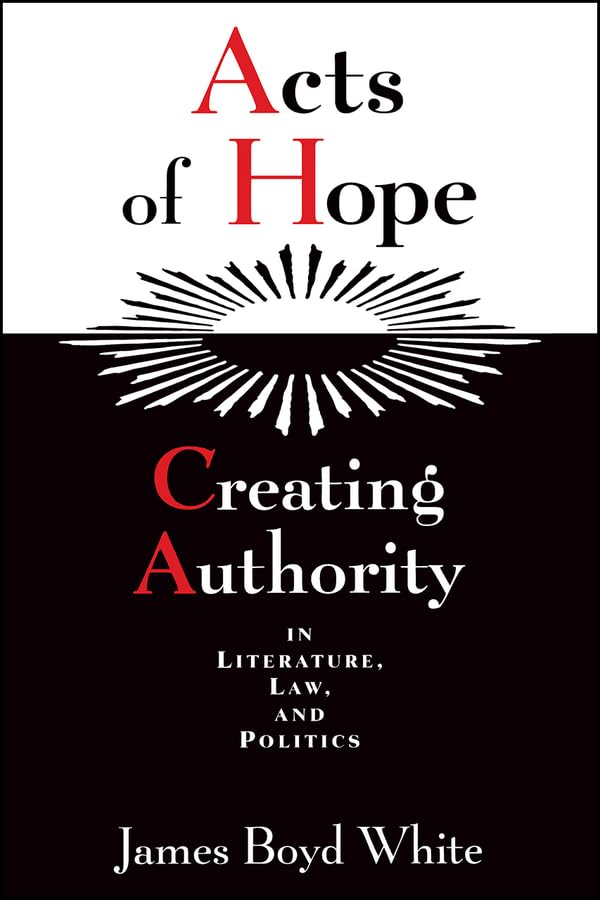

Acts of hope creating authority in literature, law and politics James Boyd White.
Detalles de publicación: Chicago University of Chicago Press 1994.Descripción: xv, 322 p. 24 cmISBN:- 0226895106
- JC328.2 .W55 1994.
| Imagen de cubierta | Tipo de ítem | Biblioteca actual | Biblioteca de origen | Colección | Ubicación en estantería | Signatura topográfica | Materiales especificados | Info Vol | URL | Copia número | Estado | Notas | Fecha de vencimiento | Código de barras | Reserva de ítems | Prioridad de la cola de reserva de ejemplar | Reservas para cursos | |
|---|---|---|---|---|---|---|---|---|---|---|---|---|---|---|---|---|---|---|
| Libro | Biblioteca de Derecho Mons. Fremiot Torres Oliver Colección General biblioteca derecho | JC 328 .2 .W55 1994 (Navegar estantería(Abre debajo)) | Disponible | 70000000593298 |
Descripciones mejoradas de Syndetics:
To which institutions or social practices should we grant authority? When should we instead assert our own sense of what is right or good or necessary?
In this book, James Boyd White shows how texts by some of our most important thinkers and writers--including Plato, Shakespeare, Dickinson, Mandela, and Lincoln--answer these questions, not in the abstract, but in the way they wrestle with the claims of the world and self in particular historical and cultural contexts. As they define afresh the institutions or practices for which they claim (or resist) authority, they create authorities of their own, in the very modes of thought and expression they employ. They imagine their world anew and transform the languages that give it meaning.
In so doing, White maintains, these works teach us about how to read and judge claims of authority made by others upon us; how to decide to which institutions and practices we should grant authority; and how to create authorities of our own through our thoughts and arguments. Elegant and accessible, this book will appeal to anyone wanting to better understand one of the primary processes of our social and political lives.
Includes bibliographical references and index.
Plato's Crito: the authority of law and philosophy -- Shakespeare's Richard II: imagining the modern world -- Hooker's preface to the Lawes of Ecclesiastical Politie: constituting authority in argument -- Hales's "Considerations touching the Amendment of Alteration of Lawes : determining the authority of the past -- Planned Parenthood v. Casey: legal judgement as an ethical and cultural art --Austen's Mansfield Park: making the self out of and against -- the culture -- Dickinson's poetry: transforming the authority of language -- Mandela's speech from the dock and Lincoln's second inaugural.
Tabla de contenidos provista por Syndetics
- Preface
- Acknowledgments
- I The Claims of the World on the Self, the Self on the World
- 1 Plato's Crito: The Authority of Law and Philosophy
- II Creating a Public World
- 2 Shakespeare's Richard II: Imagining the Modern World
- 3 Hooker's Preface to the Lawes of Ecclesiasticall Politie: Constituting Authority in Argument
- 4 Hale's "Considerations Touching the Amendment or Alteration of Lawes": Determining the Authority of the Past
- 5 Planned Parenthood v. CASEY: Legal Judgment as an Ethical and Cultural Art
- III The Authority of the Self
- 6 Austen's Mansfield Park: Making the Self Out ofùand Againstùthe Culture
- 7 Dickinson's Poetry: Transforming the Authority of Language
- IV Reconstituting Self and World: The Creation of Authority as an Act of Hope
- 8 Mandela's Speech from the Dock and Lincoln's Second Inaugural Address: Giving Meaning to Life in an Unjust World
- Afterword
- Additional Notes
- Index