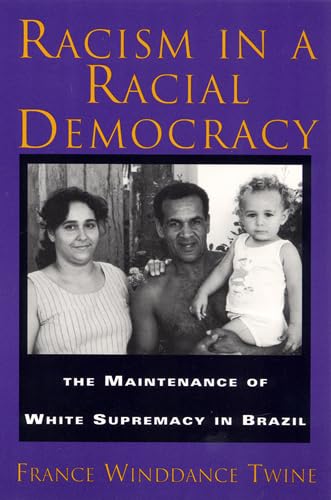

Racism in a racial democracy the maintenance of white supremacy in Brazil France Winddance Twine.
Detalles de publicación: New Brunswick, N.J. Rutgers University Press 1998.Descripción: xiii, 175 p. illISBN:- 0813523656
- F2659 .N4 T86 1998
| Imagen de cubierta | Tipo de ítem | Biblioteca actual | Biblioteca de origen | Colección | Ubicación en estantería | Signatura topográfica | Materiales especificados | Info Vol | URL | Copia número | Estado | Notas | Fecha de vencimiento | Código de barras | Reserva de ítems | Prioridad de la cola de reserva de ejemplar | Reservas para cursos | |
|---|---|---|---|---|---|---|---|---|---|---|---|---|---|---|---|---|---|---|
| Libro | Biblioteca de Mayagüez Colección General mb | F2659 .N4 T86 1998 (Navegar estantería(Abre debajo)) | Disponible | 50000002074531 |
Descripciones mejoradas de Syndetics:
In Racism in a Racial Democracy , France Winddance Twine asks why Brazilians, particularly Afro-Brazilians, continue to have faith in Brazil's "racial democracy" in the face of pervasive racism in all spheres of Brazilian life. Through a detailed ethnography, Twine provides a cultural analysis of the everyday discursive and material practices that sustain and naturalize white supremacy.
This is the first ethnographic study of racism in southeastern Brazil to place the practices of upwardly mobile Afro-Brazilians at the center of analysis. Based on extensive field research and more than fifty life histories with Afro- and Euro-Brazilians, this book analyzes how Brazilians conceptualize and respond to racial disparities. Twine illuminates the obstacles Brazilian activists face when attempting to generate grassroots support for an antiracist movement among the majority of working class Brazilians. Anyone interested in racism and antiracism in Latin America will find this book compelling.
"Twine offers one of the most sophisticated analyses to date of the intransigence of Brazilian racism. Her nuanced account of the complex interplay of gender, race, and class is particularly exciting. This book will have a powerful impact not only on the field of Brazilian racial studies, but on the whole burgeoning literature on the African Diaspora." -- Howard Winant, author of Racial Conditions: Politics, Theory, Comparisons
"A revealing and sharply observed dissection of how racism works 'on the ground' in Brazil." -- George Reid Andrews, author of Blacks and Whites in Sao Paulo, Brazil, 1888-1988
Includes index.
Includes bibliographical references (p. 167-172).
Tabla de contenidos provista por Syndetics
- Acknowledgments(p. xi)
- Chapter 1 Introduction(p. 1)
- Chapter 2 Vasalia: the Research Site(p. 15)
- Conclusion(p. 30)
- Chapter 3 Mapping the Ideological Terrain of Racism: The Social, Sexual, Socioeconomic, and Semiotic Contours(p. 31)
- Conclusion(p. 63)
- Chapter 4 Discourses in Defense of the Racial Democracy(p. 65)
- Chapter 5 Embranquecimento: Aesthetic Ideals and Resistance to Mestiçagem(p. 87)
- Conclusion(p. 107)
- Chapter 6 Memory: White Inflation and Willful Forgetting(p. 111)
- Conclusion(p. 133)
- Chapter 7 Strategic Responses to Racism Preserving White Supremacy(p. 135)
- Conclusion(p. 152)
- Appendix A Interview Schedule(p. 155)
- Appendix B Biographical Data on Interviewees(p. 157)
- Notes(p. 159)
- Glossary(p. 165)
- Bibliography(p. 167)
- Index(p. 173)
- About the Author(p. 176)